One overall traits level
Your answers are combined into a Level 1–5 sociopathic-traits result rather than separate scores for empathy, remorse, manipulation, impulse, risk, or rule-breaking.

You do not need to accept a label before you begin. Thinkhint gives you one overall sociopathic-traits level based on your own answers and a report for reflection. It does not diagnose antisocial personality disorder or predict whether someone is dangerous.
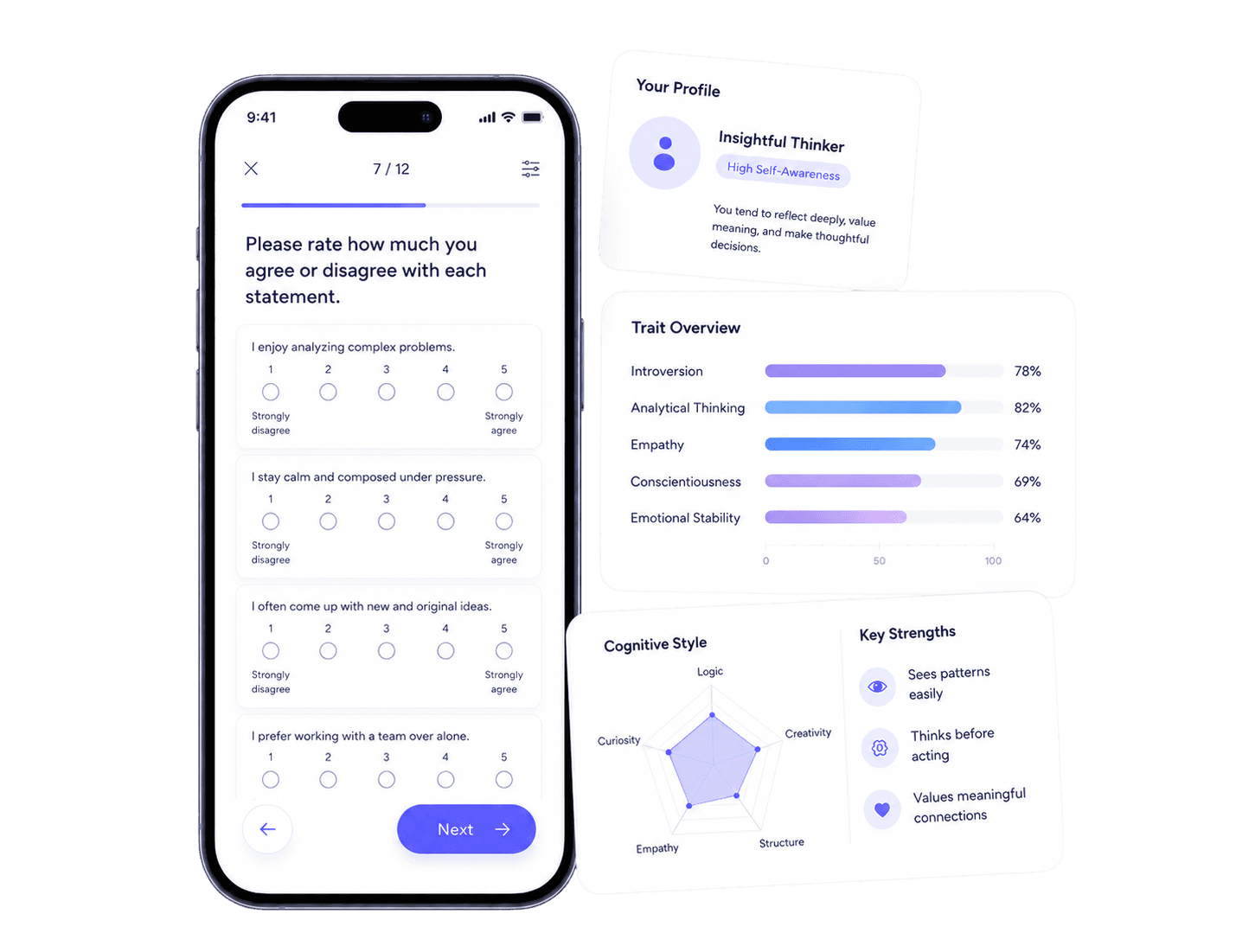
Your answers are combined into a Level 1–5 sociopathic-traits result rather than separate scores for empathy, remorse, manipulation, impulse, risk, or rule-breaking.
The report helps you think about emotional distance, responsibility, relationships, rules, self-interest, risk, and how consequences affect later choices.
The result cannot establish antisocial personality disorder, childhood conduct history, or any other diagnosis that requires professional assessment.
A high or low score is not a prediction of violence, criminality, morality, or what you will do in the future.
Answer for your usual behavior and let the questions make the topic more specific before deciding whether any description feels relevant.
Treat the result as a summary of this questionnaire, not proof that a diagnosis or fixed identity applies.
Use the report to identify real patterns you can compare with your experience, relationships, responsibilities, and consequences.
One overall Level 1–5 sociopathic-traits result plus report content explaining the broader pattern in everyday terms.
No. ASPD requires professional assessment and developmental history that this online self-report cannot establish.
No. Thinkhint uses its own questionnaire and scoring and should not be treated as equivalent to those or other named instruments.
No. It does not predict violence, crime, dangerousness, or moral character.
That is possible. A range-level report describes a broad pattern. Compare it with your own examples and do not force every statement to fit.
If behavior is causing repeated harm, aggression, exploitation, legal problems, loss of control, or serious relationship disruption, professional assessment is more useful than repeated online testing.
People often arrive at a sociopath test because a word has been used in an argument, because a behavior worries them, or because they are curious about a stereotype. Those are different starting points, but all benefit from moving toward specific behavior.
The assessment can help you ask whether empathy, remorse, rules, impulse, influence, emotional distance, or responsibility show a recurring direction in your answers. It cannot explain why that direction exists or convert it into a clinical diagnosis.
Trying the test is therefore best treated as structured curiosity: useful if it sharpens the question, limited if it is expected to provide a final identity verdict.