Compare motives, not only behavior
The same visible action can come from different priorities. Use the result to ask what the recurring response is trying to secure, avoid, prove or protect.

Thinkhint compares your responses across nine Enneagram patterns. The result gives you one dominant type to examine through its motivations, fears, relationships, work, stress and growth themes.
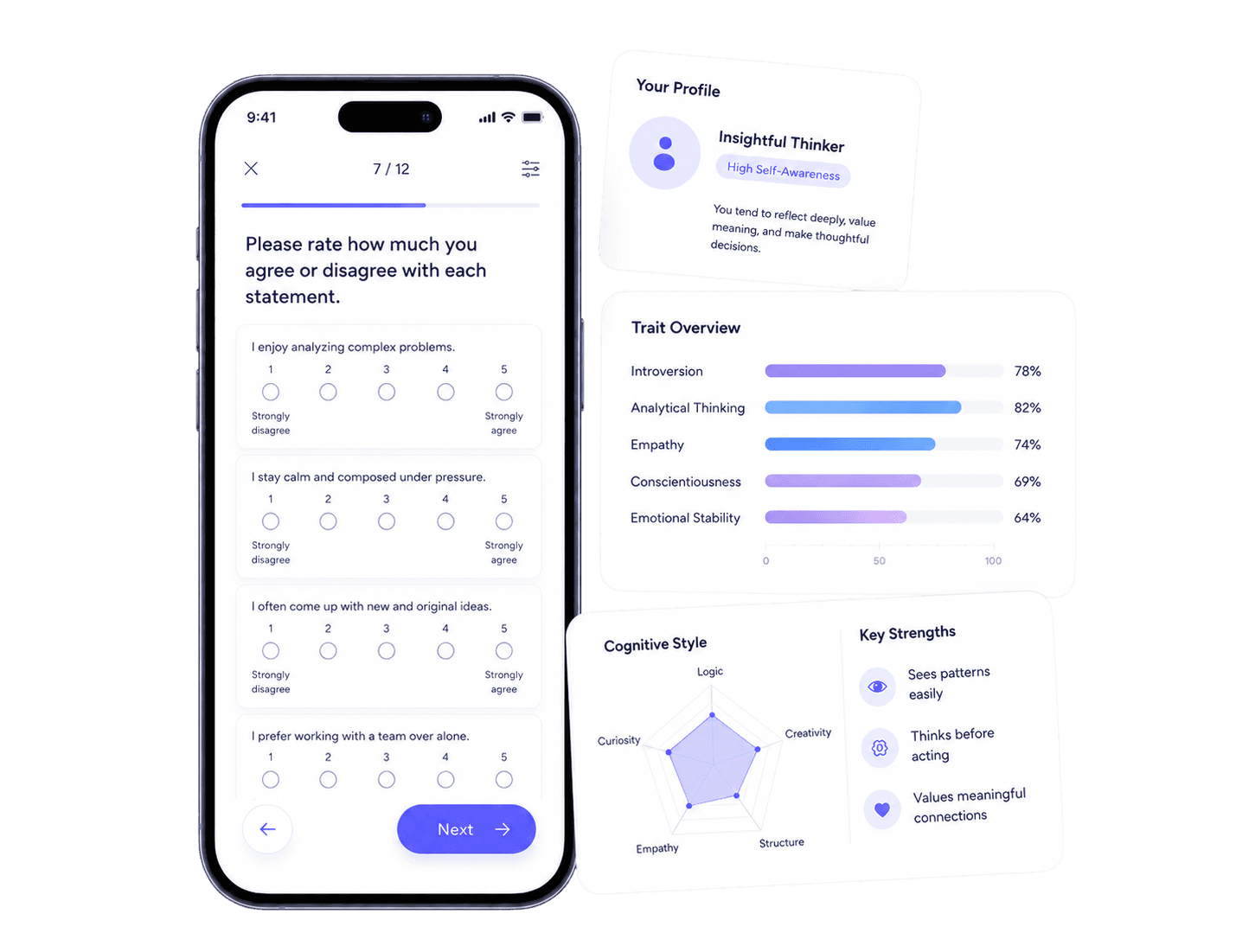
The same visible action can come from different priorities. Use the result to ask what the recurring response is trying to secure, avoid, prove or protect.
See whether the same underlying pattern helps explain how you approach closeness, conflict, reassurance and boundaries.
A stronger interpretation should survive a change of context. The report follows the type into work, stress and balance instead of relying on one setting.
Read the growth section as a direction to compare with your own evidence rather than a rule about what you must become.
Work through the assessment on a five-point scale. Use your broader life as evidence rather than one recent event or one role.
Your responses are normalized across the nine Enneagram types. The strongest overall match becomes the dominant result.
Use motivations, fears, relationships, work, stress and growth sections to see whether the type keeps explaining the same underlying pattern.
The assessment scores nine Enneagram patterns and identifies the strongest normalized match as your dominant type. Your personalized report develops that result in greater depth.
No. Thinkhint does not calculate an Enneagram wing, instinctual subtype or tritype from this assessment.
It covers your type overview, characteristics, motivations and fears, relationships, career and work, growth path, stress and balance, and type-compatibility context.
After you finish the assessment, Thinkhint prepares your personalized Enneagram result and detailed report around the strongest type match in your answers.
No. Thinkhint uses the Enneagram as an educational self-reflection framework, not a medical or psychological diagnosis.
A single behavior is weak evidence. Helping, withdrawing, planning, achieving or keeping the peace can each serve very different motives. That is why a useful Enneagram interpretation asks what keeps making the behavior matter.
Then change the setting. Does the same motive help explain your reaction at work, in close relationships and under stress? If it only fits one narrow example, keep the conclusion open.
Thinkhint gives you a dominant pattern and a detailed report. The useful work is comparing those claims with evidence from your own life, including the parts that do not fit.