Self-awareness
How quickly you notice what you are feeling and why, before it shows up in what you say or do.

This 100-question emotional intelligence test looks at how you notice your own feelings, keep them in check, understand other people, and communicate when things get tense.
How quickly you notice what you are feeling and why, before it shows up in what you say or do.
How you deal with frustration, disappointment and stress, and how fast you get back on track.
How well you pick up on other people's feelings, including the ones they don't say out loud.
How you handle disagreements, give and take feedback, and stay motivated when plans change.
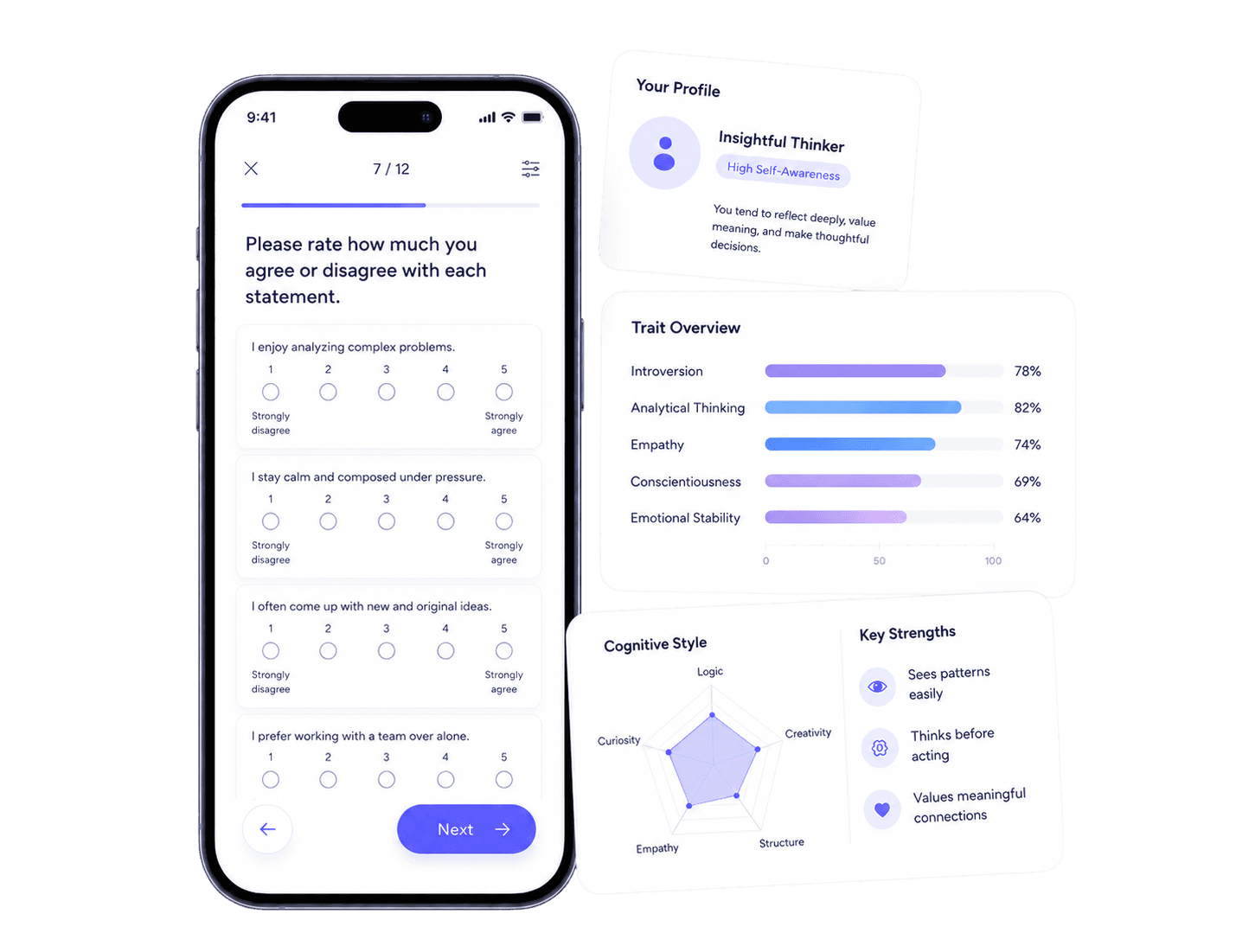
Rate how much each statement sounds like you, from strongly disagree to strongly agree.
Your answers are scored across five areas and placed on one of five levels, from foundational to advanced.
See where you are strongest, which areas could use work, and how they affect your relationships and daily life.
Most people finish the 100 questions in 10 to 20 minutes. Go with your first honest answer.
It is the ability to recognize and manage your own emotions and to understand and respond to the emotions of others.
Your result is one of five levels: foundational, emerging, developing, strong or advanced emotional intelligence, with a breakdown of the five areas.
Yes. It is a set of skills rather than a fixed trait, and most people get better at it with attention and practice.
No. Thinkhint is a self-reflection test. It is not a clinical or workplace assessment.
Most people can think of a moment they wish they had handled differently: snapping at someone, missing that a friend was upset, or letting stress take over a conversation. Emotional intelligence is what shapes those moments, and it is hard to judge in yourself.
The test looks at five areas: self-awareness, emotional control, empathy, communication and adaptability. You may be strong in some and less so in others. Someone can read people well, for example, and still find it hard to calm down after an argument.
Use your result to see where to focus. The report is based only on your answers and is meant for self-reflection, not as a formal assessment.