A thought that keeps asking for attention
Notice when a question, doubt or unwanted thought returns even after you have already tried to settle it.

Use familiar situations — one more check, one more review, one more attempt to feel certain — to explore what happens before the response, what it changes, and whether the relief lasts.
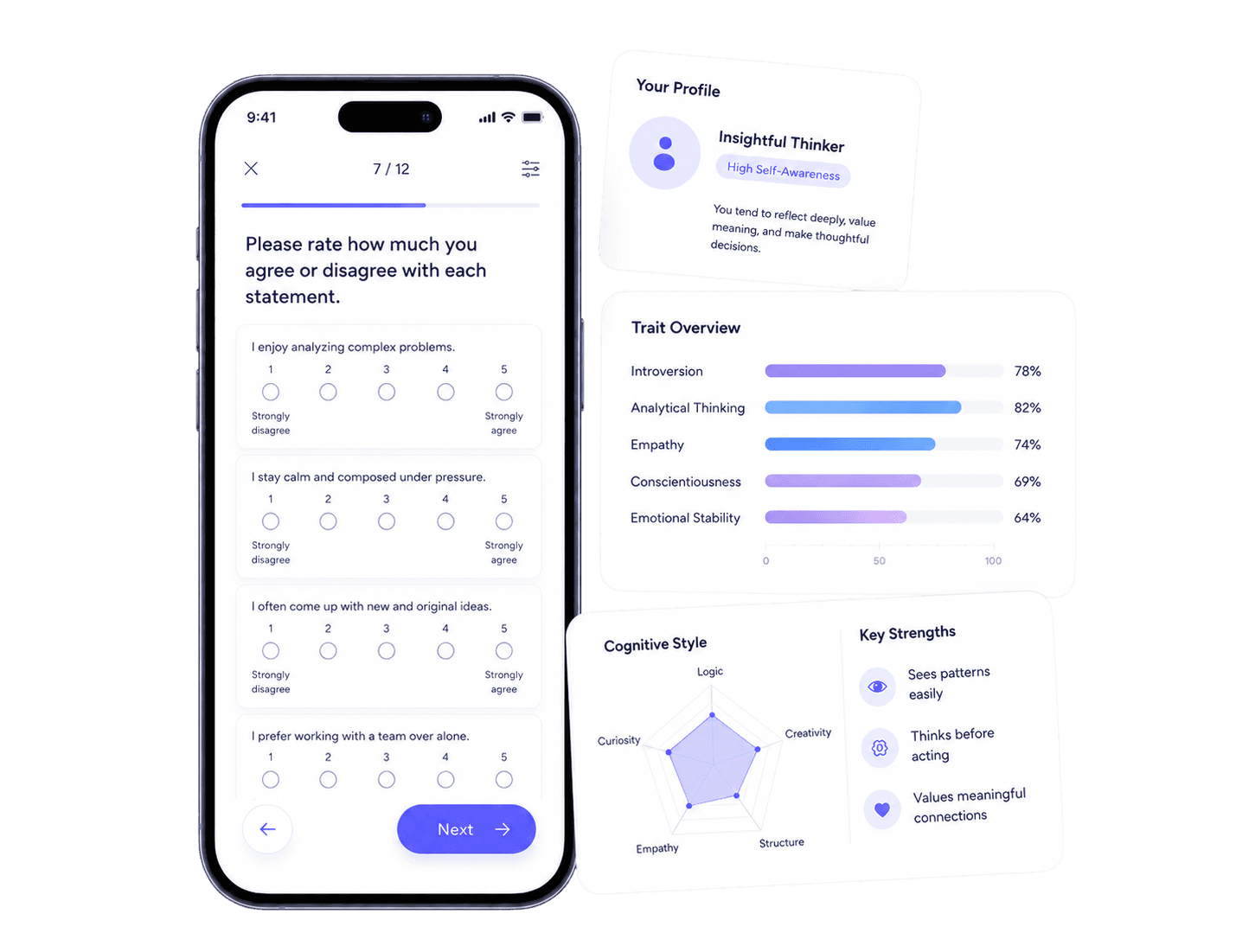
Notice when a question, doubt or unwanted thought returns even after you have already tried to settle it.
Explore checking, reassurance, mental review, repetition or routines as attempts to reduce discomfort or reach certainty.
Consider whether you can move on afterwards or whether the same concern quickly becomes important again.
Use the result to identify one recurring mechanism in your own experience rather than deciding whether a stereotype fits you.
Answer for what usually happens when doubt, an intrusive thought or an unfinished feeling becomes difficult to ignore.
Look for the purpose behind checking, repeating or reviewing: certainty, safety, completeness, reassurance or relief.
Read the overall result with several real examples in mind so the reflection stays grounded in your own life.
No. It is an educational self-reflection tool. It cannot diagnose obsessive-compulsive disorder or replace professional assessment.
The response can reveal how uncertainty is being managed. Checking, repetition or mental review may reduce discomfort briefly while also making the same response feel necessary again later.
No. Unwanted thoughts can occur without OCD. The more useful questions are how much distress the thought creates, what meaning you assign to it and what you feel driven to do in response.
No. Thinkhint returns one overall result range and uses several themes to help explain it in context.
If recurring thoughts or compulsive responses are causing significant distress or disruption, consider discussing them with a qualified mental-health professional.
Most people check important things sometimes. The experience changes when leaving without another check feels intolerable, when a thought seems to demand an answer, or when a routine feels necessary before you are allowed to move on.
That is why this quiz is organised around situations and consequences rather than a stereotype about cleanliness or order. It asks you to notice the relationship between uncertainty, response and relief.
The result remains an overall self-reflection range, not a clinical conclusion. Its value is in giving you a more precise question about your own pattern.