Curiosity can become distraction
Openness can support imagination and flexibility, while too many possibilities can make focus and completion harder in the wrong context.

You are not one trait all the time. But some tendencies keep appearing when you choose, plan, socialise, cooperate, or respond to pressure. This Big 5 Personality Test helps you examine which one leads most consistently.
Openness can support imagination and flexibility, while too many possibilities can make focus and completion harder in the wrong context.
Conscientiousness can support reliability and follow-through, but strong standards can also make disorder, ambiguity, or unfinished work harder to tolerate.
Extraversion and agreeableness can support connection in different ways while also changing how you handle stimulation, assertion, disagreement, and other people’s expectations.
Neuroticism can make threat, uncertainty, criticism, or emotional shifts register quickly, which may help you notice risk while also increasing stress under pressure.
Think about what usually happens before you edit yourself for a role, audience, or ideal image. Repeated behaviour is more useful than one exceptional day.
The five dimensions are scored from your responses, and the strongest one becomes the organising theme for the report.
A good interpretation explains where the trait helps, where it becomes overextended, and what kind of situation changes the outcome.
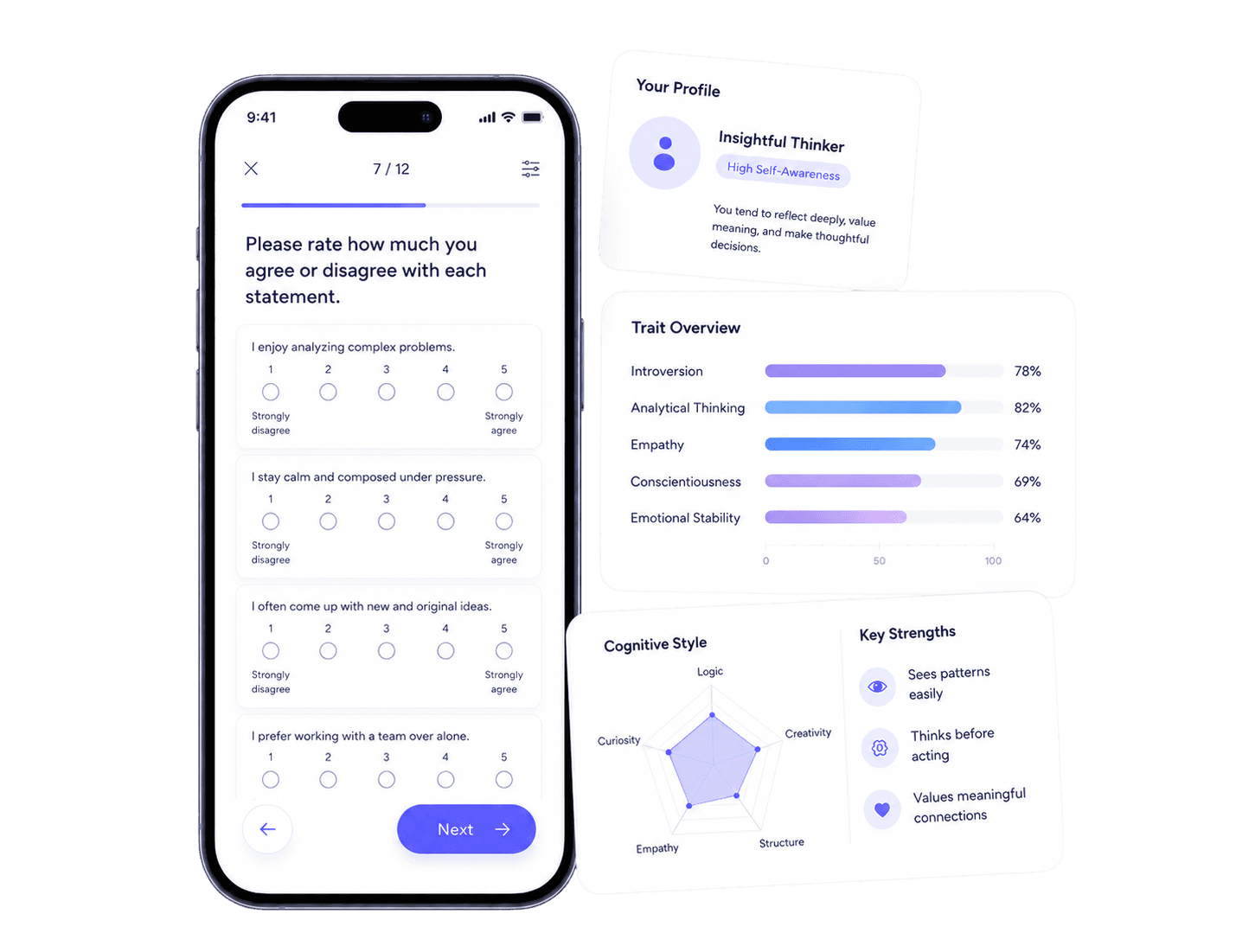
ThinkHint does not return a clinical five-score profile with population percentiles. It identifies the strongest trait pattern in your answers and builds the report around how that tendency may show up in characteristics, motivations, relationships, work, stress, and growth.
That structure gives you a practical question: when this trait is leading, what changes? The answer may involve energy, pace, communication, standards, flexibility, or the way you react when the stakes rise.
The Big Five itself is dimensional, not a fixed type system. ThinkHint uses those dimensions to identify the trait that stands out most strongly in your answers and then builds a narrative report around it.
No. The product is not a normed percentile profile. The result experience is centred on your strongest Big Five trait and a detailed interpretation of that pattern.
Not completely. A dominant trait is a useful organising signal, but people show all five dimensions and behave differently across roles and situations.
Personality shows continuity, but traits are not fixed forever. Experience, roles, environments, habits, and deliberate effort can influence how tendencies are expressed over time.
No. ThinkHint is for educational self-reflection and does not administer a named professional inventory or provide diagnosis.
Most people already know the flattering version of their personality. They know they are curious, disciplined, sociable, considerate, or emotionally perceptive. What is harder is recognizing the moment when the same tendency starts creating a problem.
That is where Big Five language becomes practical. A trait is not simply a compliment or criticism. It is a repeated bias toward certain responses, and every bias works better in some situations than others.
Use your result to find the trade-off. The strongest insight may be less about who you are and more about when your usual way of operating stops matching what the situation needs.