Find the personality type that comes through most strongly
Instead of leaving you with a vague list of adjectives, the quiz points to one dominant type from nine possibilities so you have a clear answer to react to.

Start with curiosity. Your answers point to one dominant type from a nine-type personality system, giving you a clear result to recognise, question and compare with the way you actually think, react and relate.
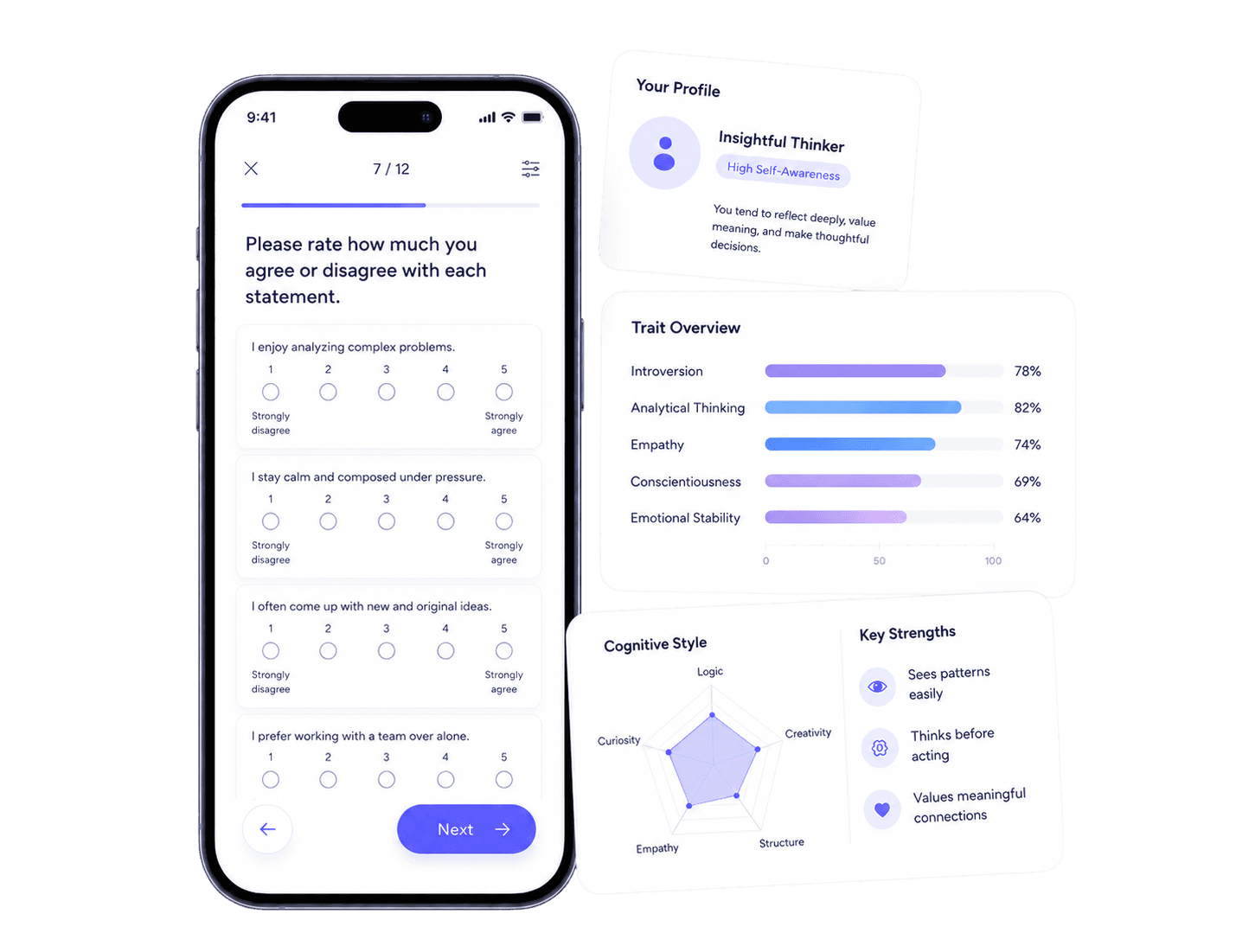
Instead of leaving you with a vague list of adjectives, the quiz points to one dominant type from nine possibilities so you have a clear answer to react to.
The result goes beyond surface behaviour and introduces the characteristic motivations and fears associated with your type — useful clues for why certain reactions feel so natural.
Compare the type with decisions, relationships, responsibility and work. The most satisfying result is one that reminds you of situations you can immediately picture.
You do not need every line to sound perfect. Use the result as a starting point for noticing what feels recognisable, what only appears in certain settings and what deserves a second look.
Answer from your usual reactions and preferences rather than trying to choose the most impressive or socially desirable response.
The overall pattern across your answers is compared with nine personality types, and the strongest pattern becomes your result.
Read about the motives, strengths, relationships, work themes and pressure patterns linked with the type, then compare them with moments from your own life.
You receive one dominant personality type from a nine-type system, followed by an explanation of its characteristics, motivations and fears, relationships, work themes, stress patterns and growth areas.
No. Each type comes with strengths as well as tendencies that can become less helpful in some situations. The interesting part is seeing which pattern feels most familiar to you.
Yes. Different types can share visible behaviours, and people also act differently across situations. The quiz highlights the strongest overall pattern in your answers rather than claiming that every other type will feel completely unfamiliar.
No. Thinkhint does not return five Big Five trait scores or a four-letter 16-personality code. It uses a separate nine-type model and returns one dominant type.
Treat it as a useful prompt for self-reflection, not a rule about who you are. Notice what clicks immediately, what only fits in certain settings and what does not feel accurate at all.
No. Thinkhint is an educational self-reflection tool and does not provide diagnosis, treatment or professional mental-health advice.
A personality quiz works because the result gives you something concrete to react to. Sometimes the first response is immediate — “that is absolutely me.” Sometimes it is the opposite. Both reactions can be useful because they give you a clearer question than a blank page ever could.
The next step is to look for the reason behind the familiar behaviour. Being organised can come from pride in doing things well, discomfort with uncertainty, a wish to be dependable or a need to stay in control. Being easygoing can come from genuine flexibility or from wanting to avoid conflict. Similar behaviour can tell different stories.
So enjoy the result first, then test it against a few real moments. Think about a disagreement, a deadline, a compliment you still remember or a responsibility you take on automatically. If the type helps those moments make a little more sense, the quiz has given you something worth keeping.