What your mind keeps returning to
Look at repeated what-if thinking, mental replay, fear of mistakes, and the urge to keep analyzing after a practical decision has already been made.

Anxiety can be easier to understand when you stop treating it as one feeling and start looking at what happens around it: the thoughts you revisit, the certainty you search for, the situations you avoid, and the pressure you put on yourself to get things right.
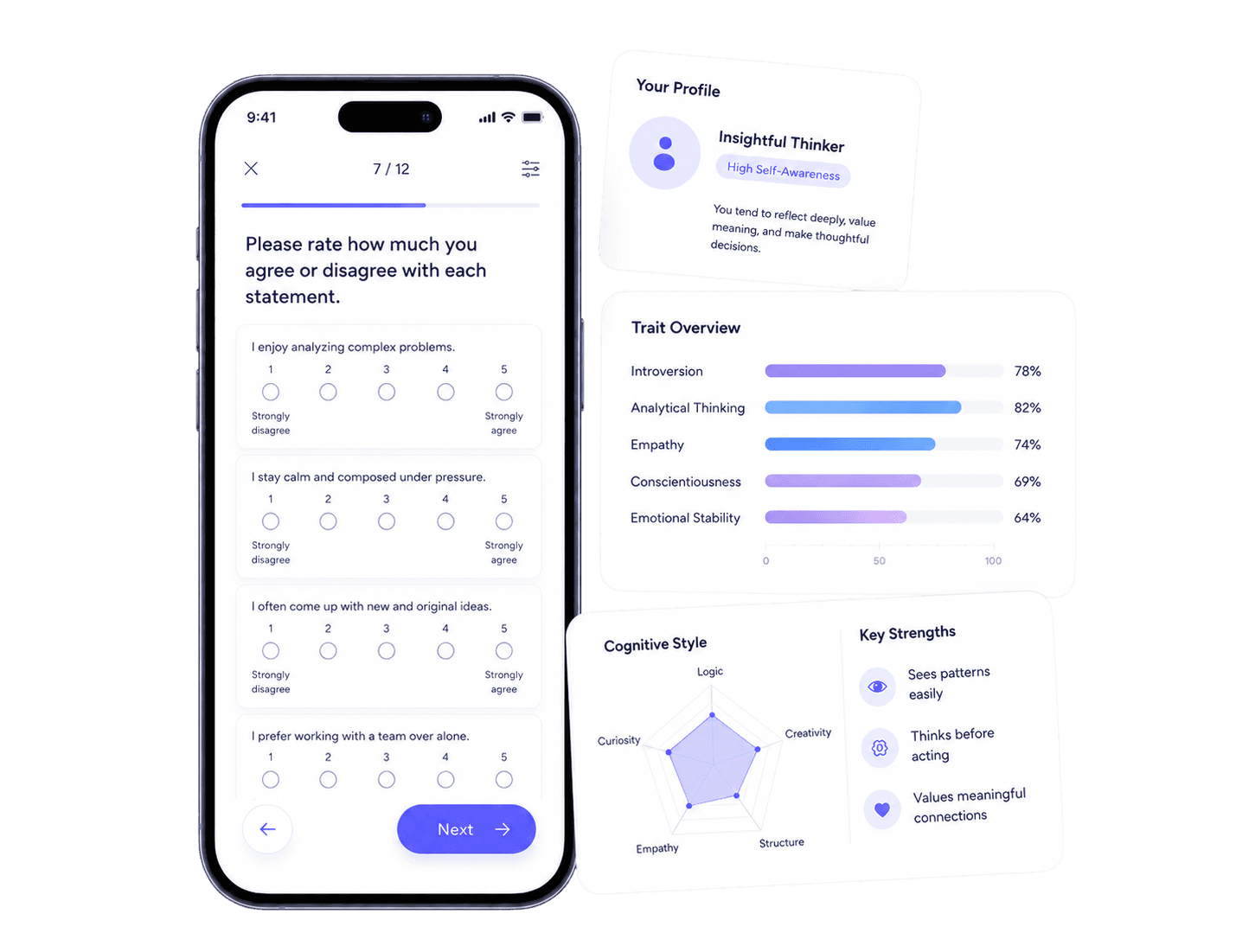
Look at repeated what-if thinking, mental replay, fear of mistakes, and the urge to keep analyzing after a practical decision has already been made.
Notice whether waiting, ambiguity, changing plans, or not knowing how something will turn out makes it difficult to settle or stay present.
Reflect on postponing, checking, over-preparing, seeking reassurance, or avoiding situations that feel unpredictable or hard to control.
Your report helps you connect the internal experience with decisions, relationships, work, communication, and the amount of energy ordinary situations can require.
Think about the moments that repeat: waiting for an answer, making a decision, handling pressure, replaying a conversation, or facing something you would rather postpone.
The assessment combines anxiety-related experiences across thinking, physical tension, social situations, uncertainty, and avoidance into one overall anxiety-traits level.
Compare the description with your real experience. The useful part is not accepting every sentence; it is noticing which patterns explain something you have struggled to put into words.
Reflection helps you organize your own experiences and notice recurring patterns. Diagnosis requires clinical assessment and considers factors this online test does not establish.
The questionnaire includes anxious thinking, physical tension, social unease, difficulty with uncertainty, and avoidance-related behavior. These answers contribute to one overall anxiety-traits result.
No single self-report can establish the cause of anxiety. The report can help you notice where anxiety-related patterns appear and what tends to happen around them, which may give you better questions to explore next.
Try not to. Answer from what is usually true across ordinary life. Extreme moments can matter, but recurring everyday patterns give a more balanced basis for reflection.
You can use it to help describe what you have noticed about yourself, but the result is not a clinical finding and should not be treated as one.
Suppose uncertainty appears. What happens next? Maybe your mind starts generating scenarios. Maybe you seek more information, then a little more. Maybe you delay the decision until you feel completely sure, or avoid the situation and feel immediate relief. Those details often tell you more than the word 'anxiety' by itself.
Reflection becomes useful when it follows the sequence. A thought can create tension; tension can make reassurance feel necessary; reassurance can help briefly; then the next uncertainty starts the cycle again. In another person, the sequence may look completely different. That is why broad labels are often less informative than the pattern around them.
Thinkhint cannot tell you the cause of that pattern or whether it meets criteria for a disorder. What it can do is give you a more organized view of the experiences you already recognize, so the next conversation — with yourself, someone you trust, or a qualified professional — starts from something more concrete than 'I have just been anxious lately.'