Worry loops
Notice whether your mind tends to revisit possibilities, replay conversations, or search for certainty before you can move on.

This anxiety test helps you look more closely at worry, uncertainty, avoidance, and the everyday situations that can keep thoughts running in circles. It is designed for personal reflection, not diagnosis.
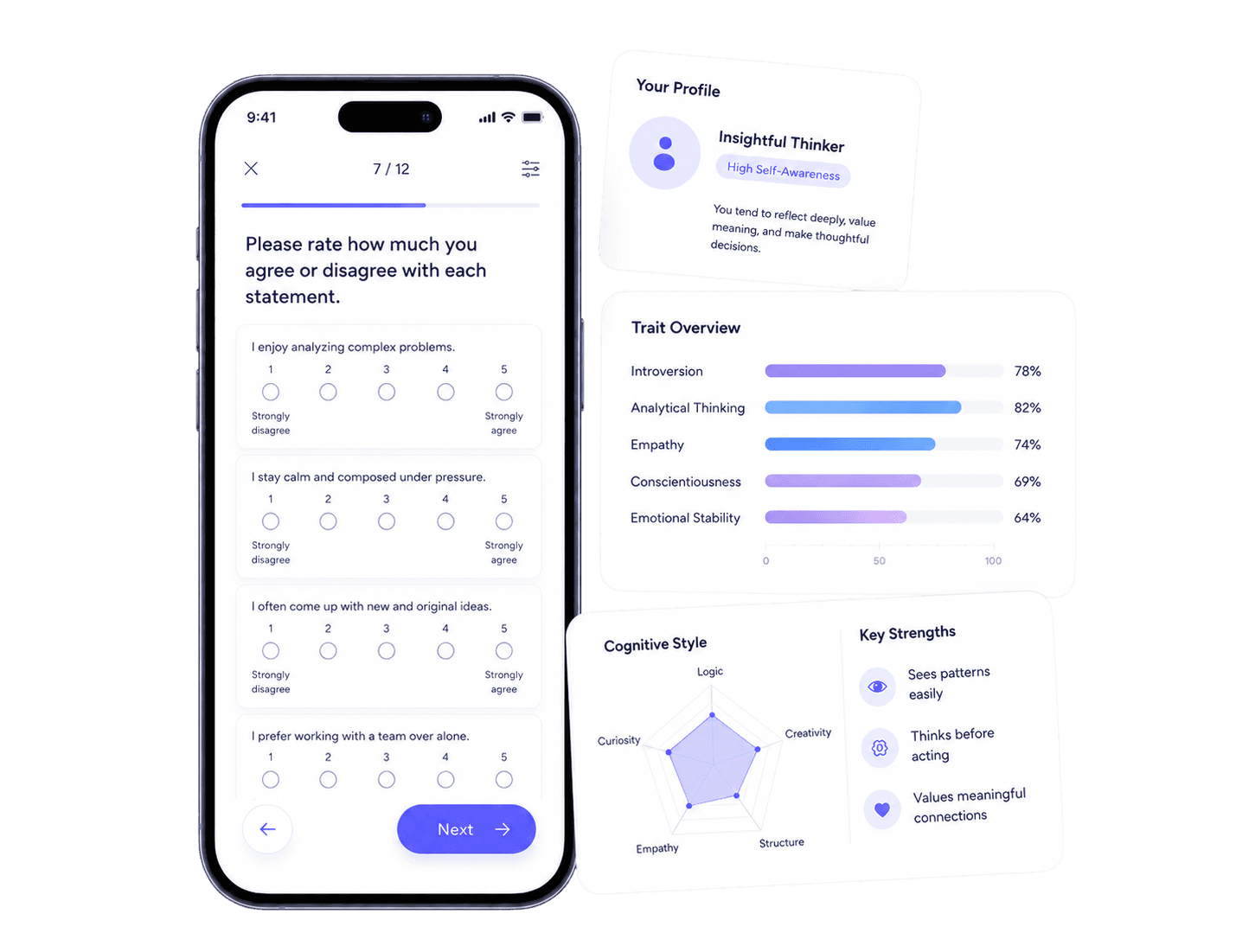
Notice whether your mind tends to revisit possibilities, replay conversations, or search for certainty before you can move on.
Reflect on how deadlines, decisions, social situations, and unexpected changes can affect your sense of ease.
Consider the situations you put off, over-prepare for, or keep checking because they feel difficult to face.
Compare the result with your own examples and see which patterns appear consistently, which depend on context, and which assumptions about yourself may need another look.
Choose the response that best matches how you usually think, feel, and act in ordinary situations—not how you wish you reacted.
Your answers are considered together across worry, uncertainty, physical tension, social situations, and avoidance rather than interpreted from one isolated response.
Use the report to ask where the description fits, where it does not, and what conditions seem to make anxiety-related patterns stronger or weaker for you.
The test is designed to help you reflect on anxiety-related thoughts, physical reactions, social unease, responses to uncertainty, and avoidance. It produces one overall anxiety-traits result rather than separate clinical subscale scores.
No. Thinkhint is an educational self-reflection tool. It does not diagnose anxiety, replace clinical assessment, or provide medical advice.
Set aside enough time to work through the questions without rushing. They are easiest to answer when you think about what is usually true for you rather than one unusually good or difficult day.
Your responses are combined into one overall anxiety-traits level, followed by a detailed report that gives the result context across thinking, stress, relationships, work, communication, and decision-making.
No. Thinkhint uses its own questionnaire and does not provide a GAD-7 score or claim to be a validated clinical screener.
A self-reflection test can be useful for noticing patterns, but it is not a substitute for professional support. Consider speaking with a qualified health professional if anxiety is persistent, worsening, or interfering with daily life.
Anxiety does not always look like panic or a single obvious problem. For some people, it shows up as constant mental rehearsal before a conversation, a need to know every detail before making a choice, or the feeling that relaxing means something important will be missed. For others, it is more visible in avoiding calls, delaying decisions, or checking the same thing repeatedly for reassurance.
The useful question is not simply whether any one of those experiences sounds familiar. It is whether they form a recurring pattern, what tends to trigger that pattern, and what happens to your behavior once uncertainty rises. A result becomes more informative when you compare it with examples from more than one setting.
An online test cannot tell you why a pattern exists or provide a medical answer. It can give you a clearer hypothesis to examine: which situations consistently pull you into worry, which reactions actually help, and which ones mainly make uncertainty feel manageable for a short time.