Your natural approach to decisions
Reflect on the tendencies that may guide how you weigh options, solve problems, respond to change, and choose what matters most.

Explore the preferences, reactions, and recurring habits that can influence the way you make decisions, relate to people, handle pressure, and approach everyday choices.
Reflect on the tendencies that may guide how you weigh options, solve problems, respond to change, and choose what matters most.
Explore recurring patterns in communication, closeness, conflict, support, boundaries, and how you respond when relationships feel uncertain.
Consider how your usual preferences may show up in teamwork, planning, feedback, motivation, and the environments where you do your best work.
Use the report to notice familiar habits earlier and make more deliberate choices in situations that matter to you.
Choose the responses that reflect what is usually true for you, not the version of yourself you wish you showed in every situation.
Your answers are considered together so the report reflects recurring tendencies rather than a single mood, moment, or isolated response.
Read the result in the context of your relationships, work, decisions, and the everyday situations where your style is easiest to recognise.
It explores recurring patterns in how you think, make decisions, communicate, respond to situations, and approach the people and responsibilities in your life.
Most people complete it in around 10 to 20 minutes. It helps to answer based on your usual behaviour rather than one unusually good or difficult day.
No. Your report is a perspective on the patterns reflected in your answers. It is not a complete definition of you or a limit on what you can change.
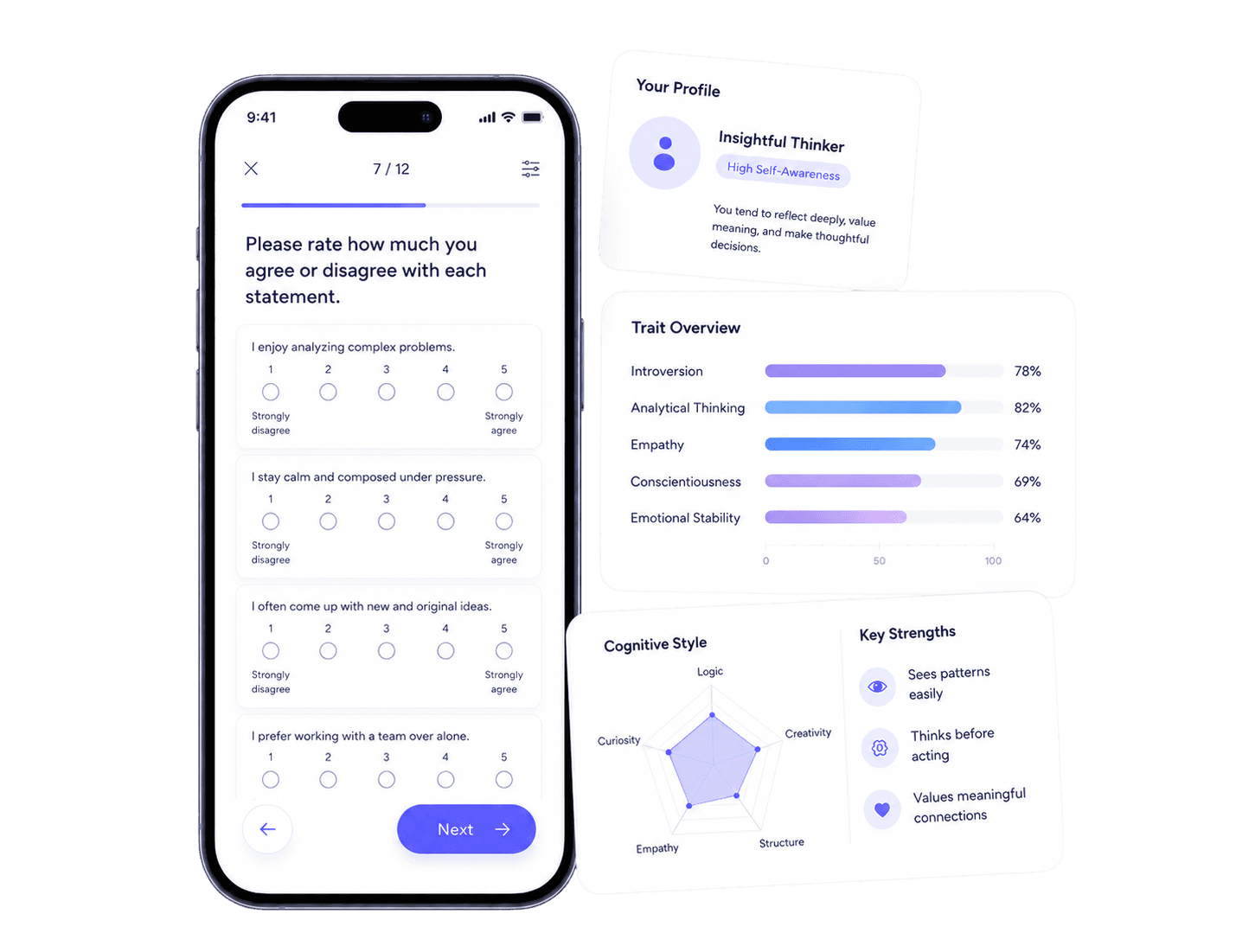
You receive a personal report that brings together the main patterns in your answers and offers context for how they may show up in everyday life.
No. Thinkhint is designed for education and personal reflection. It does not provide medical, psychological, psychiatric, or professional diagnosis.
A personality test is most useful when it helps you make sense of patterns you already notice but have not put into words. You may see the same approach appear in very different places: the way you make a decision, react to feedback, handle a disagreement, choose work that suits you, or decide how close to let someone get.
Those patterns are not fixed rules. They can be shaped by experience, environment, relationships, pressure, and the role you are in. Still, recognising a familiar tendency can make it easier to pause before it automatically takes over a situation.
Your Thinkhint report is designed to give you a clearer view of the themes in your answers. The useful part is not a label; it is the chance to compare the observations with your own life and decide what deserves more attention.