Your strongest contribution pattern
See whether your answers lean most toward practical execution, analytical problem-solving, communication, creative work, or leadership and direction.

The same person can be capable in many jobs and still feel more at home in some kinds of work than others. ThinkHint compares five career patterns to show which one stands out most strongly in the way you say you work.
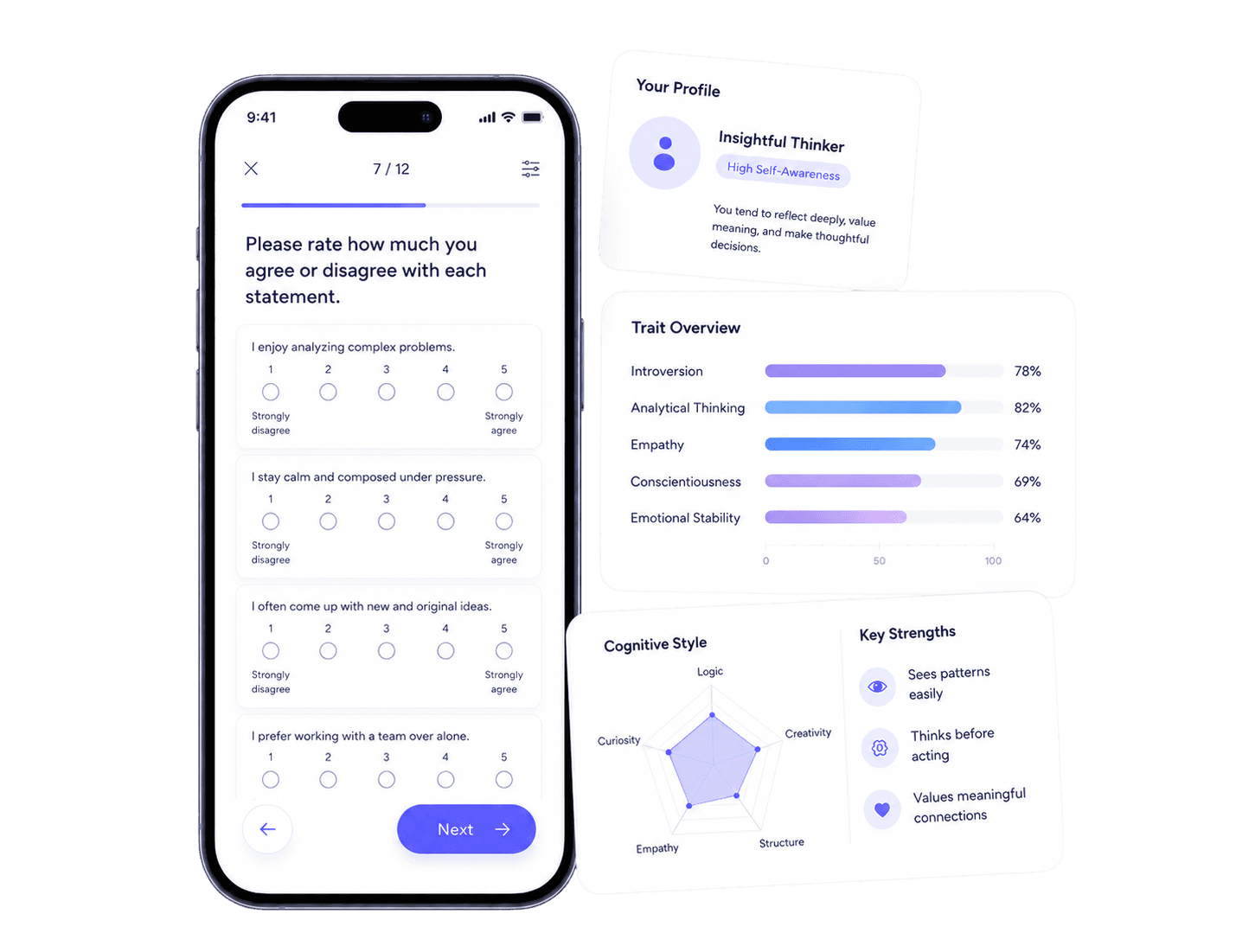
See whether your answers lean most toward practical execution, analytical problem-solving, communication, creative work, or leadership and direction.
Consider how structure, autonomy, collaboration, complexity, responsibility, and room for originality affect the way you use your strengths.
The report connects your dominant type to examples of environments and professional directions that may deserve a closer look.
Every work pattern has trade-offs. Use the result to see where the same tendency that helps you can also become limiting when overused.
Use examples from jobs, study, volunteering, projects, and everyday responsibilities rather than answering for the person you think you should be at work.
Your responses are compared across The Builder, Analyst, Communicator, Creator, and Leader to identify the strongest overall pattern.
Read the strengths, work preferences, role examples, and development themes, then compare them with qualifications, opportunities, pay, location, and the realities of the work itself.
You receive one dominant career type: The Builder, Analyst, Communicator, Creator, or Leader. The report explains the strengths, work preferences, environments, example directions, and growth themes associated with that result.
No. It does not measure performance-based abilities such as numerical, verbal, or spatial aptitude. It is a self-report assessment of work patterns and preferences.
No. ThinkHint uses its own five career types. O*NET's Interest Profiler uses the six RIASEC interest areas and links them to the O*NET occupation database; this assessment does not claim to be that instrument.
No. A useful career decision depends on your skills, qualifications, opportunities, priorities, and circumstances as well as your preferences. The result is best used to sharpen what you investigate next.
Yes. The result can help you evaluate why some parts of your current role fit better than others and what you may want more—or less—of in future roles.
A career label is easy to remember, but a workday is made of tasks, decisions, people, deadlines, ambiguity, responsibility, and trade-offs. That is why the useful part of a career result is not the label by itself. It is the explanation of what tends to bring that pattern to life.
The five ThinkHint career types describe different ways of creating value. Builders turn plans into dependable results. Analysts want to understand and solve. Communicators create movement through people and ideas. Creators look for originality and possibility. Leaders are drawn toward responsibility, direction, and influence.
No one type owns a profession, and no profession belongs to one type. Use the result to compare your pattern with the actual work inside a role, then test the match against your skills, constraints, and opportunities before making a decision.