Signal versus story
Notice what you actually observed — tone, silence, expression, behavior — before deciding what you think it means.

You can notice that someone is upset, understand why, feel affected yourself and still be unsure what would help. Separate those steps and see which empathy tendencies are most familiar in your own interactions.
Notice what you actually observed — tone, silence, expression, behavior — before deciding what you think it means.
Compare perspective-taking with emotional resonance. You can be strong in one without experiencing the other as intensely.
Look at the difference between responding with care and assuming that another person's feelings or problems are yours to carry.
See how stress, closeness, conflict and available energy may change the empathy you can access in a particular moment.
Think about real conversations, other people's distress, disagreements, emotional environments and the moments when someone needs support.
Notice what you pick up, what you infer, how much you feel, whether you act and what happens to your own emotional energy afterward.
Use recent interactions to test which observations fit well, which depend on context and which are worth watching more closely.
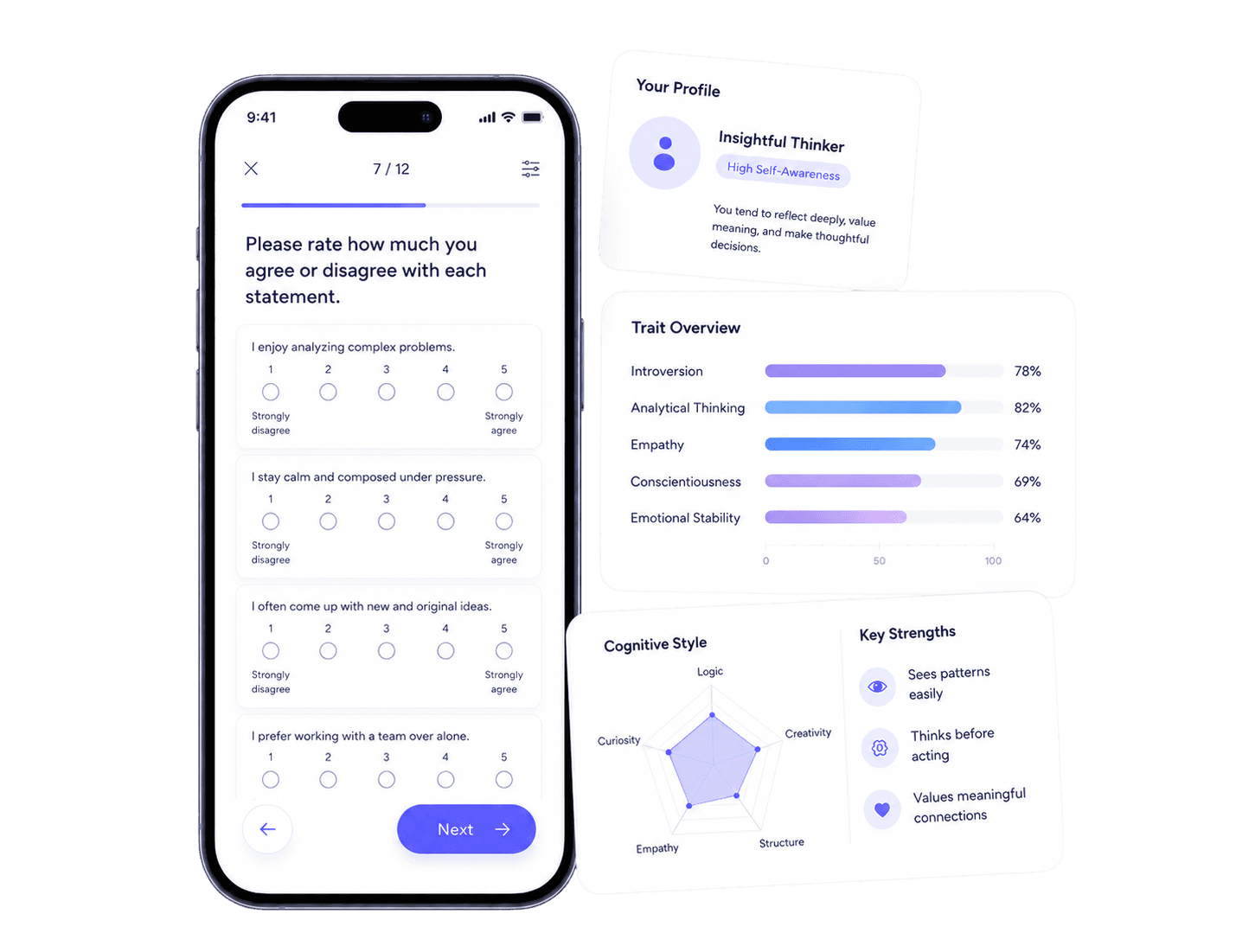
It explores self-reported patterns in emotional sensitivity, understanding other perspectives, noticing social cues, compassion, helping behavior and emotional boundaries.
Cognitive empathy is understanding another person's viewpoint or emotional state. Emotional empathy is feeling affected by what they feel. The two often overlap, but they are not identical.
No. Empathy can support connection, but emotional overload, assumptions and weak boundaries can still create problems. How empathy is used matters as much as how strongly it is felt.
Yes. Familiarity, trust, stress, conflict, role and energy can change how easy it is to understand, feel with or respond to someone.
No. Thinkhint is for education and self-reflection. It does not diagnose a condition and is not presented as a validated clinical or workplace empathy instrument.
Imagine a colleague says they are fine but becomes unusually quiet. You might notice the change immediately, feel worried yourself, infer that something is wrong, offer help, or decide not to push. Those are related reactions, but they are not the same process.
That distinction matters because people often judge their empathy from one visible behavior. Someone who gives space can look detached while actually understanding the situation well. Someone who feels another person's distress intensely can still misread what that person needs.
Use the result as a hypothesis to compare with real interactions. The useful question is not whether you are a good or bad empath. It is where your interpretation is strong, where emotion changes your judgment, and what helps you respond without losing your own boundaries.