Separate composure from emotional distance
Staying calm under pressure can be useful. Ask what happens when another person's feelings should matter: whether you understand them, feel concern, or mainly stay focused on the outcome.

A calm reaction, a strategic conversation or a risky decision can mean very different things on its own. Thinkhint helps you look at the wider combination: emotional response, empathy and remorse, goals, influence, consequences and what happens afterwards.
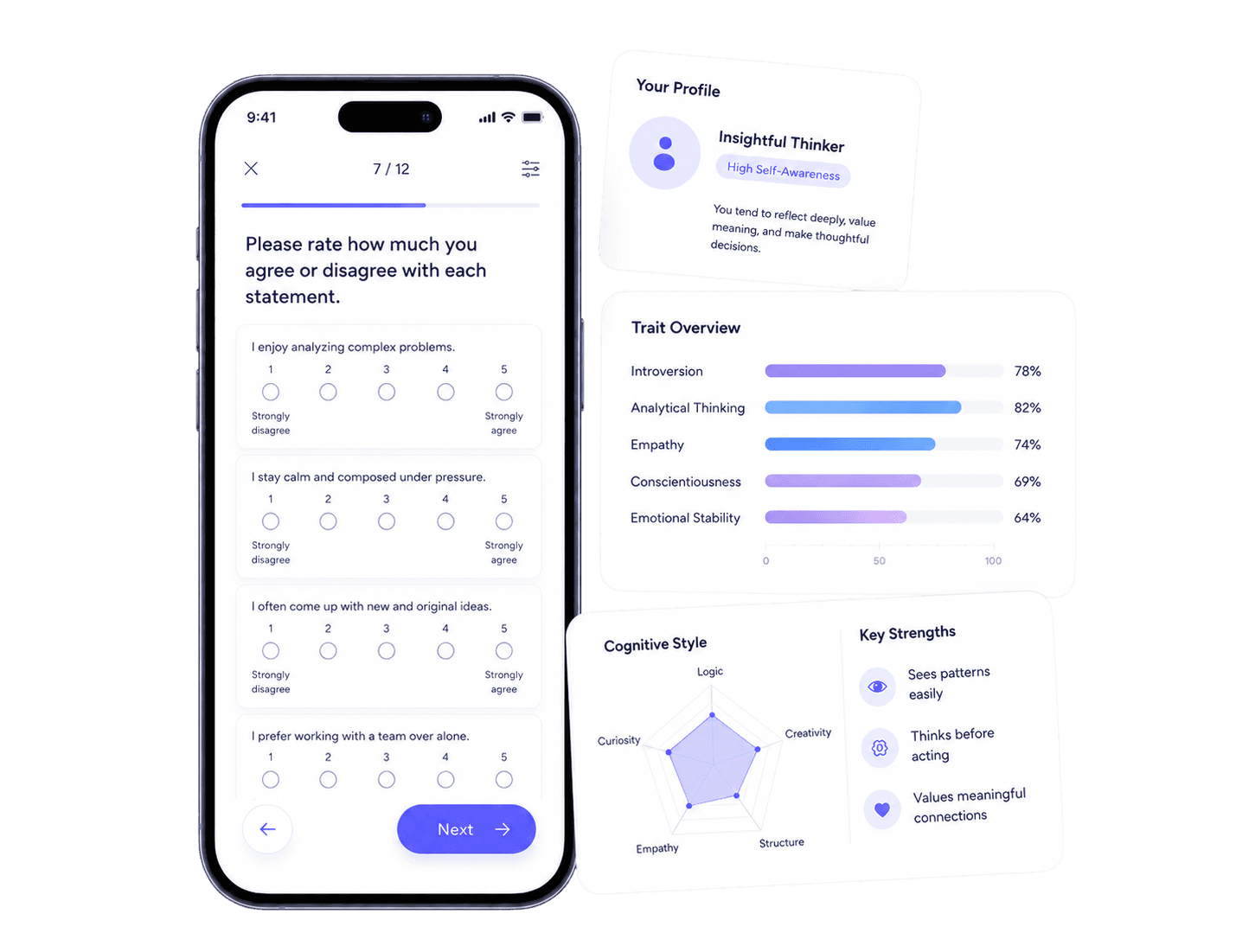
Staying calm under pressure can be useful. Ask what happens when another person's feelings should matter: whether you understand them, feel concern, or mainly stay focused on the outcome.
The aftermath can be revealing. Consider whether causing harm changes your next choice, whether regret lingers, and whether responsibility feels emotional, practical, inconvenient or easy to dismiss.
Adapting socially can build connection or secure advantage. The useful distinction is whether influence stays reciprocal and honest when there is something important to gain.
A calculated risk and an impulsive risk are not the same. Look at how quickly you act, how much future cost matters, and whether excitement or personal gain changes the balance.
Think across relationships, conflict, work, competition and responsibility instead of letting one unusually good or bad incident dominate your answers.
The test returns one overall psychopathy-traits result. Use the report to understand how different themes may contribute to the same broad pattern.
Ask what the pattern changes in real life: trust, closeness, accountability, risk, decision quality and the effect your choices have on other people.
No. Thinkhint gives an educational self-report result about psychopathy-related traits. It does not provide a clinical diagnosis or define your identity.
The questions include emotional detachment, empathy and concern, responsibility, influence and strategic presentation, guilt and remorse, composure, risk-taking, impulsivity, self-interest and consequence awareness.
No. This is a separate assessment. It does not reproduce the scoring, factors or professional administration of those named psychopathy instruments.
No. The result is one overall psychopathy-traits range with contextual interpretation, not separate primary/secondary psychopathy sub-scores.
No. The result is based on your own self-report. It cannot reliably assess a partner, colleague, family member or anyone else from your description of them.
Psychopathy research commonly combines affective and interpersonal tendencies with behavioural themes such as impulsivity and risk. That matters because a single behaviour rarely tells you which broader pattern is present. Calmness may reflect self-control, emotional distance, or both. Social skill may be collaborative, strategic, or instrumental depending on what the person is trying to achieve.
The same is true after a decision. Someone who takes a risk may have considered the cost carefully, or barely considered it at all. Someone who causes harm may understand the consequence intellectually while feeling little emotional weight, or may experience strong regret that changes later behaviour.
Use the result to ask better questions about those combinations. It is not a professional psychopathy assessment, a predictor of dangerousness or a shortcut for explaining every difficult relationship or decision.