Social desire versus social effort
Wanting connection and finding social situations demanding can both be true. Compare how much interpretation, monitoring, or recovery different interactions require.

A conversation can look ordinary and still require constant interpretation. A busy room can be manageable until the energy bill arrives later. A small change can matter because it breaks the structure that was holding the day together. Thinkhint helps you compare those patterns instead of judging them one at a time.
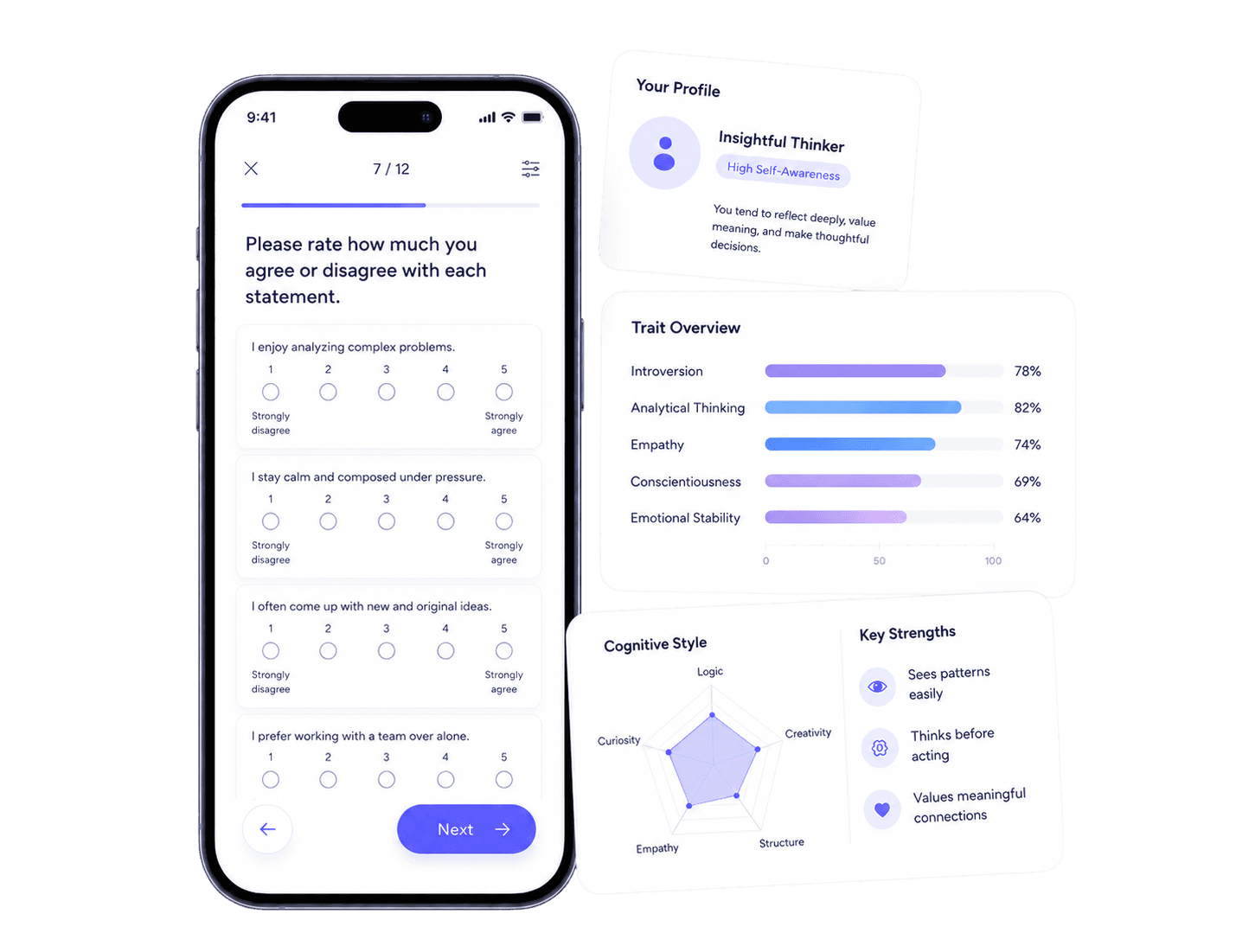
Wanting connection and finding social situations demanding can both be true. Compare how much interpretation, monitoring, or recovery different interactions require.
Getting through noise, light, crowds, textures, or layered input does not tell you how comfortable the experience was or how much recovery it required afterwards.
Notice what changes when expectations are clear and familiar compared with situations that demand rapid switching, improvisation, or last-minute adjustment.
Strong concentration on an interest can coexist with difficulty moving away from it, changing tasks, or distributing attention across competing demands.
Answer from what is usually true across ordinary weeks. Include easier settings as well as difficult ones so context stays visible.
Thinkhint combines the full questionnaire into one level from Minimal Traits to Strong Traits. It does not return separate clinical domain scores.
Read the report for what fits, what does not, and what changes when communication is clearer, sensory load is lower, or the environment is more predictable.
Your overall level is a summary, not an explanation. The report is more useful when you read it beside the situations that brought you here: the conversation you had to rehearse, the routine you depend on, the sensory environment that drains you, or the interest that holds your attention with unusual intensity.
A strong fit can sharpen the question, but it cannot establish why the pattern exists. A weak fit can also be informative if only a few areas match or the experience appears mainly under stress, poor sleep, anxiety, ADHD-related difficulties, or another kind of load. The result should organize evidence, not replace it.
No. Thinkhint uses its own educational self-report questionnaire. The result should not be interpreted as a score from the AQ, RAADS-R, or another validated clinical screening instrument.
You receive one overall autism-traits level from Minimal Traits to Strong Traits and a detailed report that discusses the result in everyday context.
Include the effort behind the outcome. Some adults learn to adapt or mask in ways that make difficulty less visible. Preparation, monitoring, and recovery can be relevant parts of your experience even when the situation looked successful from the outside.
Yes. Similar experiences can have different causes and conditions can overlap. A self-report result cannot determine the explanation by itself.
Choose the answer that best represents the broader recurring pattern, then keep the contrast in mind. Differences between quiet and busy settings, familiar and unfamiliar routines, or direct and ambiguous communication are useful context.
No. Autism diagnosis requires a broader professional assessment that considers developmental history, persistent patterns across settings, daily impact, and other possible explanations.
Adults can become skilled at getting through situations that remain demanding. Someone may maintain eye contact because they learned to, navigate a meeting by consciously tracking every cue, tolerate a noisy environment until they get home, or build elaborate routines that prevent change from becoming visible to anyone else.
That is why adult autism guidance does not reduce assessment to one outward behavior. Clinicians consider persistent social-communication differences alongside restricted or repetitive patterns, resistance to change, focused interests, sensory differences, developmental history, and the effect across everyday life.
An online self-report cannot perform that assessment. It can make the evidence you already have easier to compare. Which situations cost the most? Which supports change the outcome? Which patterns have been present for a long time? Those questions are more useful than trying to prove a conclusion from one score.