Holding and returning to attention
Consider both staying with a task and what happens after your attention is pulled away. The cost of getting back into the task can be as informative as the distraction itself.

Instead of asking only whether you get distracted, look at the sequence around it: what the task demanded, what interrupted you, whether you could return, and what happened to time and follow-through after that.
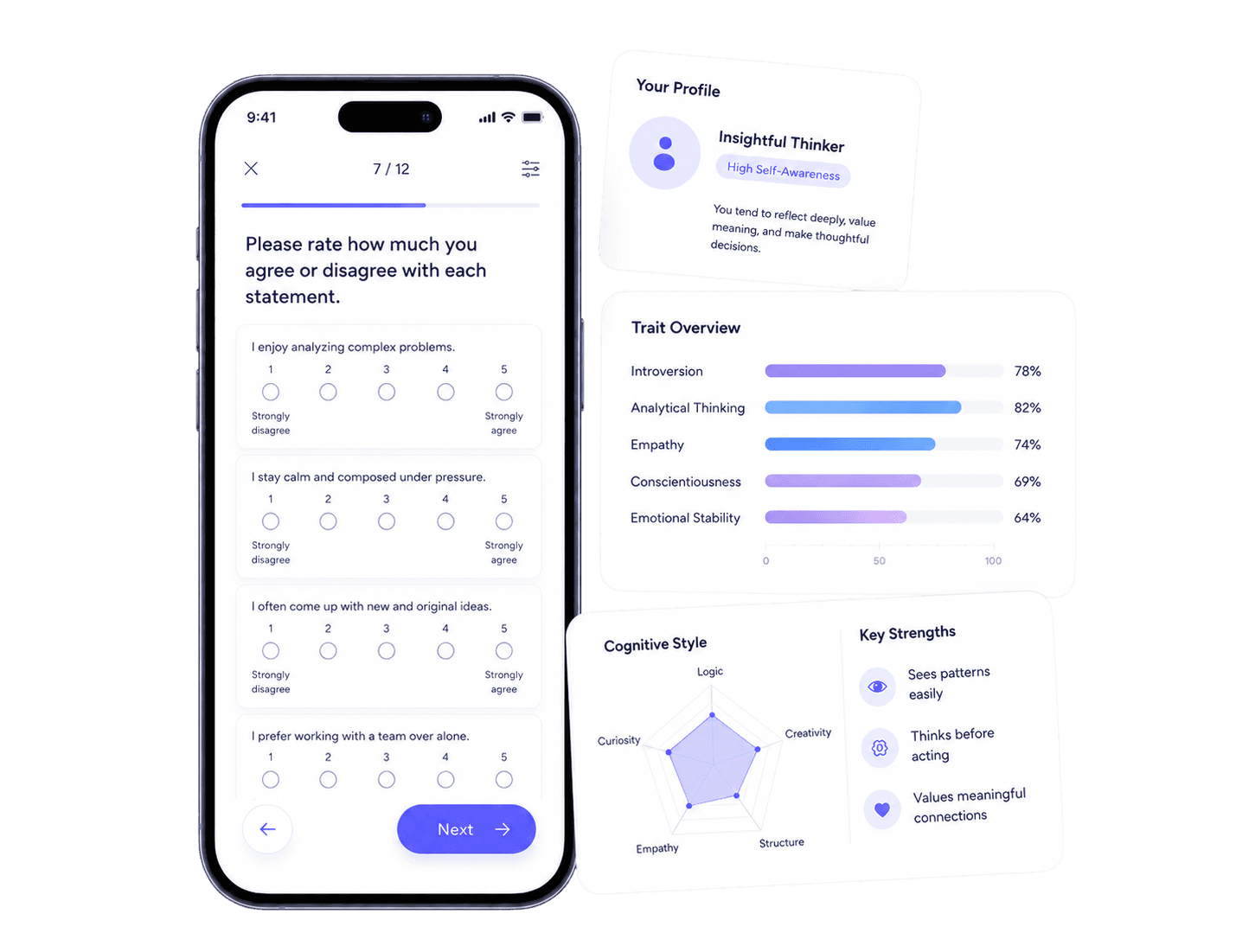
Consider both staying with a task and what happens after your attention is pulled away. The cost of getting back into the task can be as informative as the distraction itself.
Look at planning, remembering obligations, judging how long work will take, and keeping track of the details that make a plan usable.
Compare the tasks you begin easily with the ones you delay, abandon, restart, or complete only when urgency changes the equation.
Notice quick decisions, interruptions, impatience, physical restlessness, and whether pressure changes how quickly you react.
Answer from patterns you have seen more than once and across ordinary situations. One unusually productive or chaotic day should not set the baseline for every response.
Your responses are combined into a single result from Minimal Traits to Strong Traits. ThinkHint does not return a separate numerical score for each area above.
Read the report for what fits and what does not. The useful outcome is a more precise set of observations, not a requirement to agree with every description.
The result does not tell you why a pattern exists. It gives you a better set of questions: does the difficulty repeat, does it change with structure or interest, does it appear in more than one setting, and how much does it interfere with ordinary life?
Those questions are useful whether the report feels strongly familiar or only partly familiar. They let you move from a broad impression such as “I am bad at focus” toward examples that can be compared, challenged, or discussed with more precision.
Most people finish in about 10 to 20 minutes. There is no benefit to rushing; answer from what is usually true for you.
Yes. Attention can change with interest, novelty, structure, urgency, and task demands. Strong focus in some situations does not explain what happens in every other one.
ThinkHint gives you one overall ADHD-traits level and a detailed report. It does not assign a clinical ADHD presentation or separate symptom-domain scores.
Yes. Sleep problems, stress, anxiety, depression, and some physical conditions can affect attention and organization. A self-report result cannot determine the cause by itself.
No. ThinkHint is an educational self-report test. ADHD diagnosis requires a broader professional assessment that considers persistence, impact, developmental history, and other possible explanations.
Attention is not required to fail in every situation for a recurring problem to matter. A person may stay absorbed in an interesting project and still find routine, delayed-reward, or interrupted work unusually difficult to begin or complete. The contrast between those situations is useful evidence about the conditions around the difficulty.
ADHD itself is defined by persistent patterns that interfere with functioning, not by constant distraction. Professional assessment also looks for symptoms across more than one setting and for evidence that they began in childhood. That wider history is outside the scope of an online result.
Use the test to make your own examples more exact. Which situations are reliably harder? Which supports change the outcome? What remains difficult even when you care about the result? Those are better questions to carry forward than a single global judgment about whether you are good or bad at focusing.