What makes a thought feel difficult to leave
Reflect on repeated thoughts, doubts, images or questions and whether their presence starts to feel unusually significant or urgent.

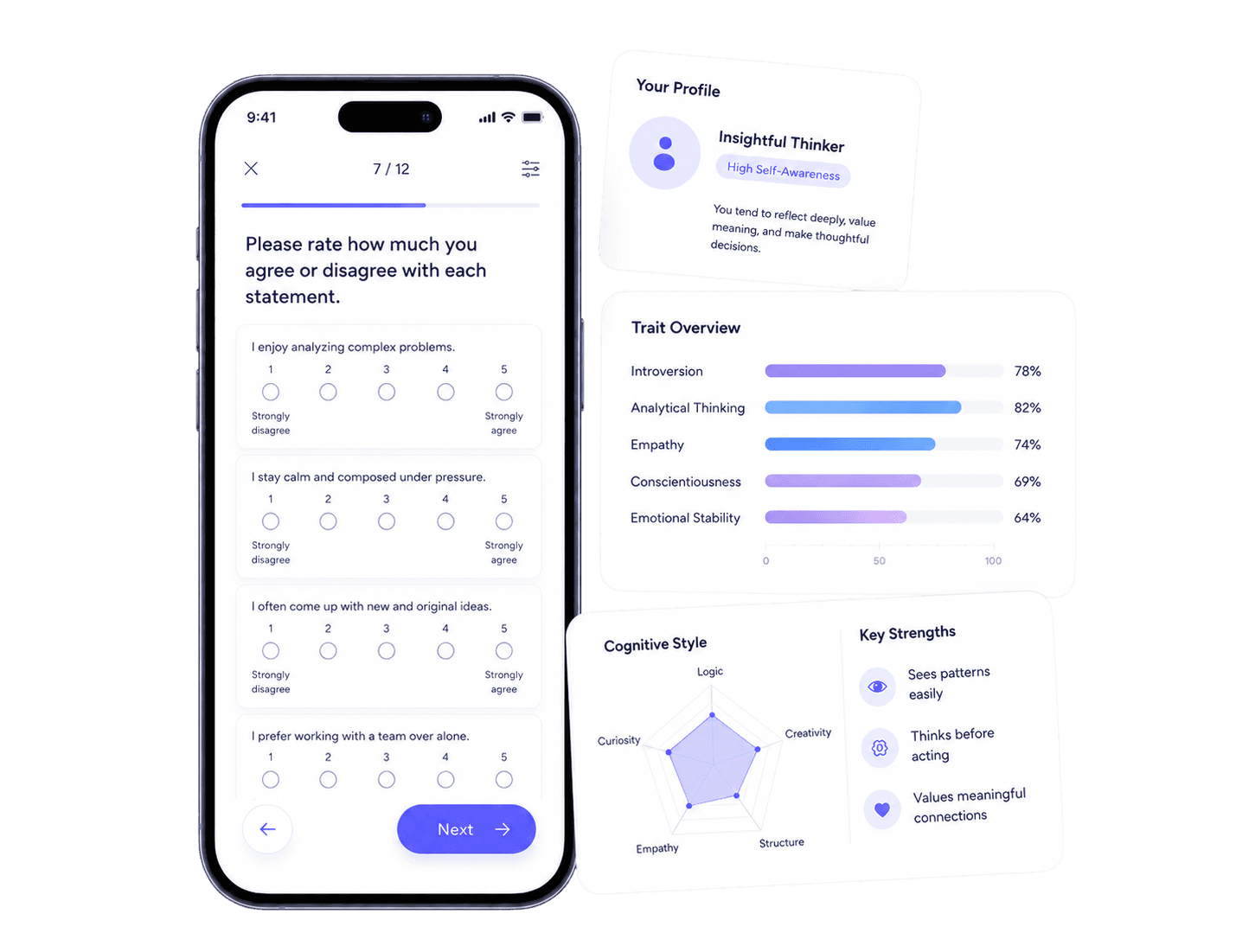
This OCD self-reflection test looks at the connection between recurring thoughts, uncertainty, checking or repetition, and the momentary relief that can make the same response feel necessary again.
Reflect on repeated thoughts, doubts, images or questions and whether their presence starts to feel unusually significant or urgent.
Consider checking, reassurance, mental review, routines or repetition as responses to uncertainty rather than as isolated habits.
Notice whether the response helps you move on or whether the same doubt returns and asks for another round of certainty.
Use the report to interpret themes in your own answers without turning an online range into a clinical conclusion.
Think about what usually happens when a thought sticks, uncertainty feels difficult, or something does not feel completely finished.
Look at what started the discomfort and what you did next to reduce it, including visible actions and mental review.
Use the report to compare those experiences across your life rather than treating one question or one habit as proof of OCD.
No. Thinkhint provides educational self-reflection only. Diagnosis requires assessment by a qualified mental-health professional.
It looks at self-reported themes including intrusive or recurring thoughts, rumination, checking, repetitive actions, routines, certainty-seeking and the difficulty of moving on when something feels unresolved.
No. You receive one overall result range. The report uses several themes to explain that result, but it does not provide separate clinical sub-scores.
A response that quickly reduces discomfort can become more convincing the next time doubt appears. That relationship can help explain why a cycle repeats.
If intrusive thoughts, checking, mental rituals or repeated routines are causing significant distress or interference, consider speaking with a qualified professional.
The more useful question is what the thought or doubt means to you and what you feel compelled to do about it. A person may know logically that a task is complete while still feeling unable to leave without checking again.
That gap between knowing and feeling certain is why context matters. The response may bring genuine relief, but if the relief depends on repeating the response, the same uncertainty can become harder to tolerate next time.
Thinkhint is designed to help you interpret that sequence in your own answers. It cannot determine whether you have OCD, but it can give you clearer language for the pattern you are trying to understand.