What pulls you toward novelty or familiarity?
Openness helps describe how strongly you seek new ideas, experiences, perspectives, and imaginative possibilities.

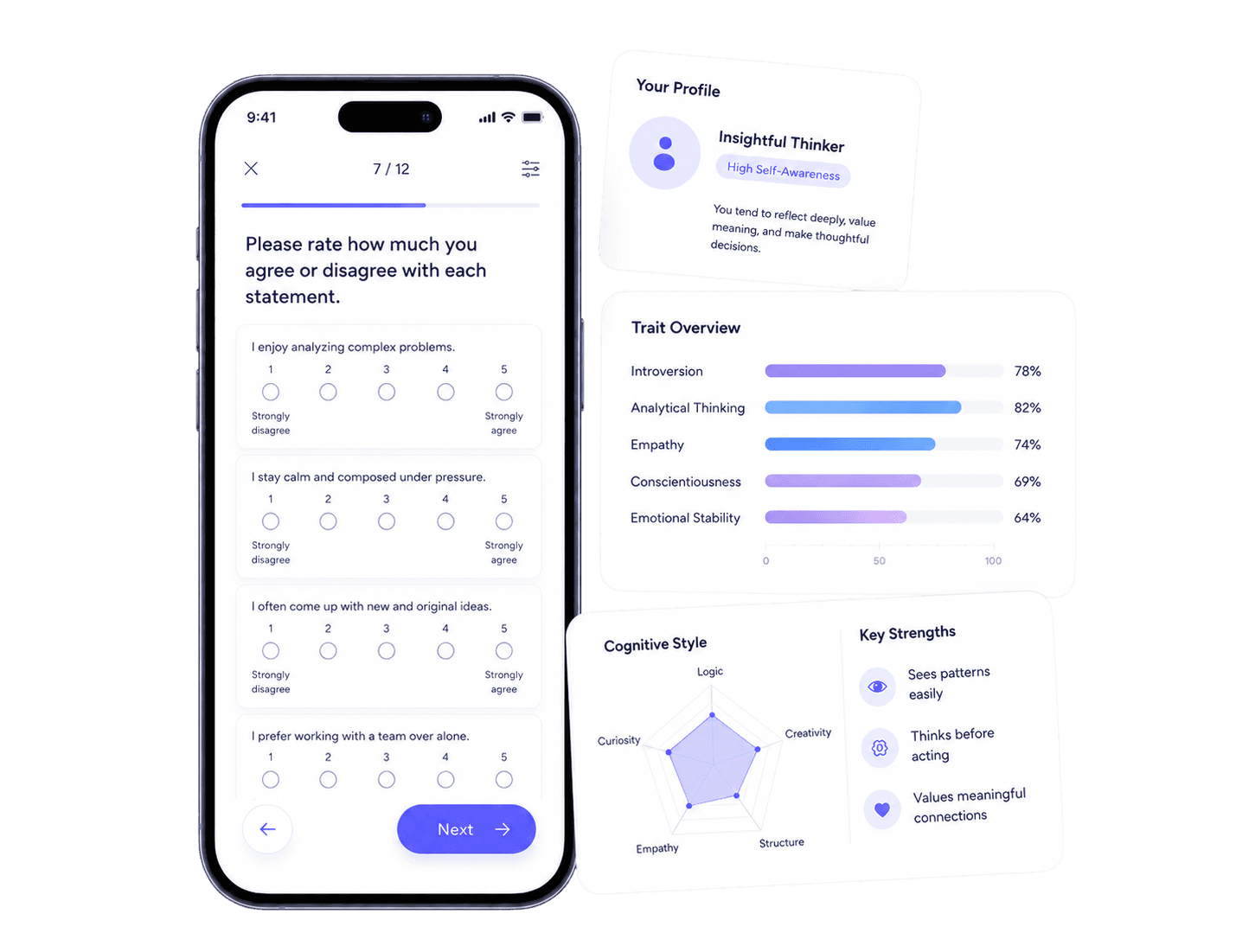
The Big Five gives you five different ways to examine personality: curiosity, structure, social energy, cooperation, and emotional reactivity. ThinkHint helps you compare them, then test the strongest pattern against real life.
Openness helps describe how strongly you seek new ideas, experiences, perspectives, and imaginative possibilities.
Conscientiousness is reflected in planning, detail, follow-through, responsibility, and the way you organise effort over time.
Extraversion and agreeableness capture different parts of social life: stimulation and assertiveness on one side, cooperation and consideration on the other.
Neuroticism describes differences in emotional sensitivity and reactivity, including how strongly uncertainty, criticism, and stress tend to register.
Use examples from ordinary life and choose what happens most often rather than answering from one unusually good, difficult, social, or stressful week.
Your responses are scored across all five Big Five dimensions. ThinkHint then organises the result around the trait that is strongest in your answers.
Compare the dominant trait with real examples from work, relationships, stress, routines, and decisions. Keep both the matches and the exceptions visible.
ThinkHint does not return a normed percentile table for all five traits. It identifies the trait that stands out most strongly in your answers and gives you a detailed narrative report built around that pattern.
The report covers characteristics, motivations, relationships, work, stress, growth, and interactions with other personality tendencies. Its value is in giving the dominant trait enough context to be useful without pretending that one dimension explains your whole personality.
Openness, conscientiousness, extraversion, agreeableness, and neuroticism. The initials form OCEAN, another common name for the same five-dimension model.
No. ThinkHint scores the five dimensions but presents a dominant-trait result and detailed report rather than a normed percentile profile for every trait.
No. ThinkHint uses its own questionnaire. It should not be presented as one of those named professional or research inventories.
No. It is the strongest pattern in your answers, not your entire identity. Context, other traits, values, experience, and circumstances all affect how you behave.
No. Each dimension involves trade-offs. A tendency can be useful in one situation and less useful in another, which is why the result should be read in context rather than as a scorecard.
A dominant trait is useful because it gives you somewhere specific to start. If openness leads your answers, you can ask how curiosity, novelty, and possibility shape your choices. If conscientiousness leads, the useful questions are different: how much structure helps, when standards become pressure, and what happens when plans are disrupted.
The same principle applies to extraversion, agreeableness, and neuroticism. The trait name matters less than the pattern it helps you recognize in actual situations.
Read the result as a hypothesis you can test against your own examples. The best interpretation is not the one that sounds flattering. It is the one that makes several repeated choices or reactions easier to understand.