Closeness that feels safe versus closeness that feels risky
Compare the relationships where intimacy feels natural with the ones where you become worried, guarded, overwhelmed, or unsure how much of yourself to reveal.

The same person can feel calm in one relationship and highly watchful or distant in another. ThinkHint helps you compare the conditions around trust, reassurance, dependence, conflict, and space before you decide which attachment description really fits.
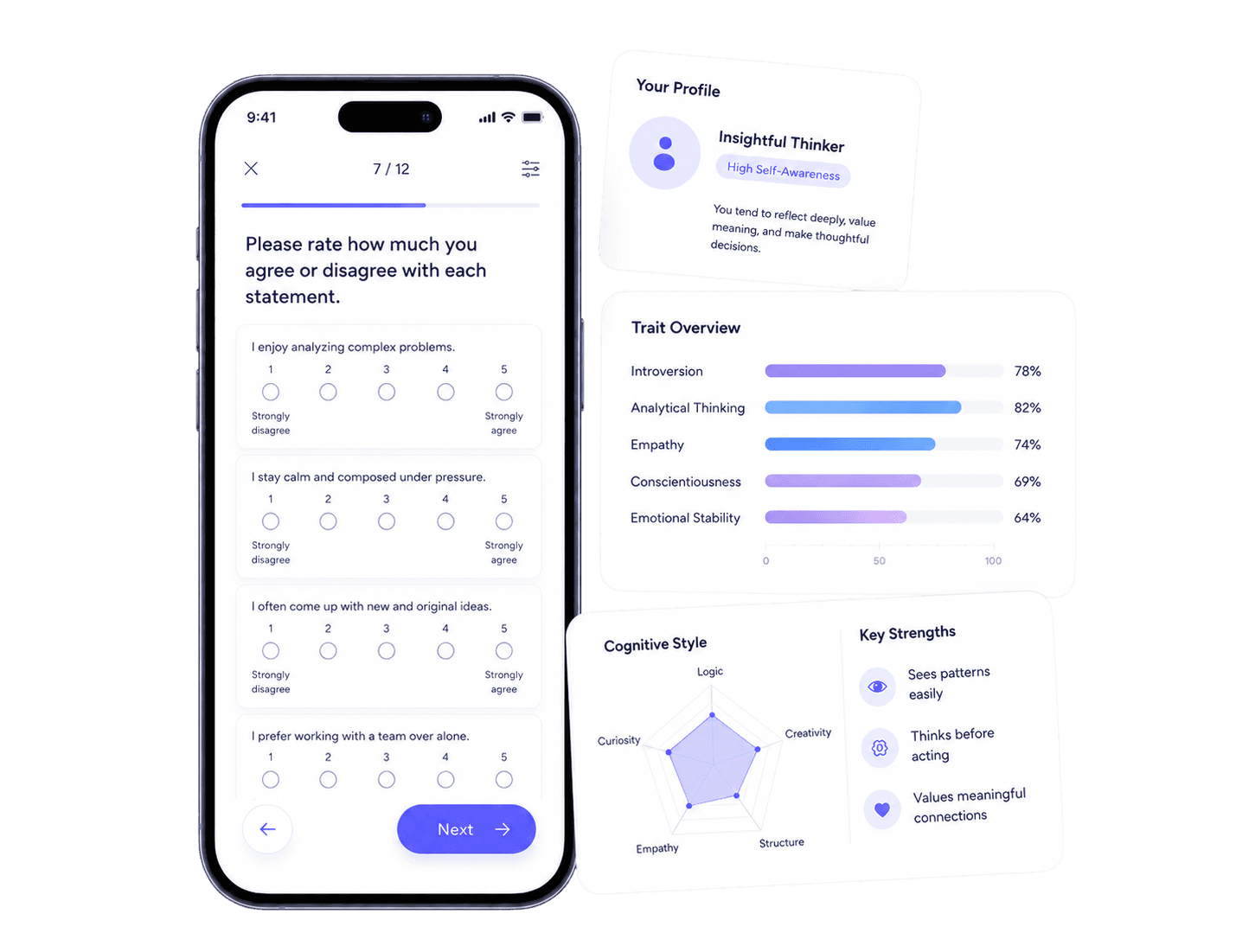
Compare the relationships where intimacy feels natural with the ones where you become worried, guarded, overwhelmed, or unsure how much of yourself to reveal.
A slower reply or request for space may feel ordinary in one context and threatening in another. Notice what makes your interpretation shift.
Look at whether depending on someone feels reassuring, exposing, uncomfortable, or necessary only after you have exhausted every other option.
Notice whether disagreement leads toward conversation and repair, urgent reassurance, withdrawal, emotional control, or a mixture that changes with the relationship.
Answer from closeness, distance, support, boundaries, conflict, and repair so that one recent event does not become the explanation for everything.
If a reaction changes with trust, consistency, stress, or the person involved, that contrast is evidence. Do not edit it out just because it complicates the label.
ThinkHint returns one leading attachment profile and a detailed report. Compare that explanation with your real examples and keep what improves the description of your relationships.
The result is useful when it explains more than one memorable event. Does the same concern show up around closeness, reassurance, support, boundaries, or conflict? Does it disappear when trust is stronger or the relationship is more consistent?
ThinkHint's report gives the leading profile context across emotional patterns, communication, close relationships, responsibility, decision-making, strengths, and growth. Use those sections to test the explanation rather than trying to force every example into it.
The assessment compares your answers across five attachment profiles and returns the strongest profile as your main result, followed by a detailed narrative report.
Adult attachment research often describes patterns along attachment anxiety and attachment avoidance. Those dimensions help explain why some people become highly concerned about rejection while others protect themselves through distance or self-reliance.
Keep that difference visible. Trust, stress, consistency, history, and the other person's behaviour can affect how strongly an attachment-related response appears.
No. A current self-report can describe tendencies in your answers, but it cannot reconstruct your childhood history or establish why those tendencies developed.
Yes. Attachment is not destiny. Experience, safer relationships, self-awareness, and therapy can all influence how people respond to closeness, dependence, and uncertainty.
No. ThinkHint is an educational self-report test and does not provide a mental health diagnosis or clinical attachment evaluation.
A person may look secure while a relationship feels consistent and become highly anxious when contact becomes unpredictable. Another person may enjoy closeness until they feel pressured to depend on someone. The contrast is not noise; it tells you what activates the pattern.
Research on adult attachment repeatedly finds that anxiety and avoidance become especially informative under stress. Anxious concerns are often activated by threats to connection, while avoidant concerns can become more visible when autonomy or emotional dependence feels pressured.
That is why ThinkHint emphasizes comparison. A useful result should help you ask what changes the reaction, what stays consistent, and which explanation still makes sense after you include both the difficult and the easier examples.