
Thinkhint

Try the psychopath test if you want a more specific question than a dramatic label

You do not have to believe one online score can define you. The useful test is whether the questions help you examine recurring behaviour around emotional distance, empathy, influence, risk and accountability more precisely than you were before.

Explore at your pace
Specific behaviour
Private by design
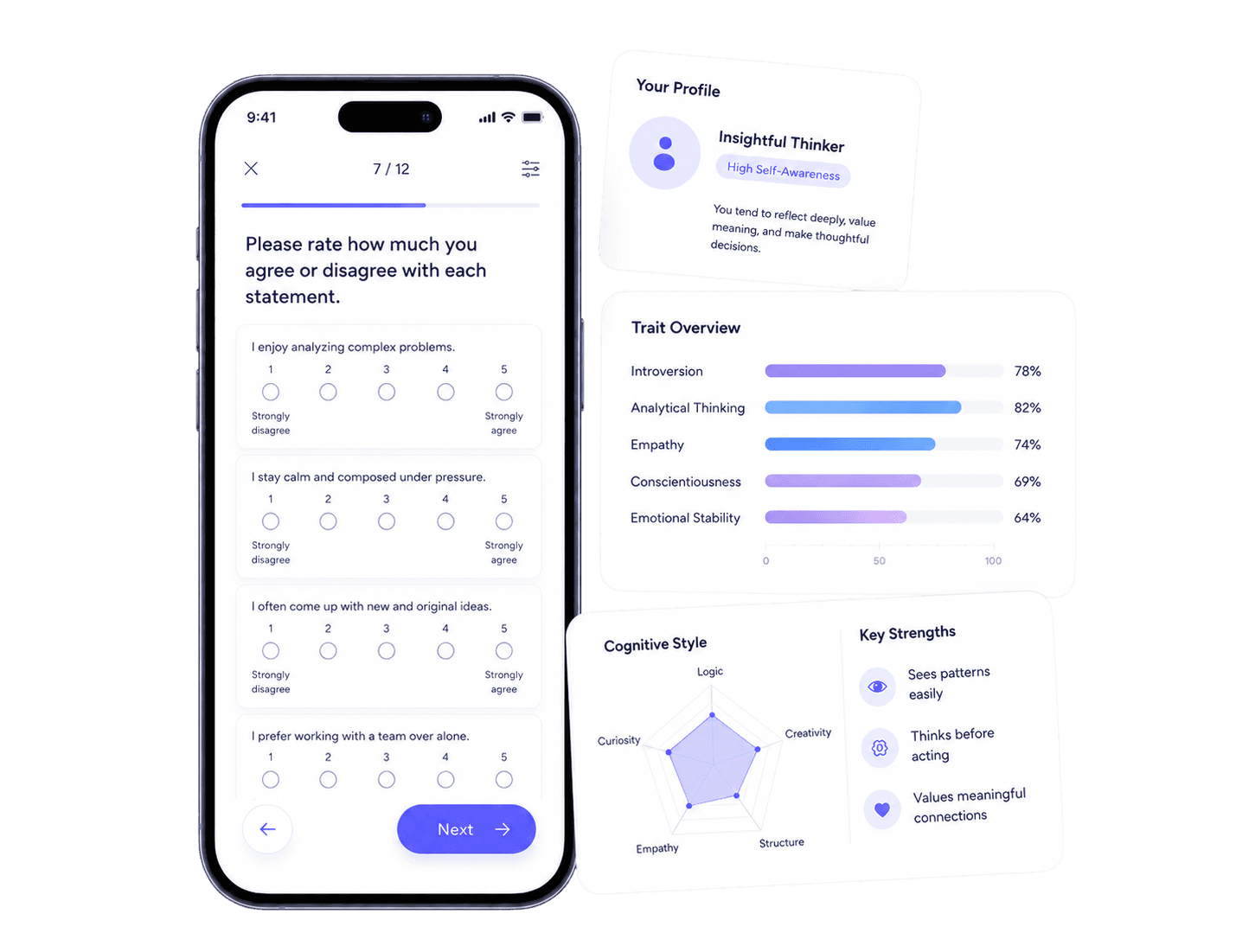
Thinkhint personality test and report preview

What makes the exercise worth trying

It breaks the stereotype into separate questions

Instead of asking whether you feel cold or fearless in general, the assessment asks about emotional response, empathy, responsibility, influence, composure, risk and consequences across different situations.

It lets apparent contradictions stay visible

You can be highly composed and still empathic, socially strategic and still fair, independent and still accountable. A useful result should leave room for combinations rather than force every answer into one caricature.

It gives the result somewhere to go

The report connects the overall range to relationships, responsibility, decision-making, social strategy and the balance between practical outcomes and emotional impact.

It has clear limits

Thinkhint does not diagnose psychopathy, reproduce the PCL-R or predict dangerousness. If those are the answers you need, an online self-report test is the wrong tool.

A simple way to decide whether the result is useful

1

Answer without trying to prove a label

Choose what is normally true and let conflicting qualities coexist. You do not need your answers to form a dramatic story before the test has even started.

2

Read the report as a hypothesis

Ask whether the interpretation explains repeated examples better than your previous explanation did. Keep the parts that fit and question the parts that do not.

3

Judge it by specificity, not intensity

A useful result should give you clearer language for behaviour and consequences. A more extreme-sounding label is not automatically a more informative one.

Before you try the psychopath test

What result will I get?

You receive one overall psychopathy-traits range with a report discussing themes such as emotional response, accountability, empathy, relationships, social strategy, independence and decision-making.

Will I get separate scores for manipulation, empathy or impulsivity?

No. Those themes appear in the questions and interpretation, but Thinkhint does not return separate numeric sub-scores for them.

Is this worth trying if I am skeptical of personality tests?

It can still be useful if you treat the result as a prompt to compare with real examples rather than as unquestionable truth. The value is in the specificity of the reflection, not in accepting a label on faith.

Can the test tell me whether I am dangerous or likely to break the law?

No. Thinkhint does not predict violence, crime or dangerousness, and an online self-report trait result should not be used for those conclusions.

Is this equivalent to a professional psychopathy assessment?

No. Professional tools such as the PCL-R involve different evidence, administration and interpretation. Thinkhint is an educational self-report assessment.

The useful standard is not whether the result sounds dramatic

A skeptical reader has good reason to ask what an online psychopathy test can really do. It cannot establish a diagnosis, reconstruct a clinician-administered instrument from a questionnaire, or tell you whether someone is dangerous. Those are important limits, not fine print.

What it can do is narrower. A well-answered self-report can put several tendencies next to one another and ask whether the combination resembles your repeated experience: emotional distance, reduced remorse, strategic social behaviour, risk tolerance, impulsivity, self-interest and how much consequences slow you down.

That is enough to make the exercise useful for some people. If the result gives you a more precise way to describe a recurring choice or relationship pattern, it has done something meaningful without needing to become a final statement about who you are.