It breaks a broad concern into specific experiences
Instead of starting with 'Do I have OCD?', look at intrusive thoughts, uncertainty, checking, repetition, routines and mental review one situation at a time.

You do not need to decide that OCD explains your experience before you begin. Use the assessment to see whether recurring thoughts, uncertainty and repetitive responses form a pattern worth understanding more carefully.
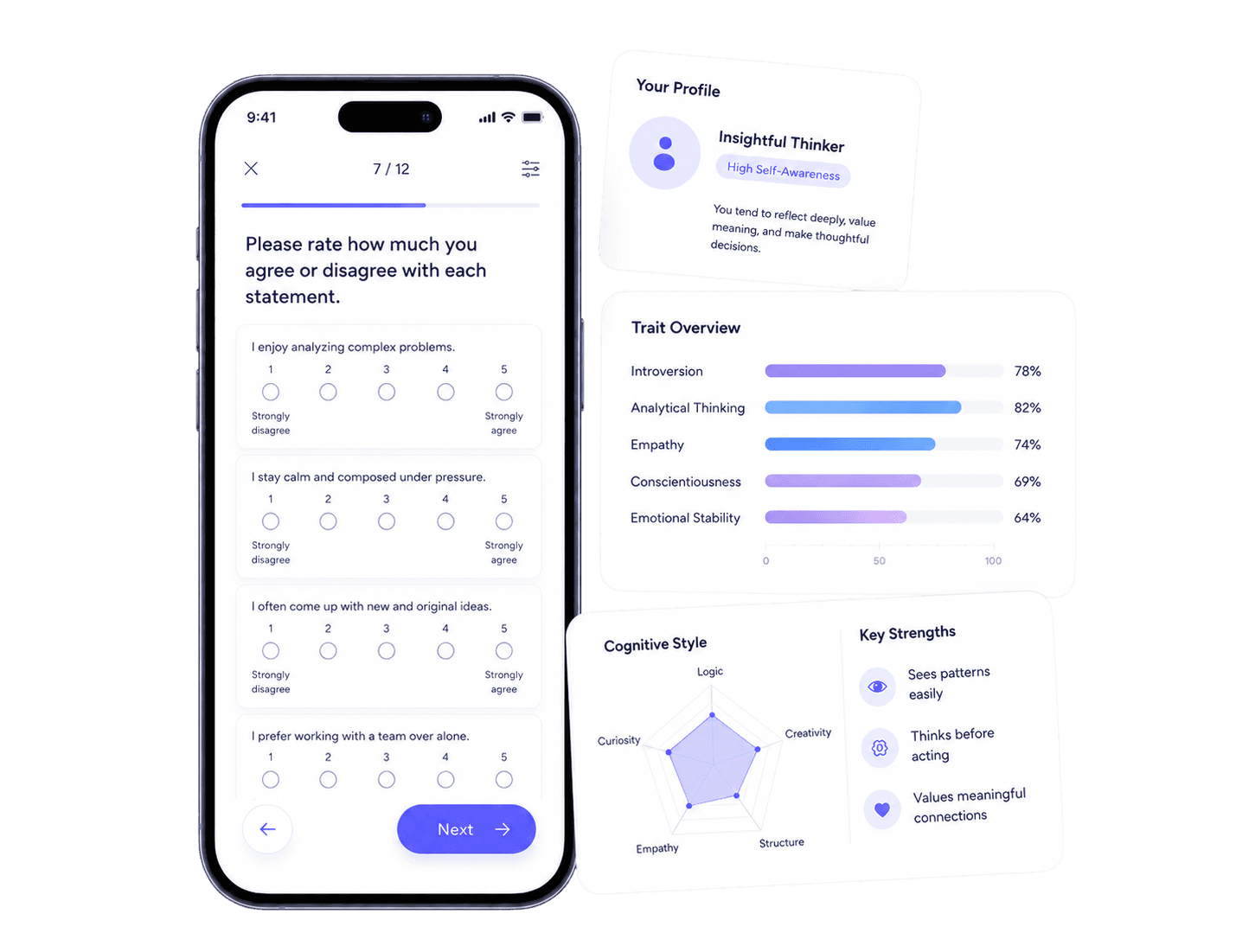
Instead of starting with 'Do I have OCD?', look at intrusive thoughts, uncertainty, checking, repetition, routines and mental review one situation at a time.
The questions can draw attention to what you do when you want certainty or relief, including responses that may be easy to overlook.
The result can organise your answers into a broader pattern, but it does not provide a validated clinical score or separate diagnostic subscales.
Use the report as a prompt. Keep the observations that match your experience and question the ones that do not.
You only need examples from your own life: what tends to repeat, what feels difficult to leave unresolved, and what you do to feel settled.
The assessment looks across the full set of responses rather than making a conclusion from one thought or habit.
It may give you language for personal reflection, a pattern to observe further, or a clearer way to describe concerns to a professional if you choose.
No. You can use the assessment simply to explore recurring thoughts, checking, routines, uncertainty and repetition in your own experience.
No. Thinkhint does not diagnose OCD and the result is not a clinical screening threshold.
That is possible. Treat the report as a structured reflection rather than a rule. Compare each idea with concrete examples from your own life.
You receive one overall result range with explanatory context. Thinkhint does not provide separate clinical scores for obsessions, compulsions or OCD subtypes.
If intrusive thoughts or repetitive responses are causing significant distress, taking substantial time or interfering with daily functioning, professional assessment is more appropriate than relying on an online result.
People often arrive at an OCD test because one experience has become difficult to explain: a thought that will not settle, repeated checking, a need for reassurance, or a routine that feels increasingly non-optional.
Trying a self-check can be useful when it turns that vague concern into more specific observations. It becomes less useful when the score is treated as proof of a diagnosis or when every familiar habit is interpreted through one label.
The right expectation is narrower: use the result to ask better questions about your own pattern, then decide whether reflection alone is enough or whether professional support would be more useful.