It replaces a binary label with several behaviours
Recognition seeking, entitlement, comparison, criticism sensitivity, self-focus and empathy can move differently rather than appearing as one all-or-nothing package.

See whether the assessment helps you describe how recognition, criticism, comparison, entitlement and other people's needs affect your reactions. You do not have to accept a loaded label before you start.
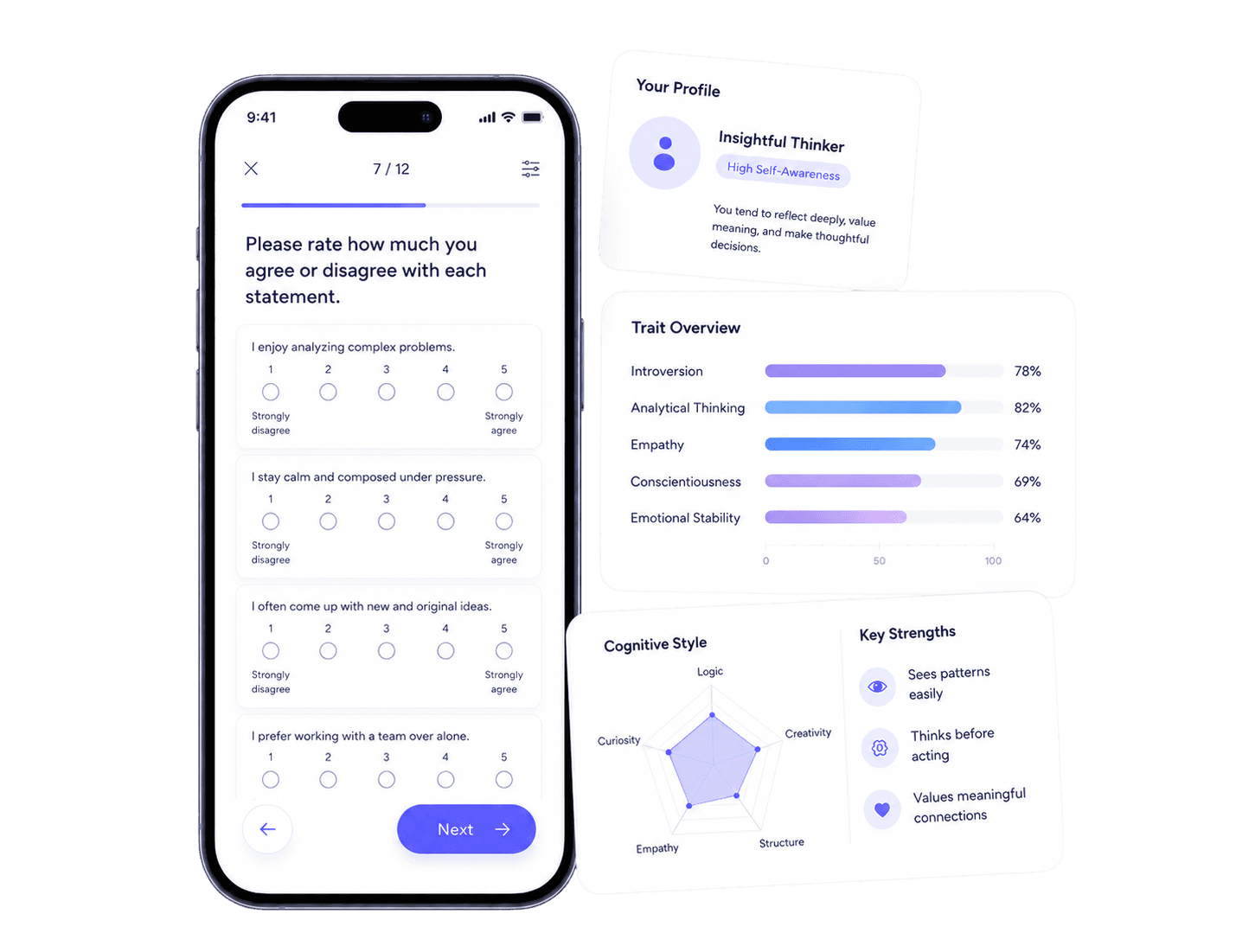
Recognition seeking, entitlement, comparison, criticism sensitivity, self-focus and empathy can move differently rather than appearing as one all-or-nothing package.
Enjoying success or praise is not treated as proof of a disorder. The useful question is what your self-image requires from other people and how that affects your behaviour.
The assessment asks you to examine your own patterns instead of using a quiz to diagnose a partner, parent, colleague or friend.
Compare the report with actual conversations, feedback, competition and relationship moments to decide which observations genuinely fit.
Maybe criticism feels too personal, validation matters more than you want it to, or someone has raised concerns about self-focus. Use that as a starting point rather than a conclusion.
The questions bring several related tendencies together so the first concern is not forced to explain everything about your behaviour.
Use real interactions to decide whether an observation is recurring, context-specific or not especially useful to your situation.
You may get clearer language for self-reported tendencies involving recognition, entitlement, criticism, comparison, self-focus, empathy, achievement and control, then compare those observations with your own experience.
You do not need to accept the label. The assessment can still be used to examine specific reactions such as praise dependence, defensiveness, comparison or difficulty making room for another person's perspective.
No. An online self-reflection test cannot confirm or rule out a clinical diagnosis. Professional assessment is required for that question.
Treat the report as a set of observations to check, not an unquestionable description. Context and self-report limitations mean some parts may fit better than others.
No. The assessment is intended for your own answers and does not provide a valid way to diagnose or classify another person.
A strong reason to distrust personality quizzes is that labels can feel more certain than the evidence behind them. Narcissism is especially vulnerable to that problem because the word is used casually in arguments, relationship advice and social media as if it explains any selfish or difficult behaviour.
A better use of the test is narrower. Does criticism reliably make you protect your image before you consider the feedback? Does being overlooked create an unusually strong need to prove your value? Does your own disappointment consistently take up so much space that another person's experience becomes harder to hear?
Those questions can be useful whether or not you adopt the word narcissistic. Try the assessment for that level of specificity, then judge the result by how well it explains repeated behaviour you can actually observe.