It separates understanding from feeling
You may be good at seeing another viewpoint without absorbing the emotion, or highly sensitive to emotion without always interpreting it accurately.

See whether the assessment gives you useful language for the way you read people, feel with them, help them and protect your own emotional space. You do not need to believe in a fixed empathy type before you start.
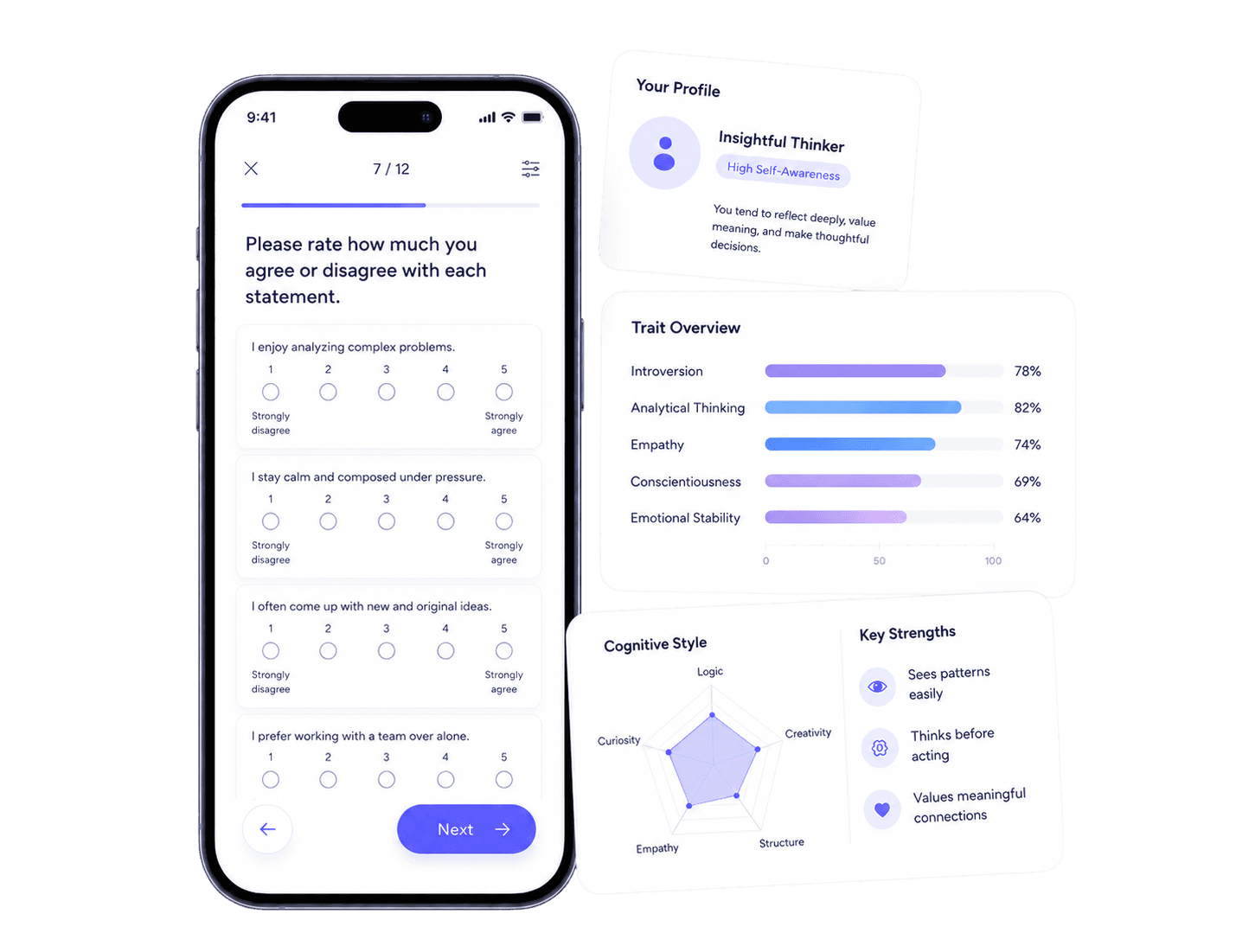
You may be good at seeing another viewpoint without absorbing the emotion, or highly sensitive to emotion without always interpreting it accurately.
Compassion and helping matter too. Notice whether you listen, act, reassure, rescue, avoid or wait until you have more information.
Empathy is not automatically healthier when it is stronger. Carrying too much of other people's emotional load can make care harder to sustain.
Compare the report with recent interactions instead of accepting a label simply because it sounds flattering or uncomfortable.
Think about where empathy feels easy, where it feels effortful and which situations make your response change most noticeably.
You may discover that the part of empathy you notice most in yourself is not the only tendency shaping your interactions.
Use actual conversations and relationships to decide which observations are genuinely useful rather than treating the report as an unquestionable identity statement.
You can reflect on patterns in emotional sensitivity, perspective-taking, social awareness, compassion, helping and boundaries, then compare the result with your own experience.
No. The test is about empathy-related tendencies, not about deciding whether you belong to a special identity category.
That variation is useful information. Stress, trust, familiarity, conflict and role can all change how available your empathy feels.
No. Understanding, care and healthy boundaries matter together. Very strong emotional sensitivity can become draining when it is not balanced with recovery and limits.
No. It is a self-report reflection on current tendencies and should be read alongside context, experience and feedback from people who know you.
You do not have to accept every statement in a self-reflection report. In fact, it is better if you do not. The useful parts are the ones you can connect to actual behavior: the conversation where you assumed too quickly, the friend whose mood stayed with you all evening, or the moment you understood someone clearly without agreeing with them.
Trying the test can help because it forces several sides of empathy into the same frame. Feeling, understanding, helping and boundaries are easy to blur together when you judge yourself from memory.
Treat the result as a set of claims to check. If one changes the way you notice a familiar interaction, it has already done more than a simple “high empathy” or “low empathy” label would.