Find the pattern before the job title
See whether your answers point most toward building, analysing, communicating, creating, or leading before you try to choose a profession from a long list.

You do not need to know whether you want a new job, a new field, or simply a different kind of workday. Start by seeing which career pattern is strongest in your answers and what that gives you to investigate.
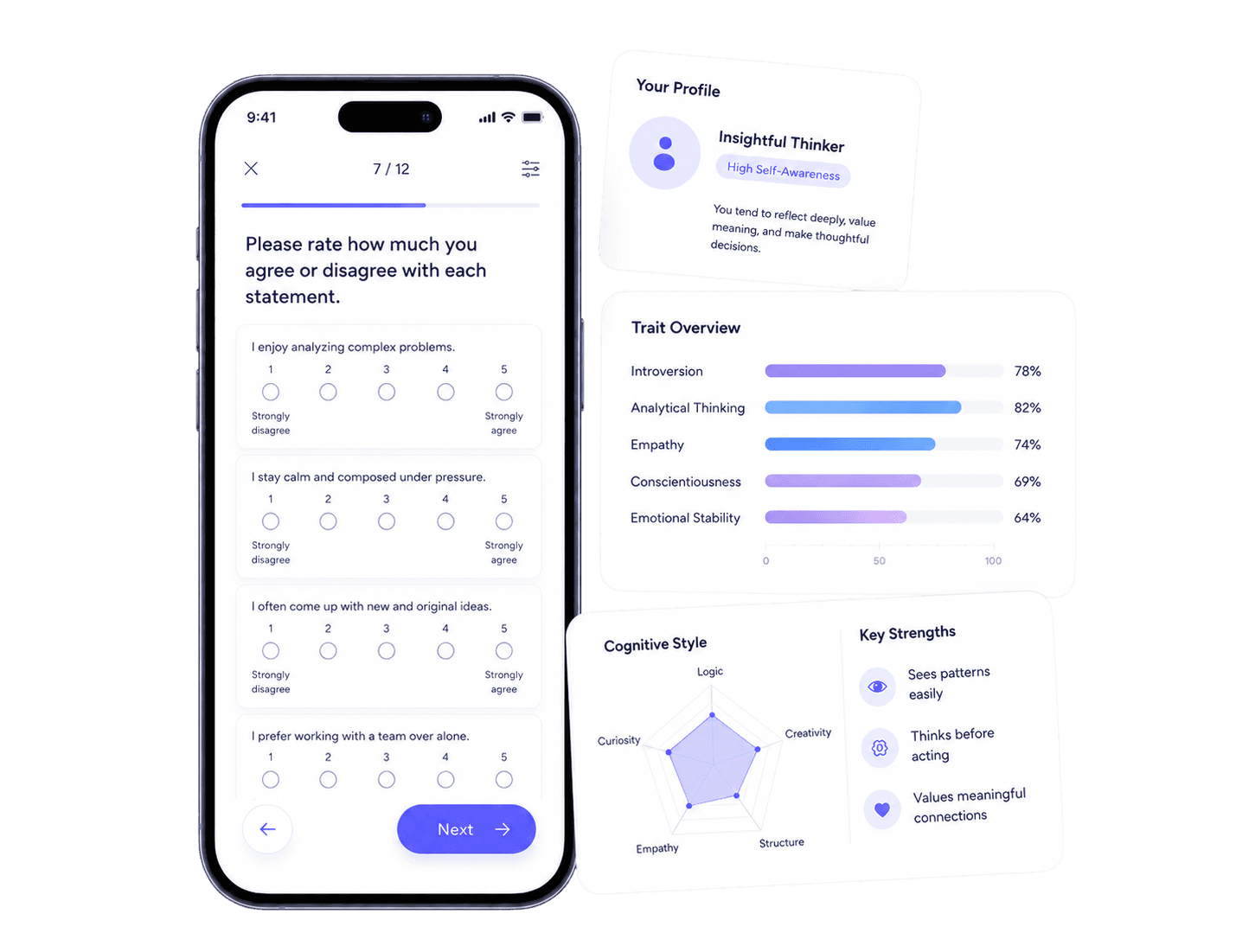
See whether your answers point most toward building, analysing, communicating, creating, or leading before you try to choose a profession from a long list.
The report gives you language for the work you may find naturally satisfying, useful, or motivating enough to sustain.
Use the role and environment examples connected to your type as hypotheses. Research them, compare them, and discard the ones that do not fit your reality.
The next useful move may be a conversation, project, course, shadowing opportunity, or targeted job search rather than an immediate career change.
Answer the questions without trying to force your responses toward a specific profession or outcome. Focus on what is consistently true about how you like to contribute.
Your responses are compared across Builder, Analyst, Communicator, Creator, and Leader patterns, and the strongest one becomes the basis of the report.
Pick one role direction, work environment, or strength from the report and gather real-world evidence before making the question bigger than it needs to be.
Yes. The result starts with your work pattern rather than asking you to choose a profession first. That can give you a smaller set of role characteristics and directions to research.
No. You receive a dominant career type and a report with strengths, work preferences, example role directions, and growth themes. The examples are starting points for exploration, not a single prescribed career.
Yes. Use examples from classes, projects, clubs, volunteering, hobbies, and responsibilities to think about how you solve problems and contribute when formal work experience is limited.
That is useful information. Focus on the underlying work pattern rather than the example title, then look for other roles that use the same kind of contribution in a field you care about more.
This page is for exploration before a decision. The assessment itself is the same, but the goal here is to generate better questions and small experiments rather than to validate a move you have already decided to make.
“What should I do with my life?” asks one test, one conversation, or one evening of research to solve far too much. A smaller question is often more productive: what kind of problems do I want more of, what kind of contribution feels natural, and which environments make that contribution easier to use?
A career type can help you answer those smaller questions. It does not need to become an identity. Its job is to give you a lens for generating hypotheses about work, then let real experience confirm or challenge them.
That is why trying a career test can be useful even when you are nowhere near a final decision. The next step can simply be learning something that makes the following decision less blind.