Whether there is a repeatable pattern
You may discover that several changes often travel together—or that what felt like one pattern is actually a set of unrelated situations.

You do not need to be convinced that something is wrong. A self-report can be useful simply because it turns a vague question about mood or energy into specific observations you can compare with your own life.
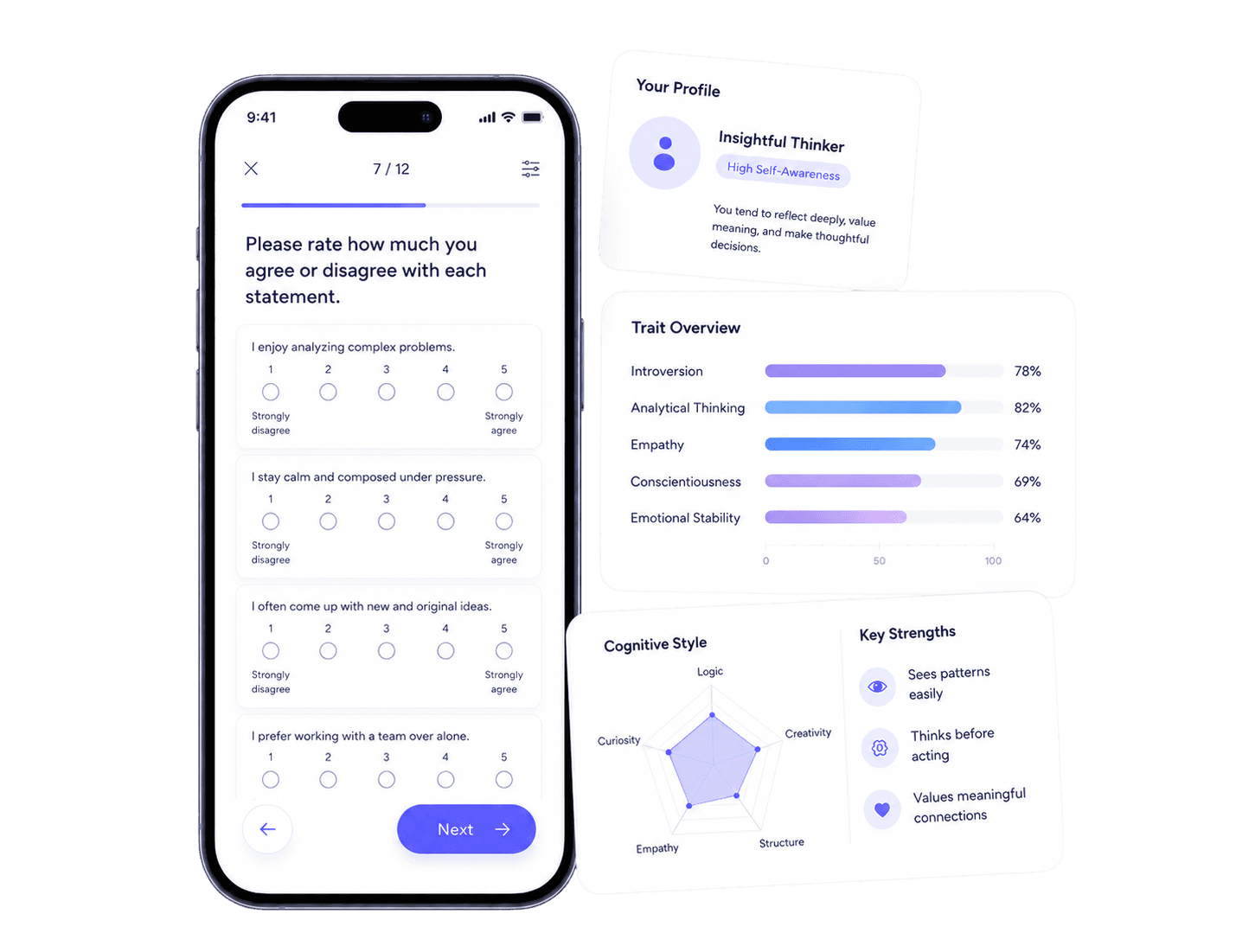
You may discover that several changes often travel together—or that what felt like one pattern is actually a set of unrelated situations.
Compare mood with sleep, energy, activity, confidence, withdrawal, motivation, and decisions instead of focusing on one emotional label.
Consider what changes in work, relationships, routines, commitments, spending, or recovery when your internal state shifts.
Leave with a more specific set of examples you can keep private, track over time, or discuss further if the changes are significant.
Answer for your actual experience rather than trying to prove or disprove bipolar disorder. Mixed or uncertain answers are still useful information.
ThinkHint combines all 100 answers into one Minimal-to-Strong Traits result plus a narrative report. It does not produce a clinical screening probability or diagnosis.
The useful outcome may simply be a clearer timeline, a better question, or a set of examples worth monitoring or bringing into a professional conversation.
It is for adults who want to reflect on recurring changes in mood, energy, sleep, activity, motivation, decisions, and daily functioning. You do not need a diagnosis or a strong suspicion before using it.
That is fine. The test can still help you compare your own experiences more systematically, as long as you do not treat the result as medical confirmation.
The most useful parts are usually specific recurring examples: what changes, what changes with it, how long the shift seems to persist, and what impact it has on ordinary life.
No. ThinkHint is not the MDQ, CIDI, or a diagnostic assessment. Bipolar disorder requires professional evaluation of the broader history and course of symptoms.
Do not rely on an online result in that situation. Seek qualified health support when mood or energy changes are severe, escalating, involve risky behaviour, or affect your safety or ability to function.
People often search for a bipolar test because they want an explanation quickly. The difficulty is that many experiences associated with bipolar disorder—changes in sleep, energy, concentration, mood, motivation, or activity—can also occur for other reasons. A responsible self-report should make the pattern clearer without pretending to settle the cause.
That makes uncertainty productive rather than frustrating. You might discover that a change was tightly linked to stress or sleep disruption. You might notice that several features repeatedly arrive together. Or you might realize the pattern is more disruptive than you had been acknowledging.
Any of those outcomes can be useful. The goal of trying the test is not to earn a label. It is to leave with more accurate observations than you had before you started.