You keep noticing the same preference
Maybe you repeatedly seek novelty, structure, company, harmony, or certainty. A Big Five lens can help you see whether that tendency connects with other choices you make.

A personality test is worth your time only if it sharpens a question you already have. Maybe you want to understand why some environments energise you, why structure helps or irritates you, or why certain social and emotional situations keep producing the same response.
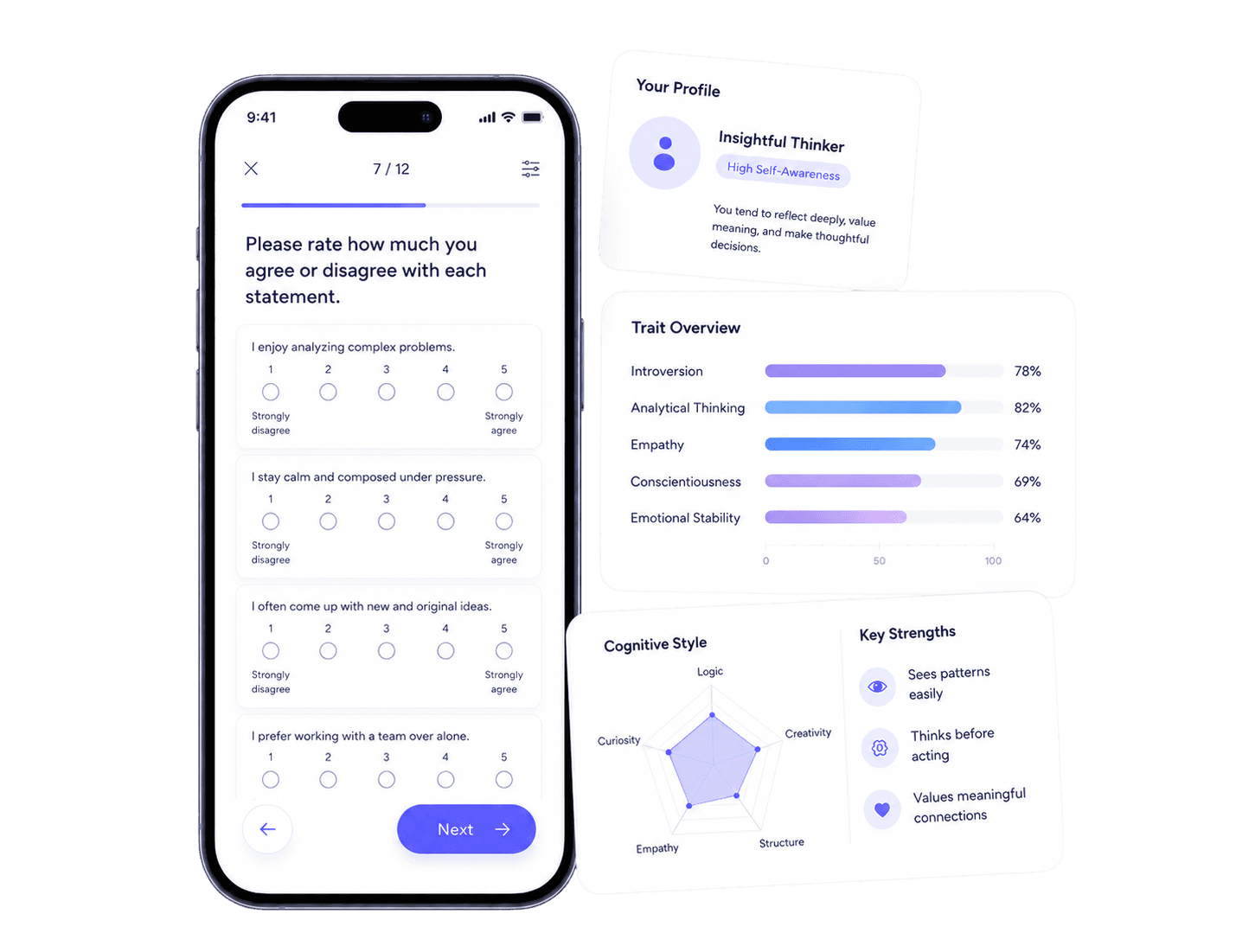
Maybe you repeatedly seek novelty, structure, company, harmony, or certainty. A Big Five lens can help you see whether that tendency connects with other choices you make.
The report can add context around work style and motivation without pretending personality alone can choose the right job, role, or environment for you.
Differences in social energy, cooperation, directness, flexibility, and emotional reactivity can shape relationships even when nobody is doing anything wrong.
ThinkHint identifies the strongest trait pattern in your answers. That is useful if you want a focused interpretation, but it is not a complete psychometric profile of everything about you.
Is the question mainly about novelty, organisation, social energy, cooperation, emotional sensitivity, or a combination that keeps showing up?
The five dimensions are scored, but your user-facing result is centred on the trait that stands out most strongly and a detailed narrative report around that pattern.
If you want a focused way to examine one leading personality tendency across real life, the test can help. If you need normed professional testing, this product is not designed for that job.
You may already suspect that you are highly open, conscientious, extraverted, agreeable, or emotionally reactive. The test can still be useful if the report helps you see the trade-offs and situations around that tendency more clearly.
Recognition is only the first step. The more useful question is what the trait changes: the work you enjoy, the pressure you tolerate, the conversations you avoid, the amount of stimulation you want, or the routines that keep you steady.
No. The test is built around five broad personality dimensions, and the report explains the dominant trait in plain language. You do not need to study the model before starting.
It can be. The Big Five uses a dimensional framework rather than a four-letter or Enneagram-style type system, so it may give you a different way to think about recurring tendencies.
No. ThinkHint’s product is centred on the strongest Big Five trait in your answers and a detailed report around it, not a normed percentile profile for all five dimensions.
No. It can add context about tendencies and preferences, but those decisions also depend on values, skills, goals, opportunities, compatibility, and circumstances.
No. ThinkHint uses its own educational questionnaire and does not administer IPIP-NEO, BFI-2, NEO-PI-R, or another named professional inventory.
The attraction of personality tests is certainty. A clear label can feel satisfying because it seems to explain a lot at once. The Big Five is more useful when you resist that temptation and treat the result as a pattern to investigate.
Your dominant trait may explain something real without explaining everything. You may strongly recognise it at work and less in relationships, or the reverse. Those differences are useful evidence about context rather than a reason to force consistency.
Try the test if you want a sharper way to examine those patterns. The result should leave you with more precise questions about your own life, not a rulebook for who you are allowed to be.