
Thinkhint

Not sure whether to try an autism test? Start with what you want it to clarify.

You may recognize a few experiences without knowing whether autism is the right frame. A self-report can help you compare the pattern more systematically before you decide what, if anything, you want to do with that question.

Explore the question
Private reflection
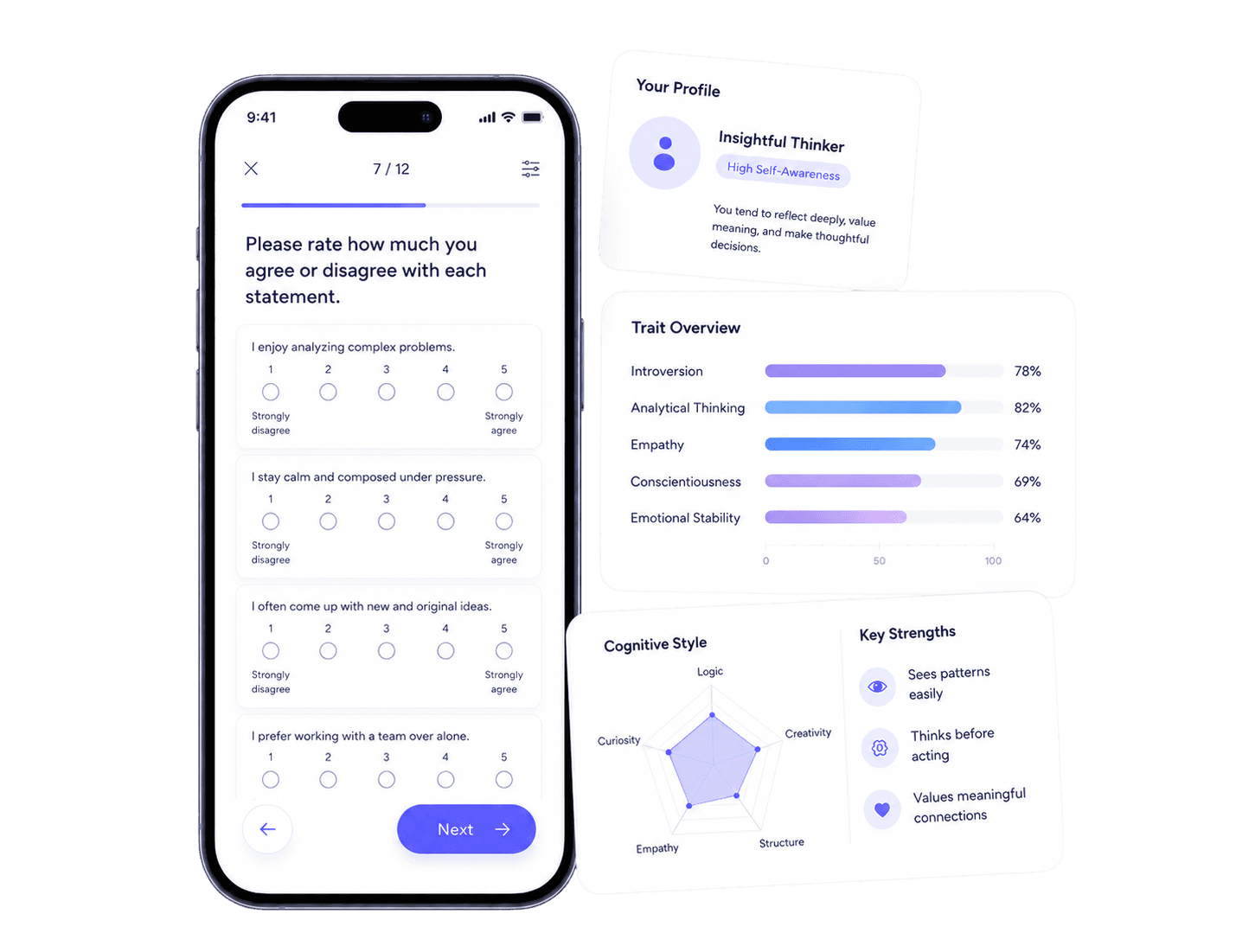
Thinkhint personality test and report preview

A test is worth trying when it can sharpen the question

Several experiences seem connected

Maybe social situations take unusual effort, sensory environments are harder to filter, routines matter strongly, or changes of plan affect you more than you expect. A fuller questionnaire lets you compare whether those experiences actually cluster together.

You are unsure whether the autism framing fits

That uncertainty is useful. Some statements may fit strongly, others weakly, and some not at all. You do not need every answer to support the same story.

You want better language before deciding what comes next

A result can turn a vague impression into more specific observations about communication, sensory load, predictability, social recovery, or focused interests.

You know the test cannot identify the cause

Anxiety, ADHD-related difficulties, stress, sleep, trauma, health, and environment can overlap with some autism-related experiences. A useful self-report organizes observations; it does not prove why they happen.

Decide whether the test answers the question you actually have

1

Name what made you curious

Was it social effort, sensory load, strong routines, difficulty with change, literal communication, focused interests, recovery time, or a combination that keeps repeating?

2

Know what the test can return

Thinkhint produces one overall autism-traits level and a detailed report. It does not diagnose autism or produce AQ, RAADS-R, or separate clinical domain scores.

3

Start only if that output would be useful

If comparing your experiences with a broader autism-traits pattern would sharpen the question, try the test. If you need diagnosis or clinical guidance, a professional assessment is the appropriate route.

What you can learn even if the result does not confirm your suspicion

A useful self-report does not have to end with “yes, that explains everything.” It may show that only some descriptions fit, that the pattern changes sharply by environment, or that sensory and social demands matter more than the broad label you started with.

That is still useful. You leave with observations you can compare: what repeats, what does not, what becomes easier with structure or direct communication, and what carries enough impact to justify a practical change or professional conversation.

Should you try an autism test?

Do I need to strongly suspect autism before trying the test?

No. Curiosity about a recurring pattern is enough. You do not need to believe autism is the explanation before you answer the questions.

When is an autism traits self-report useful?

It can be useful when you want a more systematic way to compare recurring experiences and leave with clearer language for what seems to fit or not fit your daily life.

When is this test not the right tool?

It is not the right tool for diagnosis, emergencies, treatment decisions, or determining the cause of new or severe symptoms. Those questions require appropriate professional care.

What if only a few autism-related descriptions fit me?

That is useful information. Do not force unfamiliar statements to fit. A self-report is more informative when disagreement and mixed evidence remain visible.

Is this the AQ or RAADS-R?

No. Thinkhint uses its own educational questionnaire. The result should not be interpreted as an AQ, AQ-10, AQ-50, RAADS-R, or other validated screening score.

Can the result explain why I struggle?

No. It can summarize autism-related traits in your responses, but other conditions, stressors, health factors, or environments can create overlapping experiences.

Trying a test should make the question more precise, not turn uncertainty into a premature label

People often reach an autism test after recognizing themselves in articles, videos, or other people's experiences. Recognition can be useful, but it can also make every new detail feel like confirmation if you stop noticing what does not fit.

A broader self-report forces the question beyond the examples that first caught your attention. Some statements will feel strongly familiar, some dependent on context, and some irrelevant. The pattern across all of them is more informative than collecting only the evidence you expected to find.

If the result leaves you with a clearer question, the test has done something useful. If the pattern is longstanding and has a meaningful effect on daily life, a qualified professional can add the developmental history, clinical assessment, and differential evaluation that an online questionnaire cannot provide.