You keep noticing the same relationship reaction
Maybe you become highly alert to distance, struggle to ask for support, pull back when intimacy increases, or feel responsible for restoring closeness immediately after tension.

You do not need to believe you are anxious, avoidant, secure, or anything else before you begin. A self-report is worth trying when you want to examine whether reactions around closeness, distance, reassurance, support, or conflict form a pattern that is broader than one relationship moment.
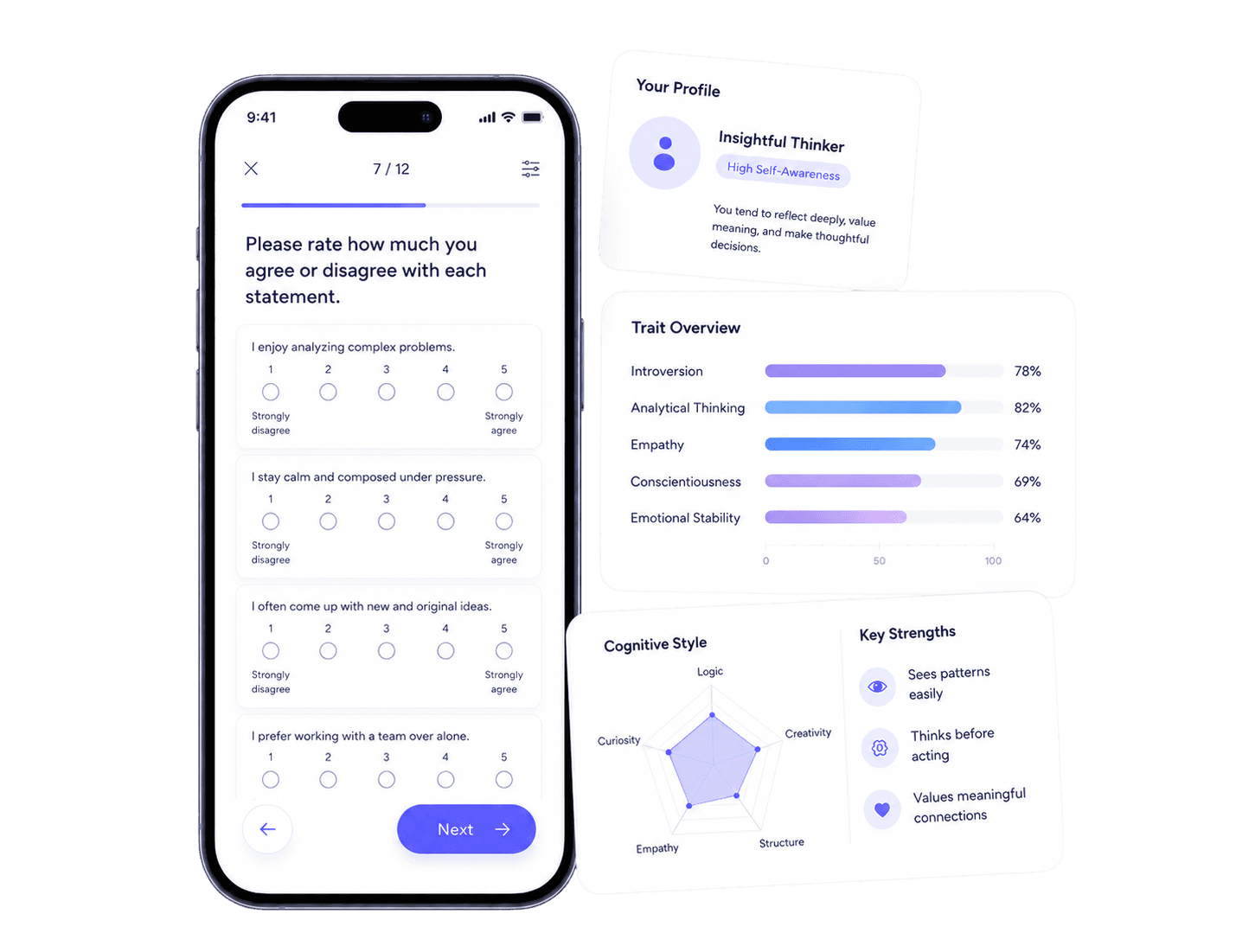
Maybe you become highly alert to distance, struggle to ask for support, pull back when intimacy increases, or feel responsible for restoring closeness immediately after tension.
That uncertainty is a good reason to test the idea rather than assume it. The questionnaire gives you many chances to agree, disagree, or notice that the answer depends on context.
A painful or inconsistent bond can change how anyone behaves. Comparing across situations helps you see whether the reaction is widespread or unusually tied to one relationship.
A result can make vague concerns more specific before a conversation with a partner, someone you trust, or a professional if the pattern is causing persistent distress.
Is the concern mainly reassurance, fear of distance, discomfort with dependence, difficulty trusting, conflict, boundaries, or a mixture that changes across relationships?
The assessment gives you one leading attachment profile and a detailed narrative report. It cannot diagnose you, explain another person's behaviour, or decide whether a relationship should continue.
If a broader profile would help you compare recurring relationship reactions with real examples, start the test. If you need an urgent safety decision or clinical evaluation, a self-report is not the right tool for that job.
A useful self-report can challenge the story you arrived with. You may find that a reaction is narrower than you thought, that you feel secure in more situations than expected, or that different concerns appear under different kinds of relationship stress.
That is still useful. The point is to leave with a better description of what repeats, what changes with context, and which reactions have enough impact to deserve a different conversation, boundary, habit, or kind of support.
No. In fact, starting without a strong preferred label can make it easier to answer from your real behaviour rather than from the result you expect.
It can be useful when you want to compare recurring reactions around trust, closeness, support, independence, conflict, reassurance, and distance across important relationships.
It cannot diagnose a mental health condition, assess another person, resolve an unsafe relationship, or determine whether you should stay with or leave someone.
Keep the parts that match your real examples and question the rest. A self-report is more useful when mixed evidence remains visible rather than being forced into a perfect type story.
Yes. They can shift with experience, trust, stress, safer relationships, self-awareness, and therapy. The result should be read as a current pattern, not a permanent identity.
Attachment terminology can be compelling because it gives a short name to complicated experiences. That can be useful, but it also creates a risk: once you identify with a label, every new interaction can start to look like evidence for it.
A better use of the test is falsifiable. Notice what does not fit. If you believe you always fear distance, where do you tolerate it well? If you think you never rely on anyone, who do you trust enough to ask? If closeness feels difficult, what conditions make it easier?
The result earns its value when it improves those questions. You do not need certainty about your attachment style before starting, and you do not need certainty after finishing either — only a more useful description of the patterns worth paying attention to.