Do not answer for your best or worst day
One unusually cold argument, reckless weekend or heroic response under pressure can distort the picture. Think about behaviour that repeats across months and situations.

A loaded test name can make people answer defensively, perform toughness, or search for the result they expect. Better answers come from repeated behaviour: how you respond to other people's needs, responsibility, influence, risk and consequences in ordinary life.
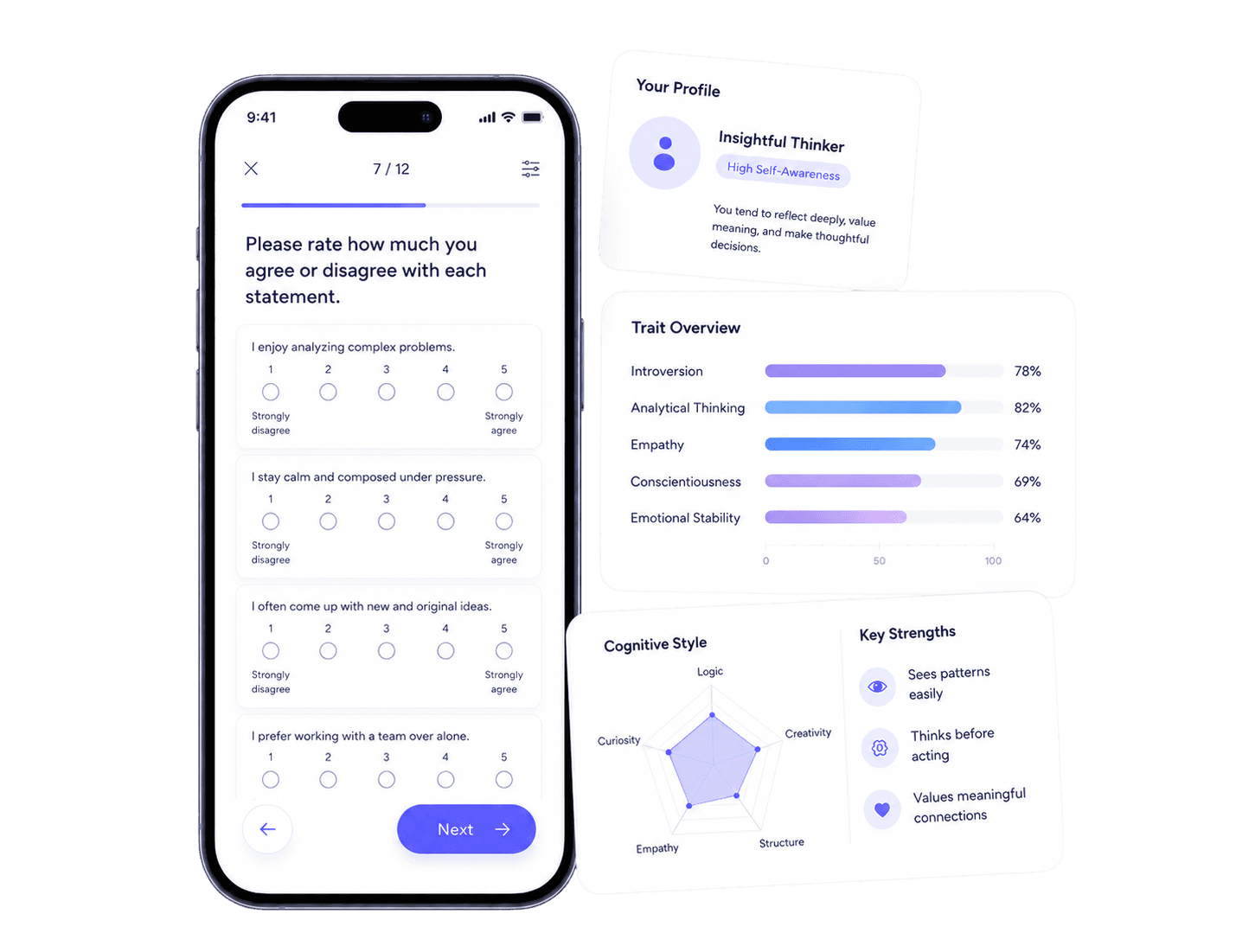
One unusually cold argument, reckless weekend or heroic response under pressure can distort the picture. Think about behaviour that repeats across months and situations.
You may understand why someone is upset without sharing their emotion strongly. When a question involves empathy or concern, answer for your actual internal response rather than what you know is socially expected.
Consequences can reveal as much as the choice itself. Think about regret, accountability, whether you repair harm, and whether a risky outcome changes how you act next time.
Do not choose an answer because it sounds tougher, kinder, more independent or more socially acceptable. The test is more useful when the response is recognisable rather than impressive.
Before choosing an answer, think of more than one situation where the same reaction appeared. If you cannot, the extreme example may not represent your usual pattern.
Psychopathy-related traits are broader than coldness or rule-breaking. Let emotional, interpersonal and risk-related questions stand on their own rather than trying to make them fit one image.
Thinkhint returns one psychopathy-traits range. Compare it with the full report and your own history rather than treating one answer as the explanation.
No. Answer for what you usually do or feel, including responses you might not choose as an ideal. Self-report assessments become less useful when answers are mainly about presenting a preferred image.
Usually not. Try to think across several ordinary situations. One unusually stressful event may exaggerate a reaction that is not typical for you.
Answer both parts honestly when they appear. Composure and empathy are not the same trait, which is why the assessment asks about multiple kinds of situations.
No. The result is an educational psychopathy-traits range based on your answers, not a clinical diagnosis or professional psychopathy assessment.
No. There is no useful target score. The purpose is to get a result that resembles your own repeated behaviour closely enough to be worth interpreting.
Personality questions are rarely answered in a vacuum. A person may want to appear compassionate, fearless, rational, independent or dominant. With a loaded word like psychopath in the title, that pressure can become even stronger because the result feels as though it says something dramatic about character.
A better approach is deliberately ordinary. Think about what you do when no one is grading the response: after you inconvenience someone, when persuasion would benefit you, when a high-stakes choice is tempting, or when another person's emotions demand time you would rather spend elsewhere.
The report still cannot diagnose psychopathy or reproduce a professional instrument. But more realistic answers give you a better basis for asking whether the interpretation describes a pattern you genuinely recognise.