Notice your default response
See the ways you are most likely to react when you are uncertain, challenged, under time pressure, or asked to make a choice.

Start with the situations you know well: how you decide, respond to feedback, connect with people, handle change, and act when something matters.
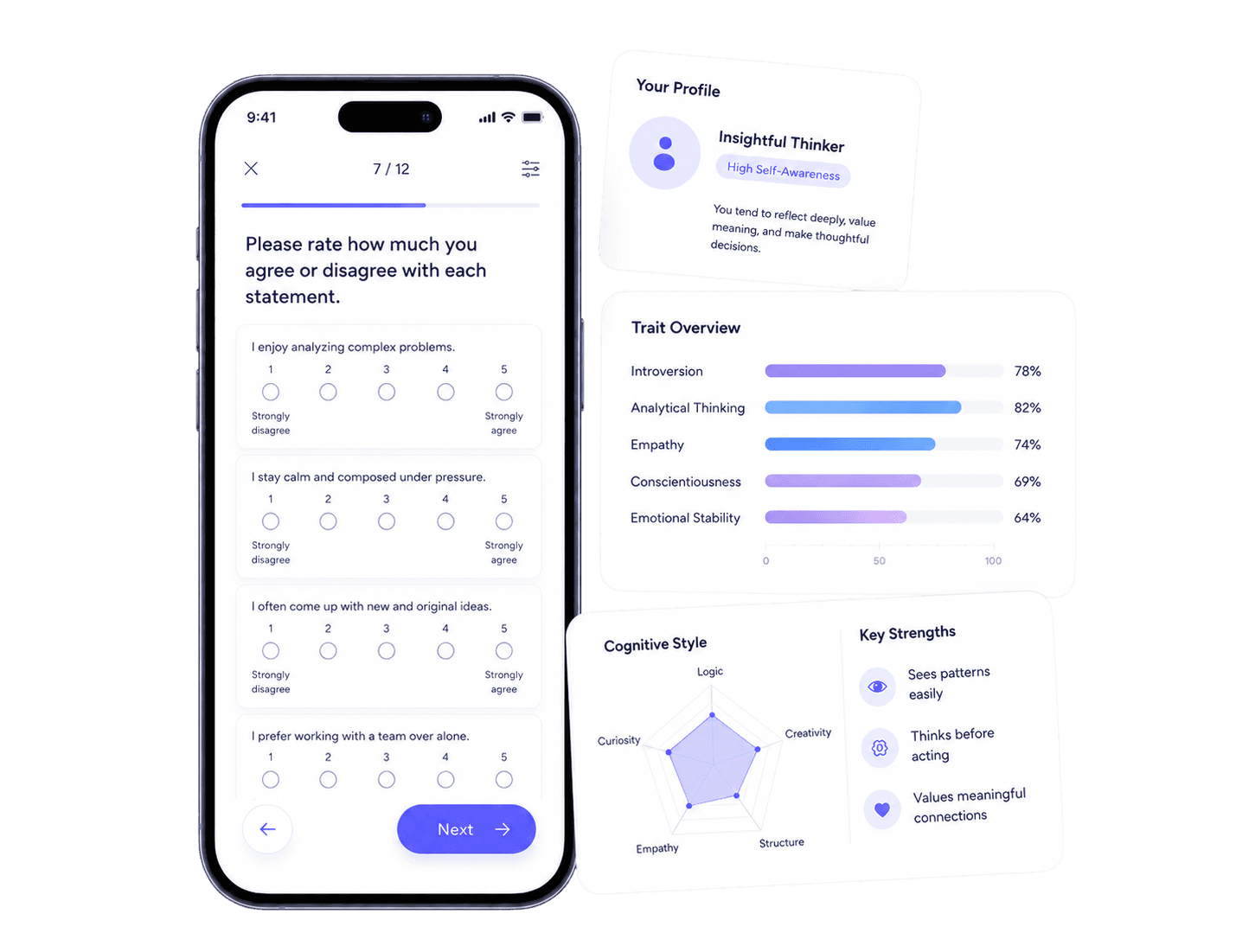
See the ways you are most likely to react when you are uncertain, challenged, under time pressure, or asked to make a choice.
Reflect on how you tend to listen, explain, ask for what you need, deal with differences, and respond to another person's expectations.
Consider how your preferences may affect planning, collaboration, motivation, responsibility, and the way you approach a difficult task.
Use the report to choose one recurring pattern worth paying more attention to in the days that follow.
Choose the answer that feels most typical, including reactions that may be easier to recognise privately than to explain to someone else.
The value comes from the overall direction of your answers, not from any one prompt or one recent experience.
Compare the observations with real moments from your relationships, work, and routines so the result stays practical.
No. The report is more useful when you choose what you normally do, particularly in situations where you are not consciously trying to manage how you come across.
Yes. Prior knowledge is not a problem, but it helps to answer from your experience rather than trying to produce a result you expect or prefer.
No. The questions are designed to explore patterns that may appear in relationships, communication, decisions, responsibilities, and responses to everyday pressure.
Read it slowly and compare it with your own history and current circumstances. A surprising point can still be useful if it gives you a new question to consider.
No. Thinkhint provides educational tools for personal reflection and does not offer diagnosis, treatment, or professional mental-health advice.
People often take a personality test because they want more than a broad description of themselves. They want to understand why certain choices feel easier than others, why the same type of conflict keeps appearing, why some environments are energising while others are draining, or why feedback lands in a particular way.
A structured test cannot explain every detail of a person, but it can make repeated patterns easier to see. You may recognise that you act quickly when you feel pressure, need time before speaking openly, take responsibility before anyone asks, or look for more information before you commit.
The report is most valuable when you connect it back to actual situations. That is where an observation becomes something you can use instead of just a sentence that sounds familiar.