Use a normal stretch of time
Think across ordinary weeks and months so one unusually stressful event does not dominate every answer.

If you are ready to start, the most useful approach is to answer from repeated experience — not your calmest day, your worst day, or the response you think you should give.
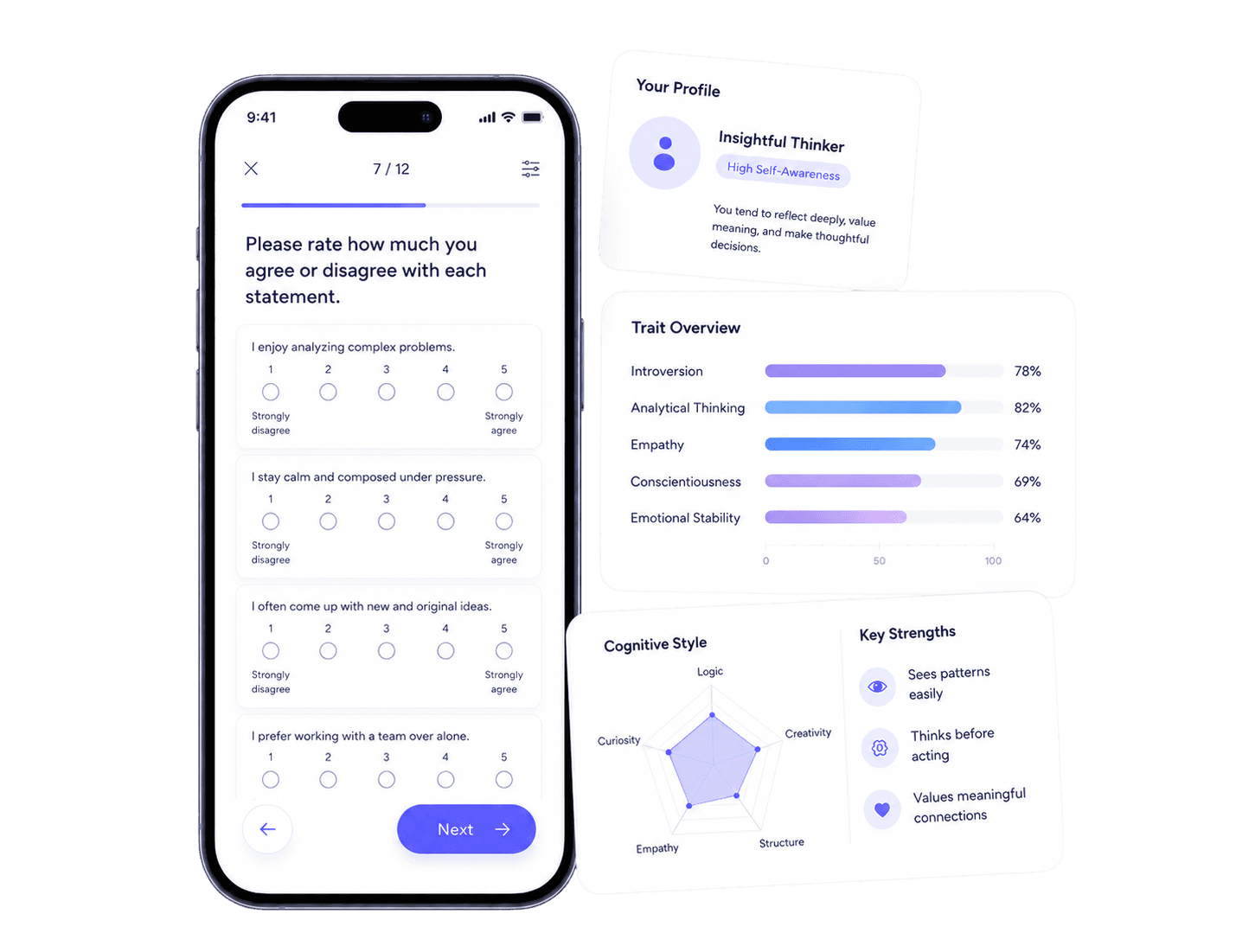
Think across ordinary weeks and months so one unusually stressful event does not dominate every answer.
Mental review, reassurance-seeking, silent repetition and attempts to neutralise a thought can matter even when nobody else sees them.
When a doubt appears, notice what you actually do next and whether that response lets you move on or keeps the issue active.
The report gives one overall traits range for reflection. It is not a diagnosis or a validated clinical severity score.
Do not optimise for a result. Think about what you tend to experience and do when uncertainty, intrusive thoughts or unfinished feelings become uncomfortable.
One check, one routine or one unwanted thought does not determine the result. The overall direction across your answers matters more.
Compare the result with moments you know well so you can separate useful recognition from statements that do not fit your context.
Use your typical recent experience rather than one unusually good or difficult day. Repeated patterns are more informative than a single event.
Answer for what happens in practice. You may know a check is unnecessary while still feeling driven to do it; that distinction can be relevant to your reflection.
No. Thinkhint provides one overall self-reflection range and does not diagnose obsessive-compulsive disorder.
Yes, when a question fits. Repetitive mental review or attempts to neutralise a thought can be part of the experience even without a visible action.
Consider speaking with a qualified mental-health professional. An online result cannot replace a clinical assessment or treatment.
Questions about checking, intrusive thoughts and repetitive routines can invite two extremes: minimising the experience because it feels embarrassing, or over-reading one difficult period because it feels frightening. Neither gives you much context.
A better approach is ordinary and specific. Think about what usually happens, what you feel compelled to do, how much relief the response creates and whether the same question returns afterwards.
That gives the result something real to reflect back to you while keeping the limit clear: it is an educational self-assessment, not a clinical determination.