Do not reverse-engineer the type
If you already know the Enneagram, resist choosing answers because they sound like the type you expect. Use what you actually do as the evidence.

You do not need to figure out your type while you answer. Rate what is usually true, let all nine patterns compete, and leave interpretation until the complete response set has been scored.
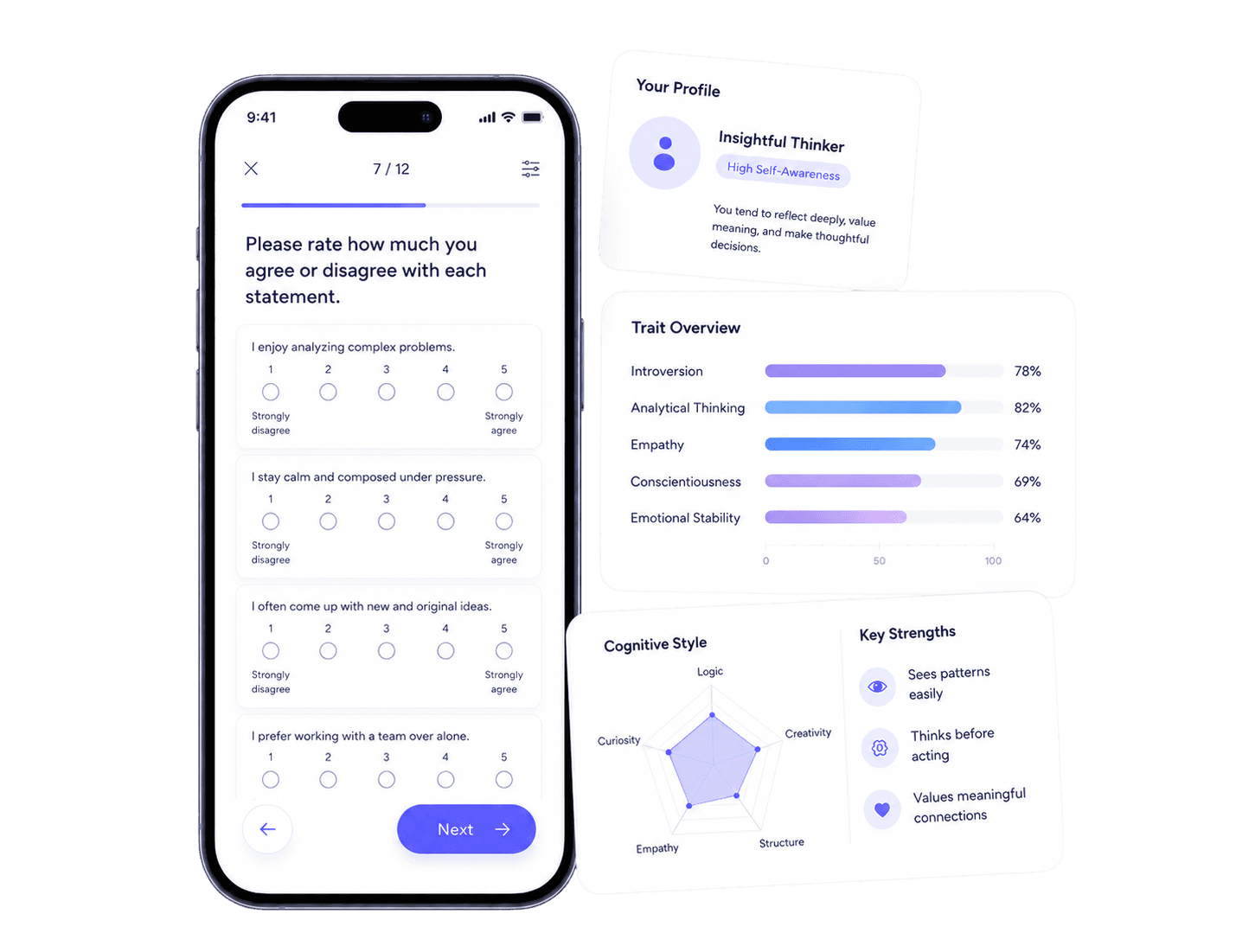
If you already know the Enneagram, resist choosing answers because they sound like the type you expect. Use what you actually do as the evidence.
A difficult relationship can make one reaction unusually loud. Think about the pattern that repeats across different people and situations.
Work may reward behavior that looks unlike home. Use the broader pattern across roles when a statement could be answered differently by context.
The assessment compares all nine type scores. Your job while answering is to supply honest evidence, not decide the conclusion in advance.
Rate each statement from strongly disagree to strongly agree based on the pattern that is most typical over time.
The complete response set contributes to scores across nine Enneagram patterns, so one answer does not decide your type.
Use motivations and fears first, then relationships, work, stress and growth to see whether the same explanation continues to fit.
No. Answer for what is usually true, including habits you would rather change. Ideal-self answers can make the final type less useful for reflection.
Use the response that is most typical overall. When work, home and close relationships differ, think about the pattern that appears most consistently across them.
You can, but doing so defeats the purpose of the assessment. The result is more informative when you answer from experience rather than from knowledge of type descriptions.
No. The assessment identifies one dominant type and does not calculate a wing, instinctual subtype or tritype.
After you finish the assessment, Thinkhint prepares your personalized Enneagram result and detailed report around the strongest type match in your answers.
Personality tests become less useful when every answer is filtered through the question, 'What would a healthy, impressive or self-aware person choose?' That creates a profile of aspiration rather than a record of your usual tendencies.
The same problem appears when you already know the Enneagram. Once you recognize which statements resemble a type, it becomes tempting to confirm the identity you expect. A better approach is to keep returning to specific, repeated examples from your life.
Thinkhint handles the comparison across nine patterns. While taking the test, the useful task is simpler: supply the most honest evidence you can.