Choose typical over exceptional
Do not let one unusually compassionate moment or one bad day stand in for how you generally respond to other people's emotions.

Use your usual response across work, friendships, family and close relationships — especially the moments when you are stressed, unsure, emotionally pulled in or tempted to fix the situation quickly.
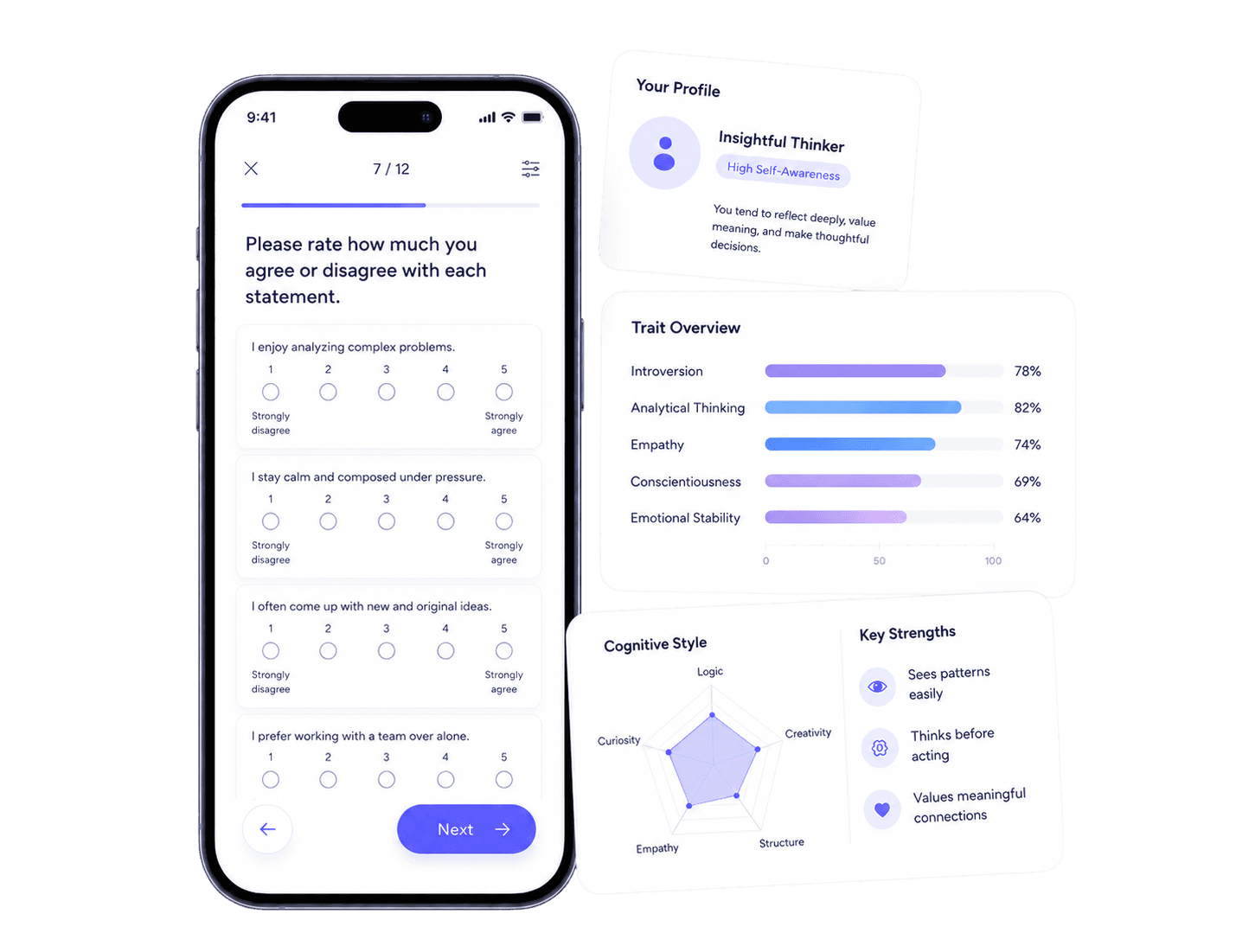
Do not let one unusually compassionate moment or one bad day stand in for how you generally respond to other people's emotions.
You may understand another person's position without feeling their emotion strongly, or feel it strongly without knowing what would help.
Support, emotional fatigue, over-responsibility, withdrawal and recovery can all reveal how empathy functions for you over time.
If your response changes under conflict, pressure or closeness, answer for the pattern that feels most representative and keep the variation in mind for the report.
Think of ordinary interactions rather than abstract ideas about the kind of person you want to be.
Understanding, emotional resonance, social reading, helping and boundaries can move together or pull in different directions.
Compare the report with the situations you had in mind and notice which parts feel consistent across more than one relationship or setting.
Think across both. If your responses differ a lot, choose what feels most typical overall and remember the context difference when you read the report.
Choose what you actually tend to do. The assessment is more useful when it reflects your real reactions rather than the answer that sounds most compassionate.
Both matter. Some prompts are about emotional sensitivity, others about understanding, helping, social reading or boundaries. Follow the wording of each item rather than forcing every answer into one idea of empathy.
Yes. Stress and emotional load can change how available, patient or sensitive you feel. Treat the result as a current reflection rather than a permanent score about your character.
No. Thinkhint is an educational self-reflection service, not a clinical, diagnostic or professional evaluation.
Empathy is easy to overestimate when you answer for your intentions. You may intend to listen but start giving advice. You may care deeply but avoid emotional situations when you are exhausted. You may understand another point of view until the disagreement touches something personal.
Those inconsistencies are not reasons to answer differently; they are the useful material. A self-report test works best when you include the versions of your behavior that appear under pressure, not only the version you prefer.
Start from that evidence. The report can then give you language for the parts of empathy that are already strong and the situations where your usual response changes most noticeably.