Use concrete work situations
Bring specific tasks, projects, decisions, group situations, study, volunteering, and responsibilities to mind instead of answering from an abstract idea of your ideal career.

The most useful answers come from real situations: the projects that held your attention, the responsibilities people trusted you with, the problems you enjoyed solving, and the work that felt harder than it should have.
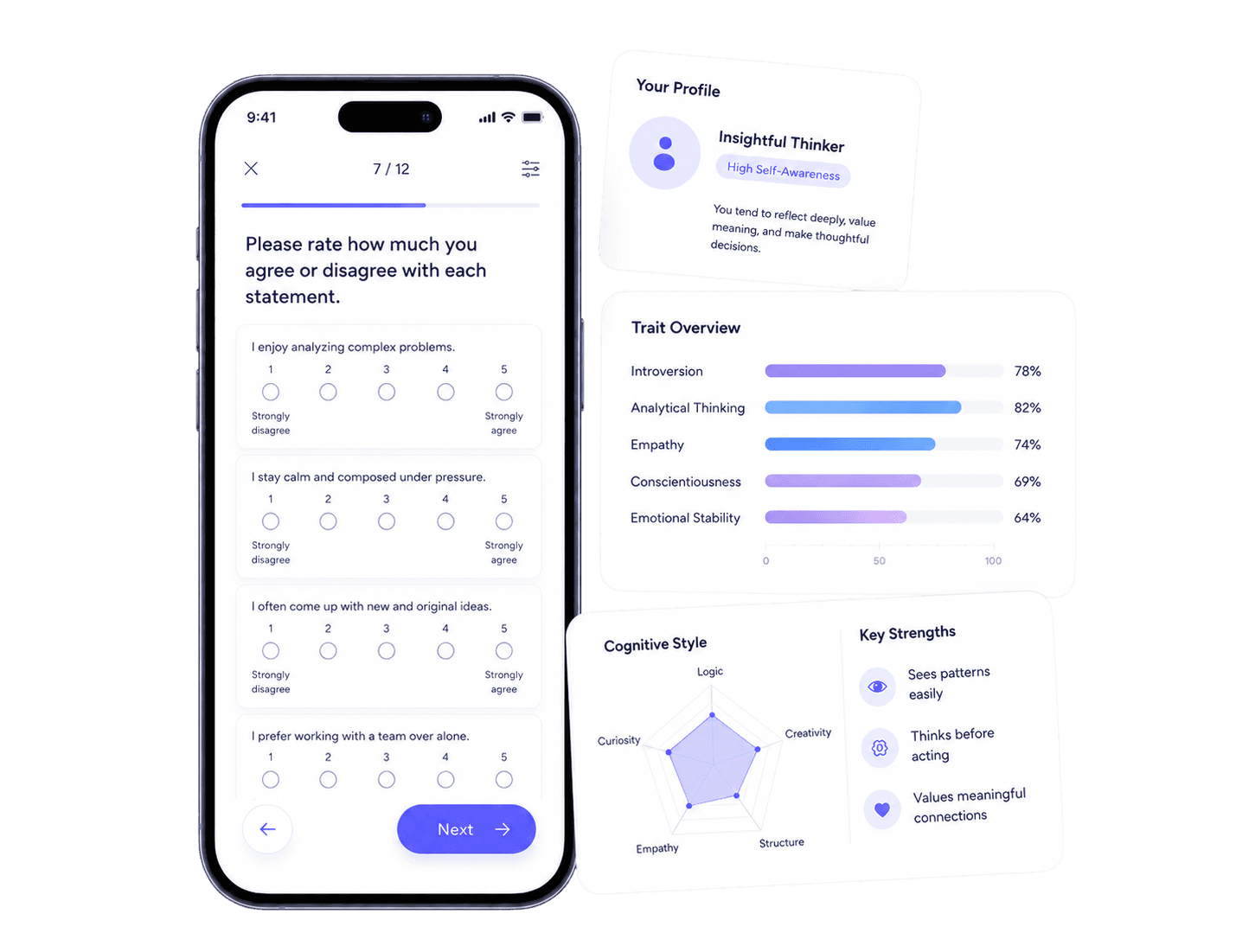
Bring specific tasks, projects, decisions, group situations, study, volunteering, and responsibilities to mind instead of answering from an abstract idea of your ideal career.
Choose the response that best reflects your typical pattern, even when another answer sounds more ambitious, social, creative, analytical, or leadership-oriented.
Your answers are compared across Builder, Analyst, Communicator, Creator, and Leader patterns, with the strongest one becoming the basis of your report.
Use the strengths, work preferences, example role directions, and growth themes to improve your next questions about real opportunities.
Give yourself enough attention to think about recurring work patterns. Do not base the entire test on one unusually good or difficult week.
There is no career type you need to aim for. Each of the five patterns has useful strengths and trade-offs, so trying to engineer a result only makes it less informative.
Afterward, compare the report with real job duties, qualifications, people, environments, and opportunities rather than treating the type as a final instruction.
No. If formal work experience is limited, use examples from education, group projects, volunteering, hobbies, family responsibilities, or other situations where you have had to solve problems and contribute.
Answer based on what is generally true for you across real situations. Your current job can provide useful examples, but the goal is not to describe the job itself or invent an idealized future self.
The assessment identifies one dominant career type—Builder, Analyst, Communicator, Creator, or Leader—and the report explains the strengths, preferences, environments, role examples, and development themes linked to it.
No. The types describe different ways of contributing at work. The useful question is where your strongest pattern fits the work and environment you are considering.
Choose one or two themes that feel accurate and use them to investigate real options: compare job descriptions, talk to people in relevant roles, review a skill gap, or test an interest through a smaller project or learning step.
Career questions can trigger the same instinct as an interview: choose the answer that sounds ambitious, flexible, collaborative, decisive, or creative. That instinct makes sense when an employer is evaluating you. It works against you when the purpose is self-understanding.
A useful result depends on the contrast between the five patterns. If you genuinely prefer solving a problem alone before discussing it, say so. If you gain energy from coordinating people or shaping a message, let that show. None of those preferences is universally better.
The goal is not to produce an ideal candidate profile. It is to produce a result you can actually recognize when you compare it with the work you have done and the roles you are considering next.