Use your own baseline
Compare a change with what is normally true for you rather than with another person's sleep, energy, confidence, sociability, or productivity.

If you have already decided to take the test, the most important part is how you answer: think across different periods, compare with what is normal for you, and do not let one recent high or low dominate every response.
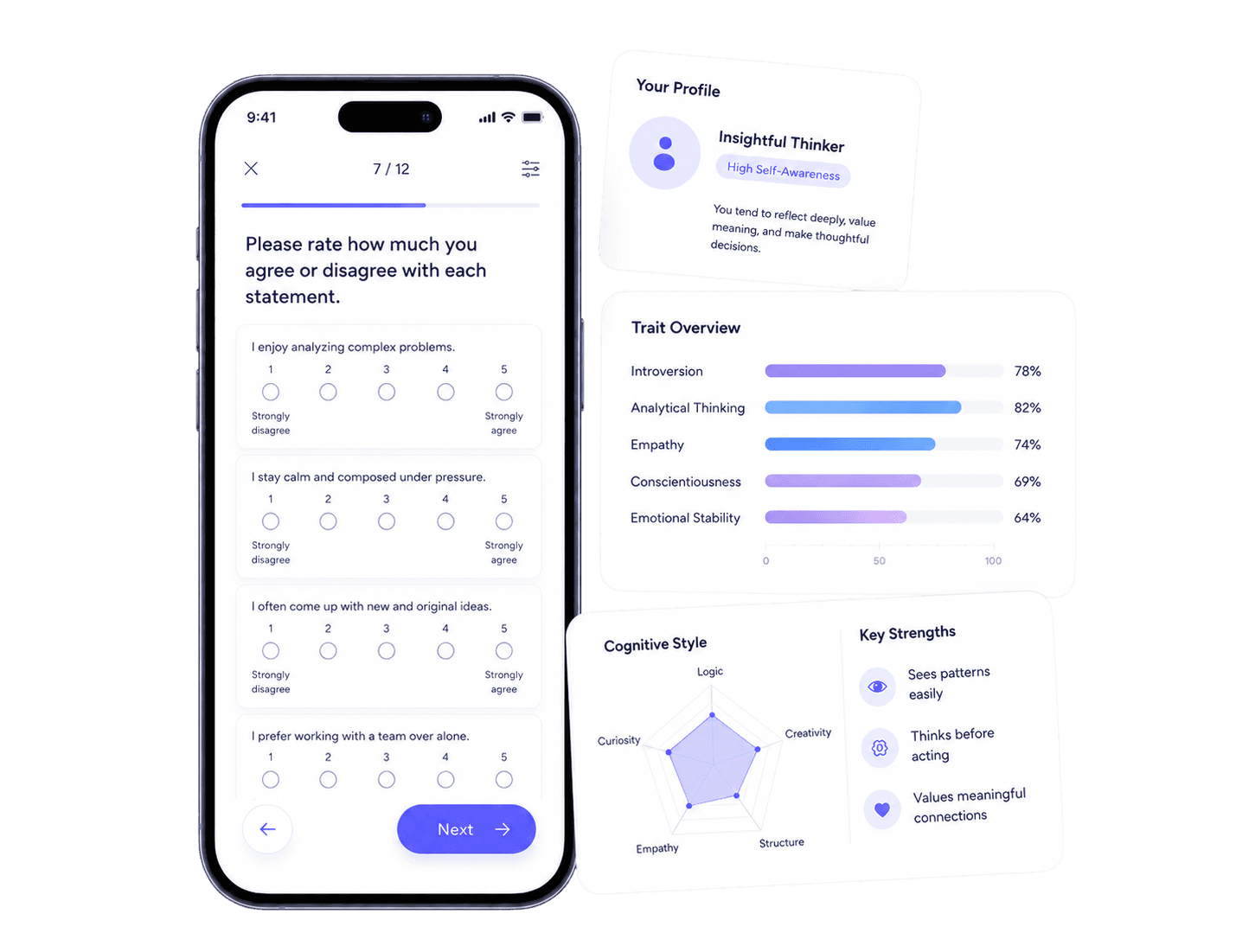
Compare a change with what is normally true for you rather than with another person's sleep, energy, confidence, sociability, or productivity.
A single stressful week can distort the picture. Look for experiences that have appeared repeatedly or stood out clearly from your usual rhythm.
Remember what happened to work, relationships, commitments, spending, routines, or recovery when mood and energy changed.
You do not need every item to fit. Choose the closest response even when your experience is inconsistent or depends on context.
Bring several different periods to mind. Ask what is generally true across time and what was only true during one unusual circumstance.
Do not treat more energy, confidence, sleep, or productivity as automatically good or bad. Answer based on whether the change actually matches your experience.
The result is one Minimal-to-Strong Traits level plus a narrative report. It is not a separate mania/depression profile and it cannot diagnose bipolar disorder.
Not only. Use a broader time frame and think about recurring or clearly unusual periods. One current mood can otherwise pull many answers in the same direction.
Choose the answer that best reflects the broader pattern, then keep the context in mind when reading the report. Different settings can change sleep, stress, activity, and behaviour.
Your own baseline is more useful. The relevant question is whether something feels noticeably different from your usual sleep, energy, activity, confidence, or functioning.
ThinkHint combines all answers into one overall bipolar-traits level—Minimal, Mild, Moderate, Elevated, or Strong Traits—plus a detailed narrative report.
No. It is an educational self-report, not a diagnostic instrument. Clinical assessment considers episode duration, severity, impairment, history, and other possible causes.
Many bipolar-related experiences are defined by change from a person's usual state. That makes the reference point important. If you normally sleep little, work quickly, or enjoy constant social contact, those facts mean something different from a period when your sleep need suddenly drops, your pace accelerates, and several other behaviours change at the same time.
The same applies to lower periods. A temporary response to illness, grief, stress, or exhaustion is not automatically the same thing as a recurring mood episode. Answering across time helps keep a self-report from becoming a snapshot of whatever is happening this week.
The result remains only a reflection tool. Its value is in helping you organize a pattern accurately enough to think about it, monitor it, or discuss it with a qualified professional if the changes are significant.