Answer for the usual pattern
One brilliant week or one chaotic deadline can distort self-report. Use what happens often enough to feel representative across time.

If you have already decided to take the test, the most useful thing you can do now is answer from the same version of your life all the way through instead of switching between work-you, weekend-you, ideal-you, and worst-day-you.
One brilliant week or one chaotic deadline can distort self-report. Use what happens often enough to feel representative across time.
Work may bring out more structure, home may bring out more spontaneity, and familiar people may change your social behaviour. Keep those differences in mind without letting one setting stand in for your whole life.
Answer from what you tend to do, not from the person you want to be or the trait you think would sound better.
The result highlights the Big Five dimension that stands out most strongly in your answers and develops that pattern in a detailed report.
Think across ordinary weeks and typical settings rather than moving between your most productive, most social, and most stressed moments from question to question.
Self-report statements will not capture every exception. Select the response that best represents the recurring tendency and keep important context for interpretation later.
The result is most useful when you compare where the trait fits strongly, where another tendency seems to lead, and which environments change your behaviour most.
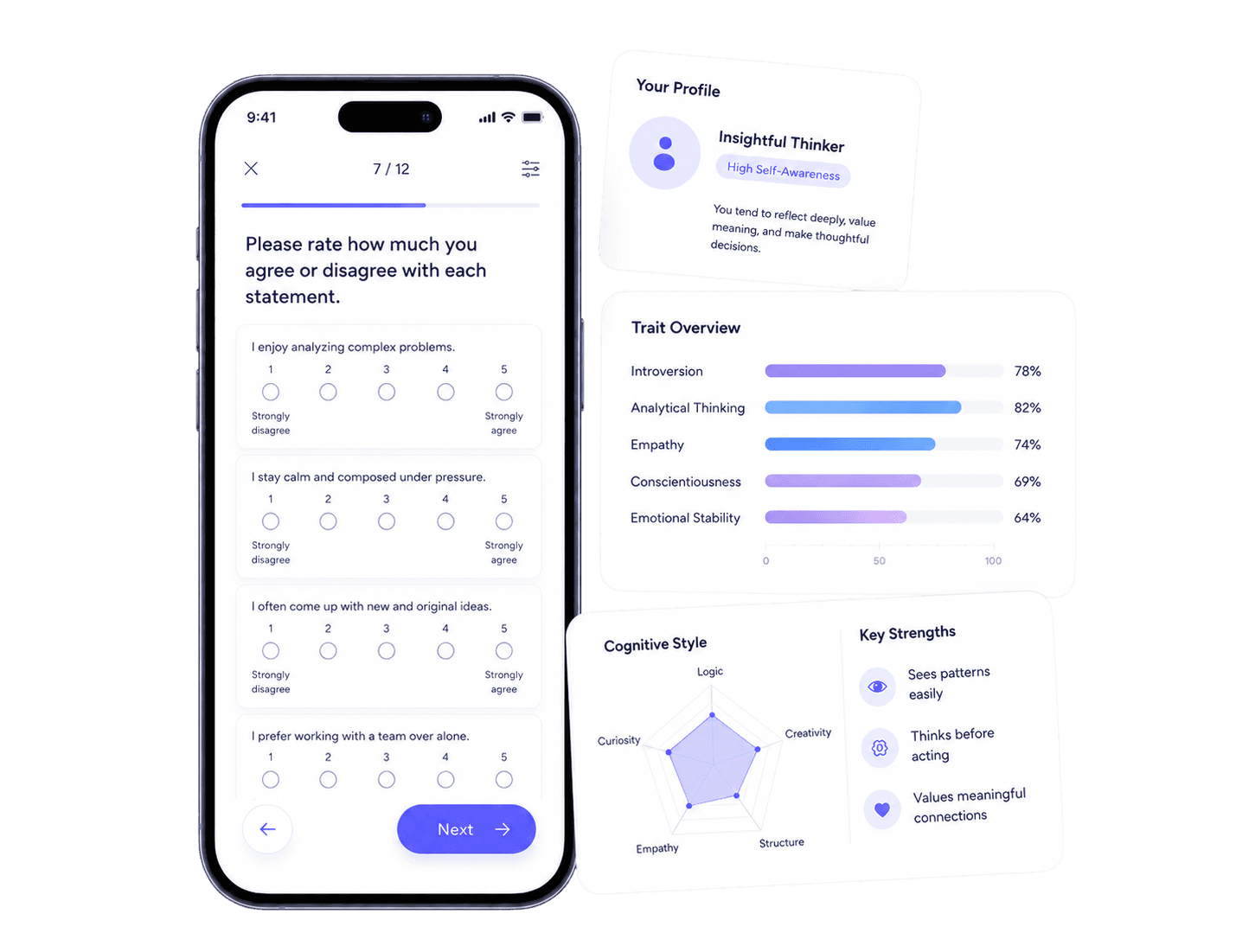
Your responses are scored across openness, conscientiousness, extraversion, agreeableness, and neuroticism. ThinkHint then identifies the strongest trait pattern and uses it as the headline of your report.
The report goes beyond the name of the trait by discussing characteristics, motivations, relationships, work, stress, growth, and interactions with other personality tendencies. It is not a normed five-percentile profile.
Answer for the broader version of yourself across ordinary life. If work and home are genuinely different, choose the response that best represents the overall pattern and keep the contrast in mind when reading the report.
Choose the one that is closer to your usual behaviour. You do not need false precision; consistency across the questionnaire matters more than perfectly resolving every exception.
Use your current typical pattern unless you have a specific reason to reflect on an earlier period. Major recent changes can be useful context when you interpret the result.
The five dimensions are scored, but ThinkHint presents a dominant-trait result and detailed report rather than a percentile scorecard for all five traits.
No. Big Five traits are not grades. Different tendencies bring different strengths and trade-offs, and the useful question is how your pattern works in the situations that matter to you.
You can be organised at work and loose about personal routines, outgoing with friends and quiet in unfamiliar groups, calm in ordinary life and highly reactive when the stakes feel personal. None of those contrasts automatically makes an answer wrong.
The goal is consistency. Use the same broad reference point throughout the test and let the exceptions remain exceptions rather than changing your baseline whenever a question reminds you of a different role.
That gives the final result a better chance of reflecting a repeated personality tendency instead of a collage of unrelated moments.