Worry that keeps coming back
Consider whether your mind repeatedly returns to possible problems, past conversations, decisions, or outcomes you cannot fully control.

If overthinking, tension, uncertainty, or avoidance keeps showing up in different parts of your life, this assessment gives you one place to look at those experiences together and see your overall anxiety-traits result.
Consider whether your mind repeatedly returns to possible problems, past conversations, decisions, or outcomes you cannot fully control.
Notice how often pressure stays in your body or attention after the situation itself is over, including moments when you want to relax but cannot quite switch off.
Look at whether not knowing leads you to postpone, over-prepare, check repeatedly, seek reassurance, or step away from situations that feel difficult to predict.
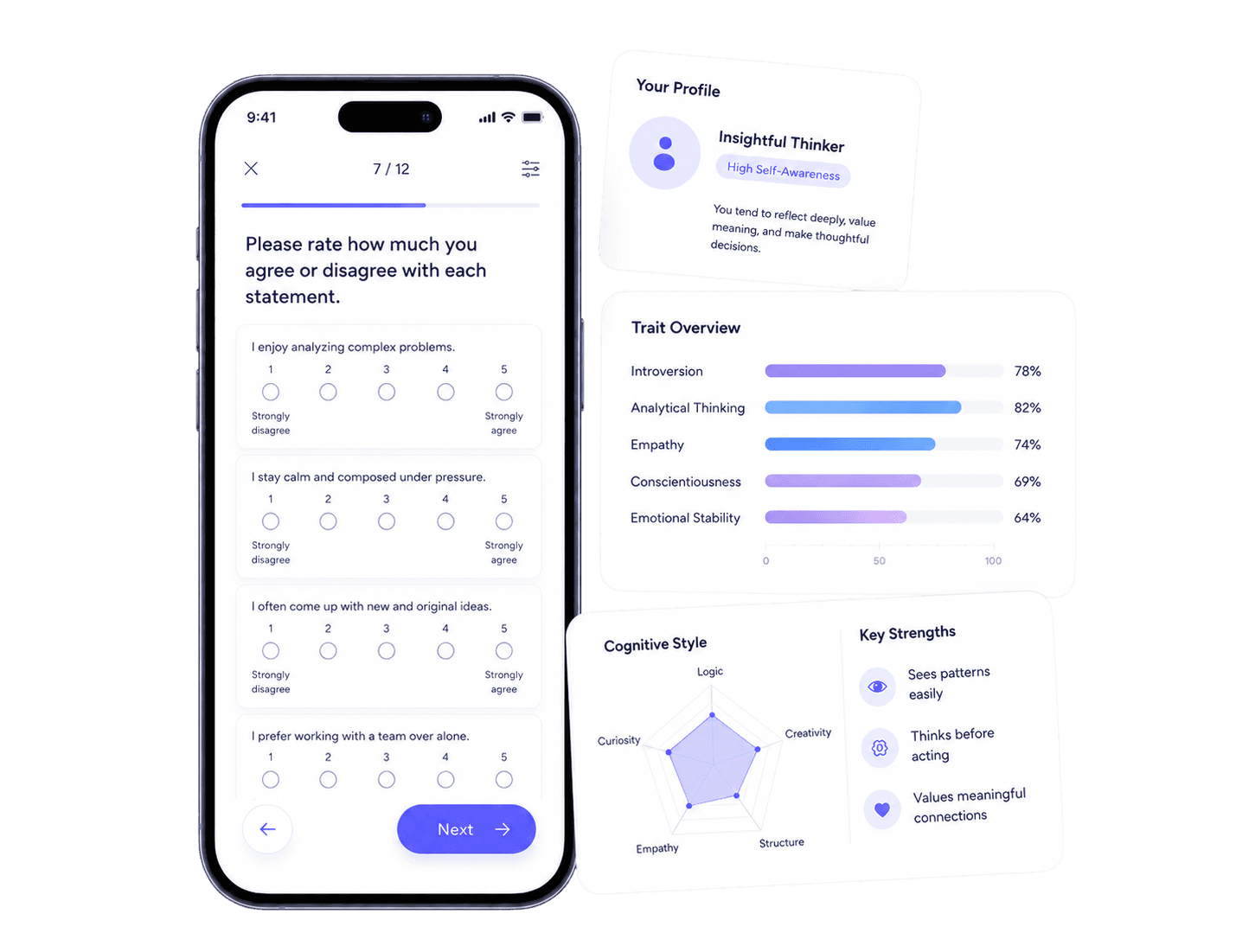
Your overall anxiety-traits level comes with a report that puts the result into context across stress, relationships, communication, work, and decision-making.
Think about recurring experiences rather than choosing answers based only on today, your worst day, or how you think you should respond.
The assessment combines anxiety-related experiences across thinking, physical tension, social situations, uncertainty, and avoidance into one overall result.
Use the result to see which descriptions feel familiar, which do not, and where anxiety-related patterns may be making ordinary situations require more effort than expected.
Thinkhint looks at anxiety-related patterns across worry and overthinking, physical tension, social unease, reactions to uncertainty, and avoidance. The answers are combined into one overall anxiety-traits level.
No. The assessment includes several kinds of anxiety-related experiences, but the result is one overall level rather than separate diagnostic or clinical subscale scores.
No. Thinkhint uses its own questionnaire. It does not provide a GAD-7 score and does not claim to be a validated clinical screener.
No. The test is for educational self-reflection and cannot diagnose a mental health condition. A qualified professional can assess symptoms, history, context, and impact in ways an online self-report cannot.
Consider professional support when anxiety is persistent, worsening, difficult to manage, or interfering with work, relationships, sleep, daily activities, or your sense of safety.
Usually it is not because of one anxious moment. It is because the same kinds of moments keep repeating: a simple decision takes too long, an unanswered message occupies the whole evening, a meeting is over but the mind keeps replaying it, or an uncertain task gets postponed until the pressure is worse than the task itself.
Those experiences can be easy to dismiss one at a time. Seen together, they may reveal a pattern in how you respond to uncertainty, pressure, social evaluation, or the possibility of making a mistake. That is the value of taking a broader assessment rather than judging yourself from one symptom in isolation.
An online result cannot tell you the cause of what you are experiencing, and it cannot replace clinical assessment. It can give you a more concrete description of what to pay attention to — especially if 'I have been stressed' no longer feels specific enough to explain what your days actually feel like.