
Thinkhint

A psychopathy quiz about real reactions rather than dramatic stereotypes

Think about ordinary moments: someone needs empathy, a rule blocks your goal, a risky shortcut looks attractive, or you realise your choice hurt someone. The quiz asks what you tend to do next and how often the same response returns.

Answer at your pace
Everyday situations
Private by design
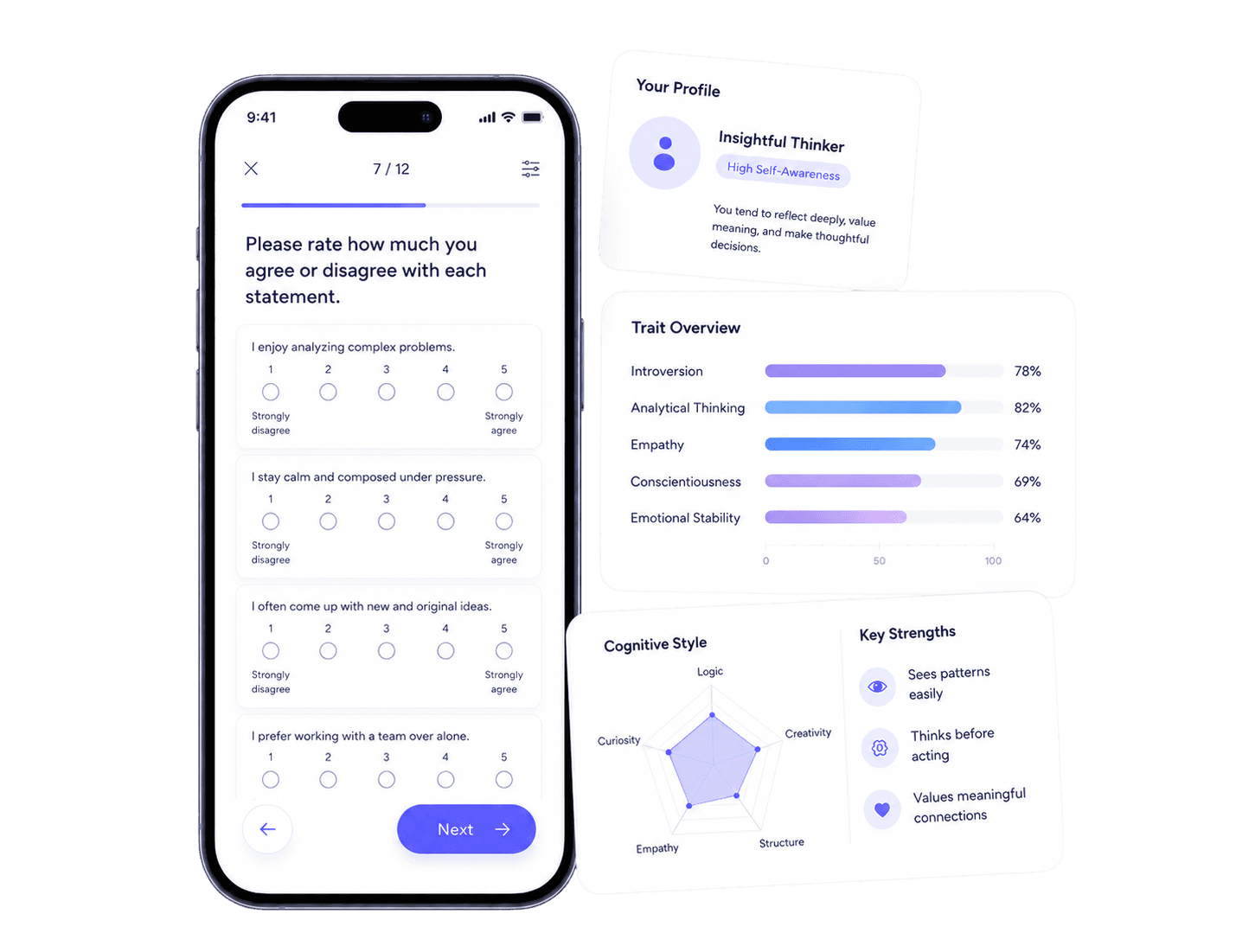
Thinkhint personality test and report preview

Use familiar situations to test your assumptions

When emotion enters the room

Do you feel another person's distress strongly, understand it without sharing it, become impatient with it, or stay focused on the practical outcome? Those are different responses even when they all look calm from the outside.

When you have caused harm

Notice whether regret changes your behaviour, whether responsibility feels important mainly because of consequences, or whether the event becomes easy to leave behind once the immediate problem is over.

When influence can get you what you want

Consider how readily you adapt your presentation, tell people what they want to hear, or prioritise your own gain when honesty and reciprocity might slow you down.

When the risky option is more exciting

Ask whether you slow down to consider consequences or whether urgency, boredom, competition or high stakes make action feel more compelling than caution.

From quiz answers to a pattern you can actually examine

1

Choose the response that is usually true

Do not search for the answer that sounds kindest, toughest or most socially acceptable. Use the reaction that repeats most often in ordinary life.

2

Let several situations contribute

One cold reply or one impulsive decision does not determine the result. The overall direction across emotional, interpersonal and risk-related questions matters more.

3

Interpret the result against examples

Use the report to ask where the same combination appears in relationships, work, responsibility, competition and decisions with real consequences.

Psychopathy quiz questions

Is a psychopathy quiz the same as a diagnosis?

No. This is an educational self-report assessment. A quiz result cannot diagnose psychopathy or another mental-health condition.

What kinds of situations does the quiz cover?

It asks about emotional detachment, empathy and concern, responsibility, social influence, honesty, guilt and remorse, composure, risk-taking, impulsivity, self-interest and consideration of consequences.

Can one answer make my result high?

No single dramatic answer should be treated as the result. The assessment combines responses across many situations into one overall psychopathy-traits range.

Why ask about positive-sounding traits like calmness or confidence?

Because a trait's meaning depends on what accompanies it. Calmness can support good decisions; the wider pattern matters when it is paired with emotional detachment, low concern, impulsivity or instrumental treatment of other people.

Can I use the quiz to test someone else?

No. The questions and result are based on your own self-report. They are not a reliable way to diagnose or label another person.

A useful quiz makes the broad label less important

The word psychopathy can pull attention toward extremes. Everyday behaviour is more informative when you compare responses that could easily be mistaken for one another: composure versus emotional distance, persuasion versus exploitation, calculated risk versus impulsive risk, independence versus indifference to impact.

Those distinctions are easier to see in situations than in adjectives. What happens when someone else's needs interfere with your goal? When a mistake has hurt another person? When a rule feels unnecessary? When there is a high payoff and little time to decide?

The result gives you one overall psychopathy-traits range, not a clinical label or a set of named psychopathy factors. Use it to sharpen the questions you ask about your own behaviour, not to settle them with one word.