Separate behavior from motive
Two types can both plan carefully, help others or avoid conflict. The distinction becomes more useful when the reasons for doing it are different.

If Type 2, 6 and 9 all sound familiar for different reasons, a checklist of behaviors will not settle it. Thinkhint compares your full answer pattern across all nine types and gives you one dominant result to examine.
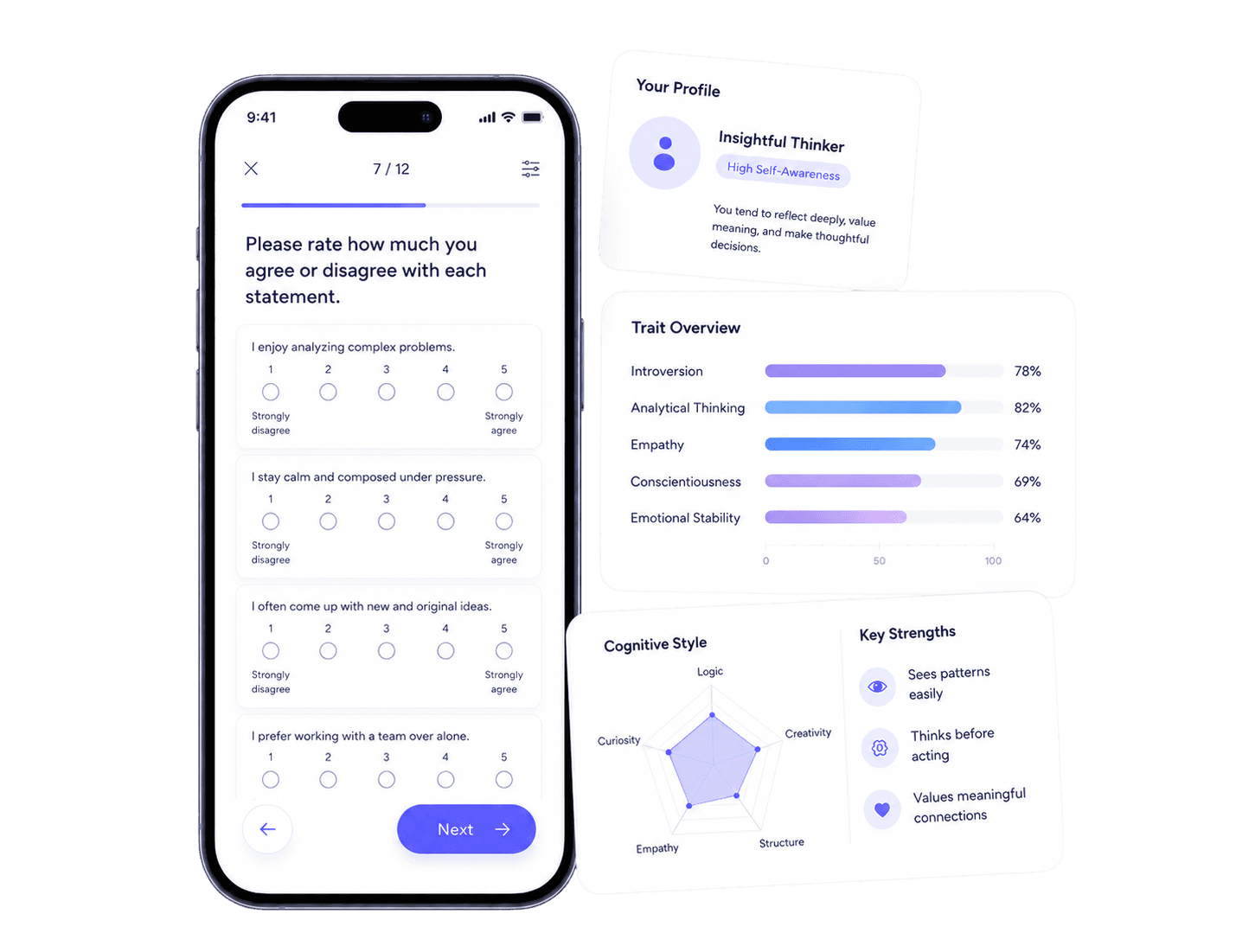
Two types can both plan carefully, help others or avoid conflict. The distinction becomes more useful when the reasons for doing it are different.
A type claim is stronger when it helps explain patterns across closeness, disagreement, reassurance and boundaries rather than one memorable situation.
Compare the same motivation with how you approach responsibility, goals and uncertainty at work or in everyday decisions.
A dominant result gives you a place to start. It does not require you to force every sentence in a type description to fit.
Rate what is generally true across your life. One job, relationship or stressful month should not become the answer to every statement.
Thinkhint normalizes your scores across nine Enneagram patterns and identifies the highest match as the dominant type.
Read the motivation and fear sections, then check relationships, work, stress and growth to see whether the same pattern still explains the evidence.
Because different types can share surface behaviors. The more useful distinction is often the motivation or fear associated with why the behavior keeps recurring.
Your 100 responses are scored across all nine types. The highest normalized score becomes the dominant result, with a fixed tie-breaker if necessary.
Compare its motivations and fears with concrete examples from your life. A test result is evidence to inspect, not a requirement to adopt a label that does not explain your experience.
Thinkhint does not calculate wings, instinctual subtypes or tritypes from this questionnaire, so it does not present them as measured tie-breakers.
No. Thinkhint uses the Enneagram as an educational self-reflection framework, not a clinical diagnosis.
A person can work hard because achievement feels essential, because mistakes feel unacceptable, because security depends on being prepared, or for reasons that have little to do with the Enneagram at all. The action by itself does not identify the type.
A stronger fit explains the recurring priority beneath several actions. It should make sense across more than one setting and continue to be useful when you include the less flattering parts of the pattern.
Thinkhint gives you a dominant result so you can make that comparison with a narrower hypothesis instead of trying to hold nine descriptions in your head at once.