Start with recognizable moments
Think about what you do when plans change, expectations rise, someone needs you, conflict appears, or certainty disappears.

This is the same full nine-type assessment, approached like a quiz: start with curiosity, answer from your usual experience, and see which Enneagram pattern becomes your strongest overall match.
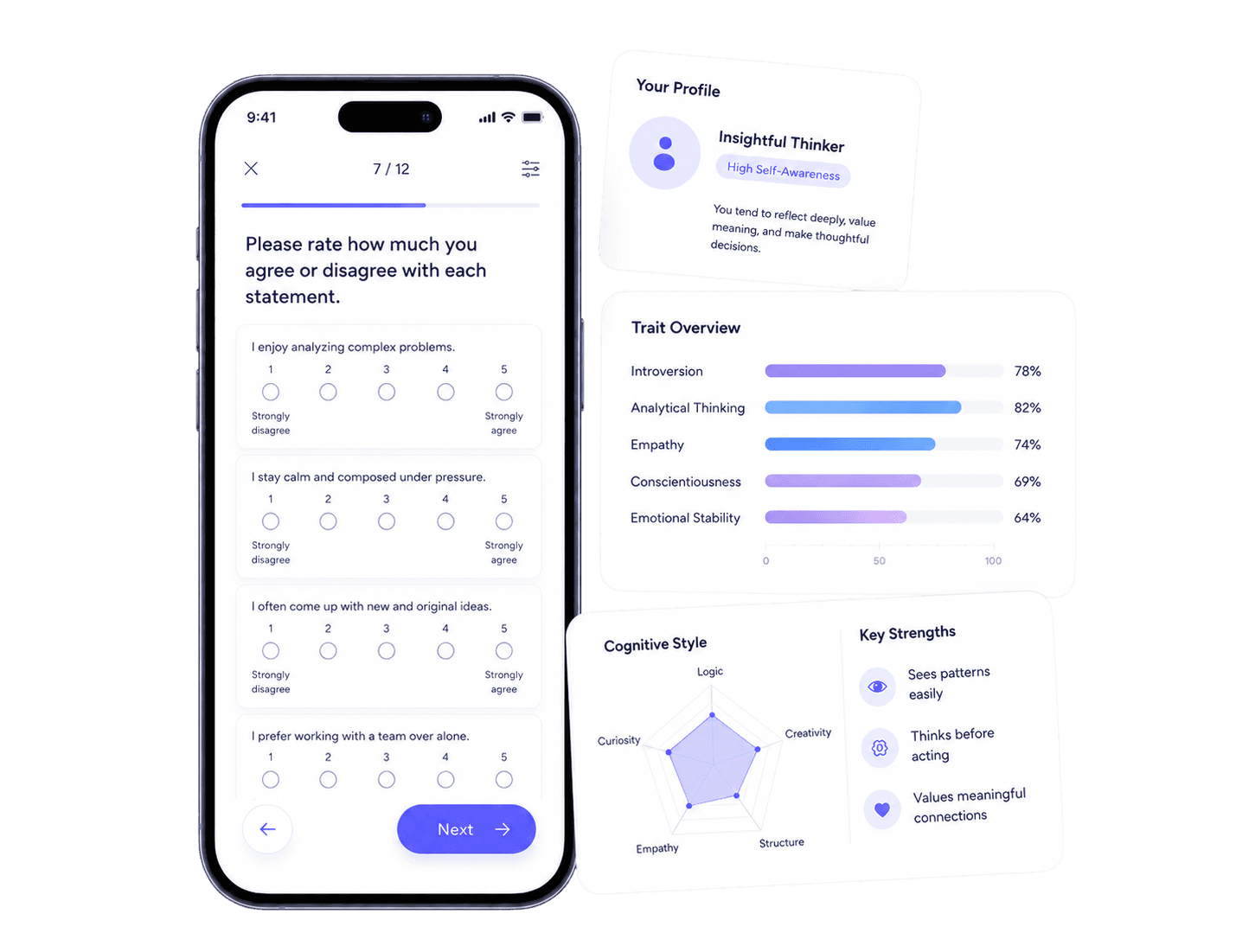
Think about what you do when plans change, expectations rise, someone needs you, conflict appears, or certainty disappears.
A familiar behavior becomes more informative when you consider the need, fear or priority that may be underneath it.
Compare the result with relationships, work and pressure rather than deciding from one amusing or flattering description.
A useful result should give you claims you can check against real examples, not a label you have to defend.
Choose how strongly you agree based on what is usually true for you, including the less flattering parts of your pattern.
The assessment combines the full set of responses and identifies the highest normalized type score as your dominant result.
Use the report to ask where the type fits, where it does not, and whether its motivation explains more than the surface behavior alone.
No. It uses the same full Enneagram assessment and scoring. This page is simply written for people arriving with a more casual or curiosity-led 'quiz' intent.
Your answers are scored across nine Enneagram types and the strongest normalized match becomes your dominant type.
No. Thinkhint does not calculate a wing, instinctual subtype or tritype from this questionnaire.
Treat the report as a set of claims to compare with your own experience. Partial fit, context dependence and disagreement are all useful evidence when deciding how much value the framework has for you.
No. It is an educational self-reflection tool and not a medical, psychiatric or psychological diagnosis.
Type labels are easy to remember, which is part of their appeal. But a label only becomes informative when the underlying explanation earns its place.
If your result says a certain need, fear or priority helps organize your reactions, look for examples in different settings. Does it appear in work and relationships? Does it become louder under pressure? Where does the description fail?
That comparison turns a personality quiz from a moment of recognition into a more disciplined form of self-reflection.