Start with a clear type, not a vague description
Your result gives you one dominant type from a nine-type system, creating a specific interpretation to examine instead of a list of qualities broad enough to fit almost anyone.

Thinkhint identifies the strongest of nine personality types in your answers, then gives you context for why that pattern may appear differently in decisions, relationships, work and moments of pressure.
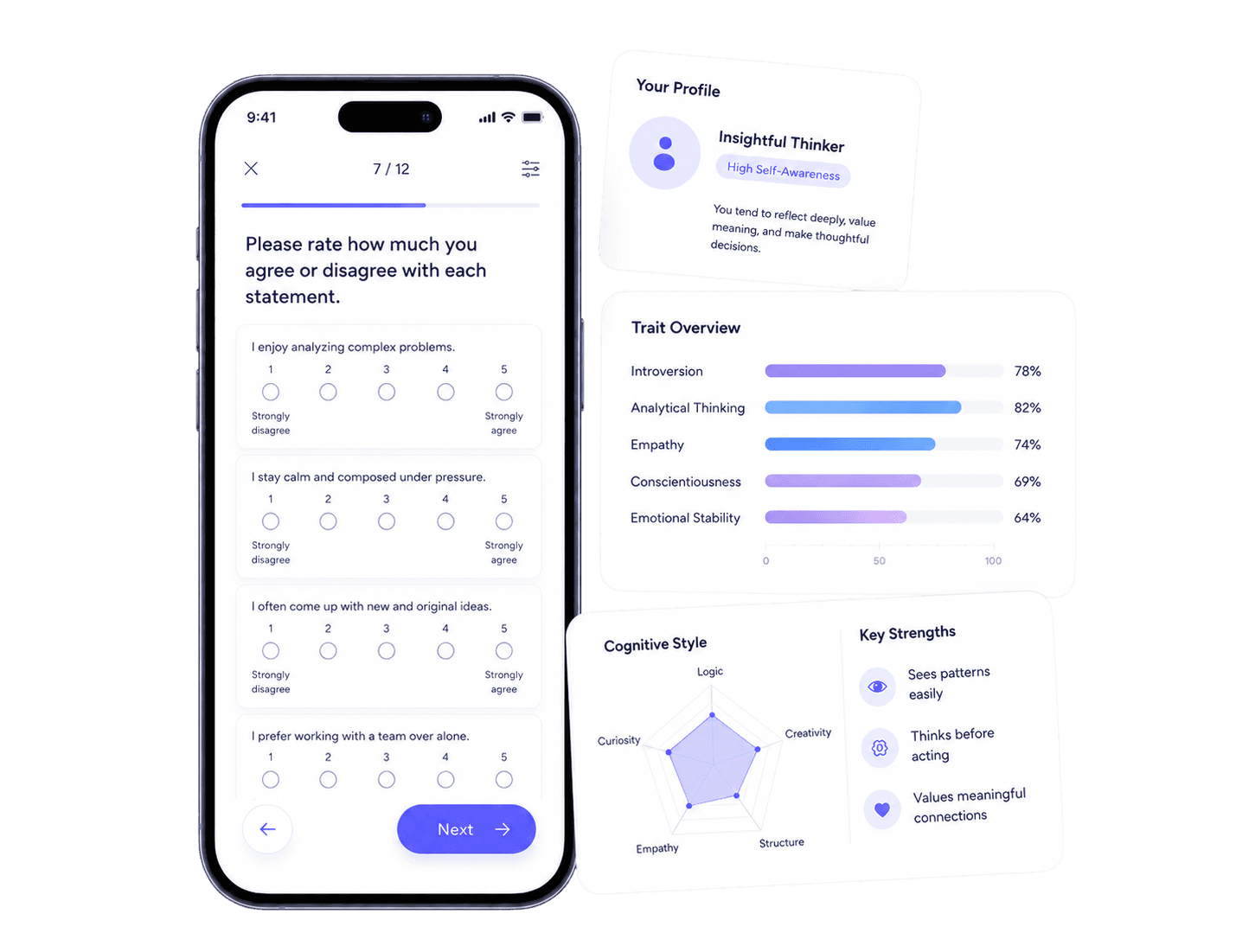
Your result gives you one dominant type from a nine-type system, creating a specific interpretation to examine instead of a list of qualities broad enough to fit almost anyone.
Two people can both be organised, supportive, ambitious or private for different reasons. The report looks at characteristic motivations and fears so you can ask what your familiar behaviour may be trying to protect or achieve.
Follow the type into relationships, work and responsibility, then notice where the description stays consistent and where the situation changes how you respond.
A pattern often becomes easiest to recognise when pressure amplifies it. Compare those observations with your own examples and decide which growth themes are actually useful to you.
Think about repeated reactions rather than one exceptional week. The most useful answers are the ones that describe what you normally do before you have time to edit the response.
Your answers contribute to nine type scores. The strongest pattern becomes the dominant type shown in your result.
Read the motivations, relationship, work, stress and growth sections with specific memories in mind. What fits, what changes with context and what does not fit are all useful information.
Thinkhint returns one dominant personality type from a nine-type system, followed by a report covering characteristics, motivations and fears, relationships, work, stress, growth and interactions with other types.
No. The result is not five Big Five trait scores and it is not a four-letter MBTI-style code. Thinkhint uses a separate nine-type personality model.
Roles, relationships, safety, expectations, energy and stress can change how a personality tendency appears. That is why the report is more useful when you compare the same type across several contexts rather than looking for one description that fits every moment.
Treat the result as an interpretation to examine, not a conclusion you have to defend. Notice which sections match repeated experience, which only fit in certain settings and which do not fit at all.
No. It can give you language for recurring motives and reactions, but choices about relationships, work and your future still require your own judgement and context.
No. Thinkhint is an educational self-reflection assessment. It does not diagnose a medical or mental-health condition or replace professional evaluation.
A personality description becomes more convincing when it explains more than one version of you. The way you act with a close friend may look different from the way you act at work, but the motive underneath both reactions can still be surprisingly consistent.
That is why concrete comparisons matter. Think about how you respond to criticism, uncertainty, responsibility, closeness and a plan that suddenly changes. Then ask whether the same need keeps appearing underneath: to be correct, useful, successful, understood, prepared, free, strong or at peace.
The result is useful when it gives you a better explanation to test against experience. Keep the parts that clarify something, question the parts that do not, and use the differences between contexts as information rather than trying to force yourself into a perfect label.