Your dominant work pattern
Identify whether your answers lean most strongly toward Builder, Analyst, Communicator, Creator, or Leader—and the way that pattern tends to create value.

Career fit is shaped by what you actually spend the week doing: solving, building, explaining, creating, deciding, coordinating, and working within a particular environment. Your result gives you a career type you can compare with those realities.
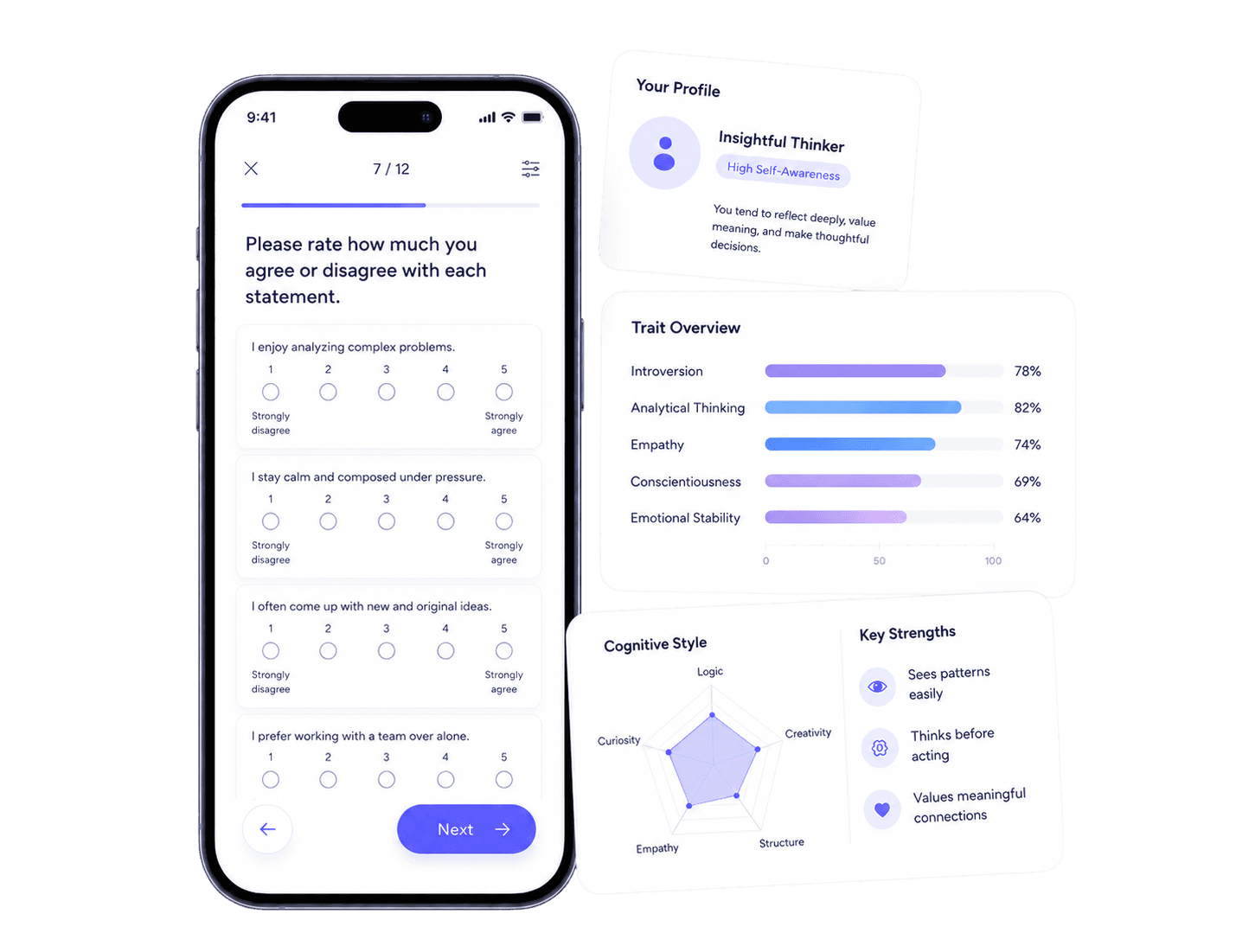
Identify whether your answers lean most strongly toward Builder, Analyst, Communicator, Creator, or Leader—and the way that pattern tends to create value.
Consider whether a job offers the structure, autonomy, collaboration, complexity, creative freedom, or responsibility that helps your strongest pattern work well.
A promising title can still hide a poor fit. Compare the type of decisions, problems, communication, execution, and ownership that take up most of the role.
No role fits perfectly. Use the report to identify which compromises are manageable and which ones are likely to make the work hard to sustain.
Think about the work settings where you have felt effective, energized, frustrated, or underused. Those contrasts make fit easier to judge.
Your answers are compared across five work patterns, and the strongest one becomes the foundation of your report.
Use the report to build criteria, then test them against real job descriptions, teams, responsibilities, qualifications, and conversations with people who do the work.
No. The same career type can fit many roles, and one role can suit people with different patterns. Fit is about the relationship between your way of working and the actual demands and environment of a role.
No. The report gives role and environment examples connected to your dominant career type, but it does not perform live vacancy matching or search O*NET occupations for you.
Yes. It can help you separate dislike of the field from dislike of the current environment, responsibilities, pace, team structure, or level of autonomy.
That is a personal decision the test cannot make. Pay, stability, responsibilities outside work, access, growth, health, and other practical factors belong in the decision alongside fit.
You receive one dominant career type—Builder, Analyst, Communicator, Creator, or Leader—plus a report explaining its strengths, preferences, example work directions, and development themes.
Two people can hold the same title and have very different experiences. One may spend most of the week coordinating people, another analysing information, and another building systems. Team culture, manager expectations, decision rights, pace, and customer contact can change the job just as much as the title does.
That is why a career type is most useful as a comparison tool. It gives you a language for the contribution and conditions that tend to suit you, then leaves you with a concrete task: check whether the role you are considering actually contains enough of those conditions.
The result cannot remove every trade-off. It can make those trade-offs easier to see before you commit to a role based only on reputation, salary, or an attractive title.