What comes before
Notice perceived rejection, criticism, uncertainty, distance, conflict, loneliness, or other situations that repeatedly increase emotional pressure.

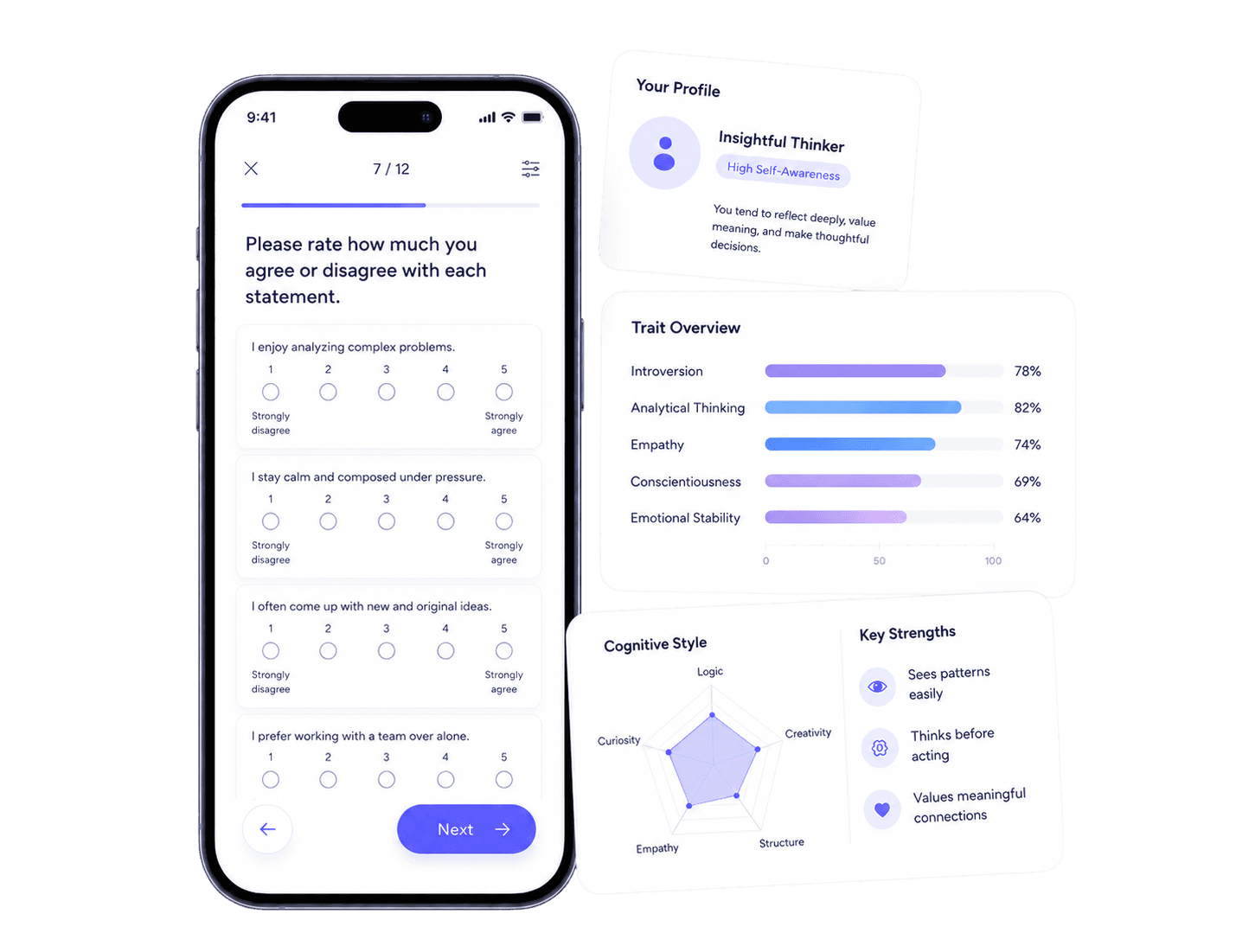
This quiz is for people who want to understand the sequence around intense reactions: what tends to set them off, how quickly emotion takes over, what happens in the moment, and what the aftermath looks like.
Notice perceived rejection, criticism, uncertainty, distance, conflict, loneliness, or other situations that repeatedly increase emotional pressure.
Reflect on anger, panic, emptiness, rapid shifts, reassurance-seeking, withdrawal, impulsive action, or changes in how you see yourself or someone else.
Look at regret, exhaustion, repair attempts, changed plans, relationship distance, shame, or the time it takes to feel steady again.
Comparing several sequences can reveal which parts are consistent and which depend on the person, setting, stress level, or type of conflict.
Patterns become clearer when you compare situations instead of replaying one emotionally charged event.
The questionnaire covers emotion, relationships, identity, behavior, and stress responses. Your answers create one overall BPD-traits level rather than a separate emotional-pattern score.
Compare triggers, escalation, behavior, consequences, and recovery to identify where a different response or extra support could matter most.
It explores the sequence around emotional reactivity and its connection with rejection sensitivity, relationships, identity, behavior, and recovery. It is part of the wider BPD-traits assessment.
No. Thinkhint reports one overall BPD-traits level. Emotional regulation is interpreted in the narrative report rather than scored separately.
One event may be unusually stressful. Repetition across different examples helps you see which parts of the sequence are more stable and which are context-dependent.
Yes. Similar experiences can occur with trauma, anxiety, mood disorders, ADHD, relationship stress, and other circumstances. A quiz cannot determine the cause.
No. Diagnosis requires a qualified professional to assess a persistent pattern, personal history, impairment, and other possible explanations.
When emotion rises quickly, the peak moment can make everything before and after it disappear. Looking at the wider sequence gives you more useful information: what felt threatening, what changed inside you, how you responded, and what the reaction changed once the intensity passed.
That sequence can look different from one situation to another, but repeated elements matter. Perhaps perceived distance reliably increases panic, criticism changes your self-view, or anger leads to a type of communication you later regret. Those are observations you can work with.
A quiz cannot tell you why the pattern exists or what diagnosis applies. It can help you describe it with more precision.