It shows the pattern behind the adjective
A word such as open, conscientious, extraverted, agreeable, or emotionally sensitive matters more when you can connect it to repeated choices and reactions.

A trait name is only a starting point. The useful part is understanding how your strongest pattern can influence motivation, relationships, work, stress, and the decisions that feel easy or difficult.
A word such as open, conscientious, extraverted, agreeable, or emotionally sensitive matters more when you can connect it to repeated choices and reactions.
The report explores how the dominant tendency may relate to structure, autonomy, creativity, teamwork, standards, feedback, and the kinds of demands that change your performance.
Relationship sections help you examine communication, closeness, cooperation, conflict, and the ways your strongest trait may interact with other people’s styles.
Instead of trying to become a different person, you can ask where your strongest tendency already works well and where more flexibility would help.
Your strongest Big Five dimension becomes the organising theme of the result. Treat it as the clearest signal in the answers, not as the whole of your personality.
As you read about relationships, career, stress, motivations, and growth, bring to mind situations that support or challenge the interpretation.
If you strongly recognise the trait in one setting and not another, keep that difference. Context often tells you more than forcing a perfectly consistent profile.
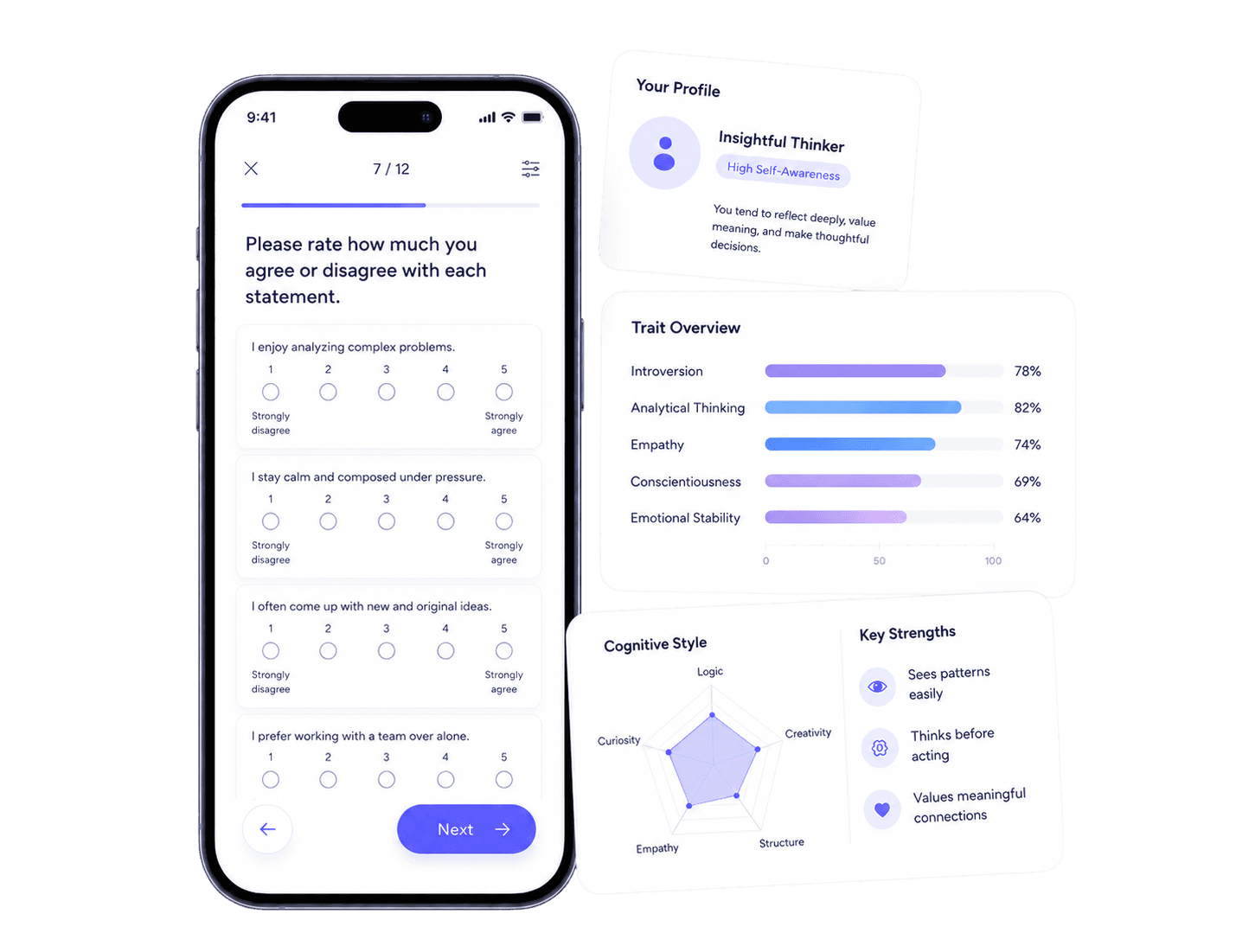
ThinkHint scores the five Big Five dimensions, but the user-facing report is organised around the trait that stands out most strongly. It does not present population percentiles for every dimension or thirty facet scores.
The profile is detailed in a different way: it follows the dominant trait through characteristics, motivations, relationships, career, stress and balance, growth, and interactions with other trait patterns.
It means a detailed narrative profile centred on the Big Five trait that is strongest in your answers. It is not a percentile chart for all five dimensions.
The dominant trait gives the report a clear organising theme. The other dimensions still matter, but the result starts with the strongest signal rather than trying to present every internal score as a separate profile.
It gives you a dominant trait pattern, not a fixed type in the MBTI or Enneagram sense. Big Five traits are dimensions, and people show all five to different degrees.
It can add useful context, but it should not make the decision for you. Skills, values, goals, circumstances, and the specific people or opportunities involved still matter.
No. ThinkHint uses its own educational questionnaire and report. It is not a named professional or research inventory.
A generic personality statement is easy to agree with and easy to forget. A useful profile should make you ask something more specific: why do I need this much novelty, why does unfinished work stay in my head, why do I speak up quickly in groups, why do I avoid conflict, or why does uncertainty linger so long?
Those questions are different depending on which trait leads your result. That is why ThinkHint organises the report around the strongest pattern rather than giving you five disconnected descriptions and leaving you to decide what matters.
The best use of the profile is to connect one of those questions to a current situation and see whether the explanation improves your next choice.