Replace “social difficulty” with the actual task
Was the hard part small talk, implied meaning, knowing when to speak, a group conversation, eye contact, or the recovery afterwards? Those are different observations.

A label such as sensory sensitivity or social difficulty can feel vague. It becomes easier to judge when you picture the actual room, conversation, change of plan, routine, or interest where the characteristic shows up.
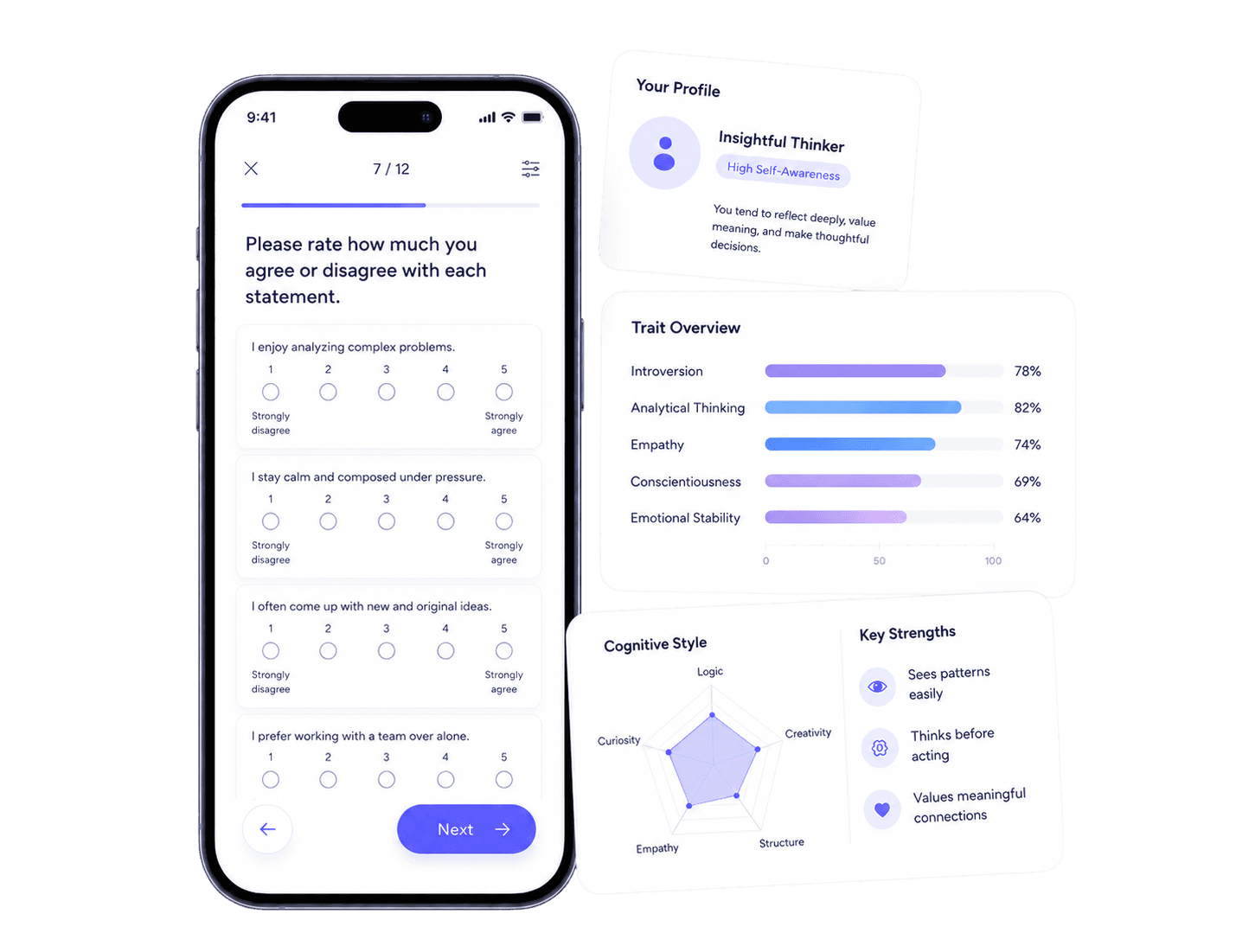
Was the hard part small talk, implied meaning, knowing when to speak, a group conversation, eye contact, or the recovery afterwards? Those are different observations.
Being able to remain in a bright, noisy, crowded, or uncomfortable environment does not mean the sensory input felt neutral or had no cost.
Ask what actually changes when a plan moves, a sequence breaks, or expectations become unclear instead of treating routine as a personality preference alone.
Deep interest can be enjoyable and useful. The relevant question is how intensity, time, switching, and conversation around that interest fit into the rest of your life.
Use real conversations, routines, sensory environments, transitions, and interests instead of answering from the category name alone.
One memorable success or difficult day should not define the full answer. Look for the version of the experience that repeats most reliably.
Your overall autism-traits result becomes more useful when you can say exactly which descriptions match your life and which remain too broad.
A broad description can feel convincing because it leaves so much room for interpretation. “I dislike change” could mean mild annoyance, hours of preparation, visible distress, or simply preferring to know the plan before leaving home.
The report becomes more informative when you keep those details attached. It gives you an overall autism-traits level and narrative context, not a separate numerical score for every characteristic. The useful work is deciding which examples genuinely belong in your pattern and which do not.
It asks about experiences related to social communication, routine and predictability, sensory input, focused interests, repetitive behaviors, flexibility, attention to detail, and other everyday preferences.
No. Some adults adapt or mask in ways that make the visible behavior look easier than the internal effort. Include preparation, monitoring, and recovery when they are part of the experience.
No. Individual characteristics can have many explanations. Autism assessment considers a broader developmental pattern and the effect across settings.
No. Thinkhint returns one overall autism-traits level and a detailed report. It does not provide independent numerical scores for each characteristic.
No. Thinkhint uses its own educational questionnaire and should not be treated as an AQ, RAADS-R, or another validated clinical screening score.
No. It is for self-reflection. A diagnosis requires a broader professional assessment that considers developmental history, persistent patterns, impact, and other possible explanations.
An adult may become very good at navigating a situation that still takes unusual effort. Social rules can be learned deliberately. A sensory environment can be endured until there is time to recover. A change can be managed because every alternative was rehearsed in advance.
That is one reason adult autism guidance recognizes masking and adaptation. What other people observe does not always reveal how much conscious work is happening underneath, and one stereotype cannot represent every autistic person or every adult exploring the question.
Use the quiz to make the descriptions more exact. What happens in the moment? What did you do to make it manageable? What happens afterwards? Those answers are more useful than trying to decide whether a broad characteristic sounds like you in the abstract.