A mind that never quite clocks out
Notice whether unfinished questions, possible problems, or conversations keep reopening after there is nothing useful left to solve.

You can keep up with work, messages, plans, and responsibilities while still carrying more tension than you realize. This anxiety check-in helps you notice where worry is taking up attention, energy, and room to relax.
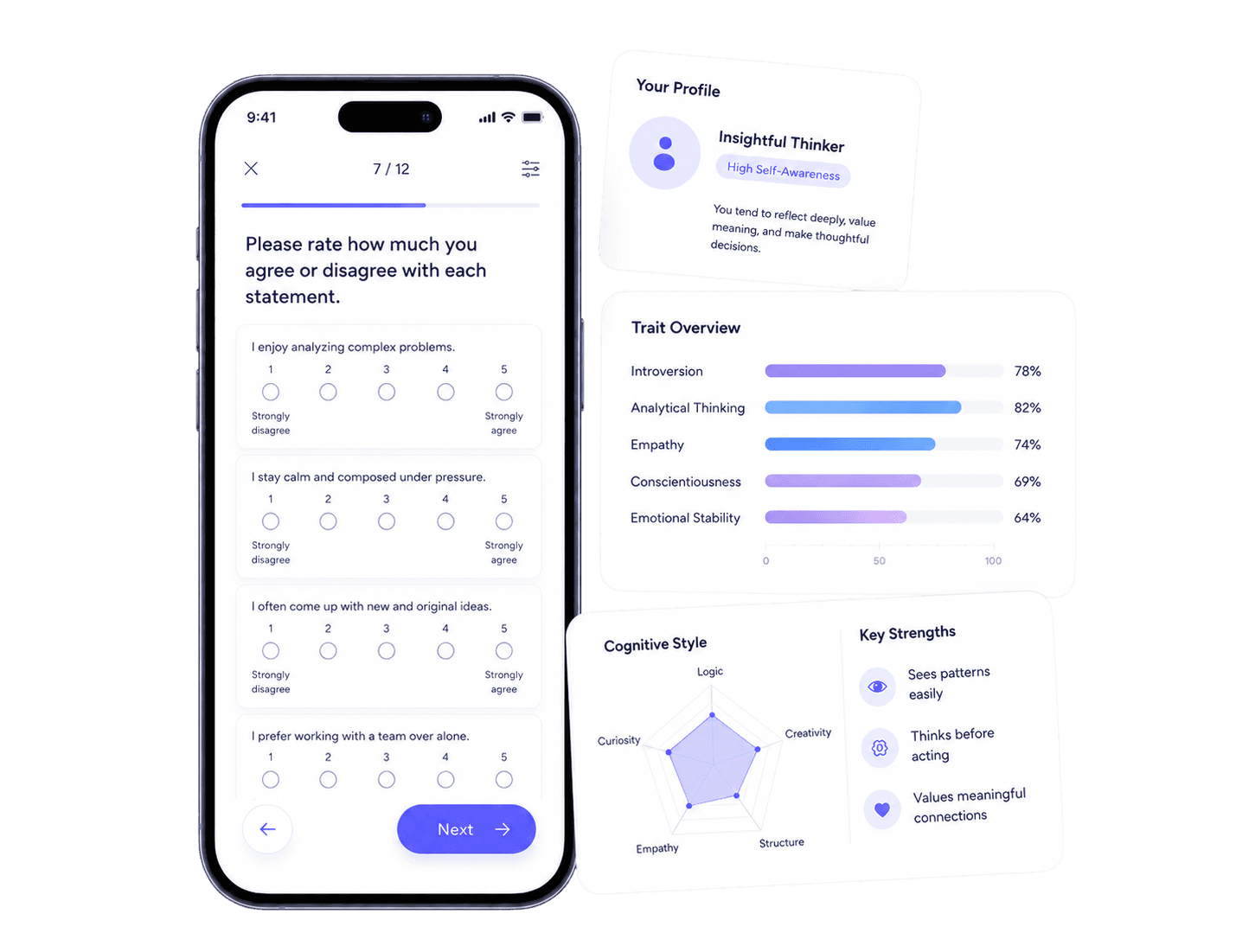
Notice whether unfinished questions, possible problems, or conversations keep reopening after there is nothing useful left to solve.
Look at how often you feel on edge, restless, keyed up, or unable to settle even when the immediate pressure has passed.
Consider whether uncertainty leads you to delay, over-prepare, avoid, check repeatedly, or seek reassurance before moving forward.
Your report gives you a way to compare how well you are functioning with how much mental effort that functioning may be taking.
Answer from recurring situations rather than one unusually calm or difficult day. The useful signal is what keeps happening across ordinary life.
The questionnaire looks across anxious thinking, physical tension, social situations, uncertainty, and avoidance instead of treating one uncomfortable moment as the whole story.
Your overall anxiety-traits level and report can help you notice where the description fits, where it does not, and which situations seem to demand the most from you.
It is a self-reflection assessment for looking at recurring anxiety-related patterns in everyday life, including worry, tension, uncertainty, social unease, and avoidance. Thinkhint returns one overall anxiety-traits level rather than separate clinical subscale scores.
No. A check-in can be useful when life looks manageable from the outside but you want to understand how much mental effort, vigilance, or avoidance may be happening underneath it.
Use today as context, but answer from what is usually true across your life and routines. The assessment is designed around recurring patterns, not a single-day mood snapshot.
Your answers are combined into one overall anxiety-traits level. The detailed report then gives that result context across thinking, stress, relationships, communication, work, and decision-making.
No. Thinkhint is an educational self-reflection tool, not a diagnostic assessment. If anxiety is persistent, worsening, or interfering with daily life, consider speaking with a qualified health professional.
Anxiety is not always dramatic. It can look like checking a message three times before sending it, mentally rehearsing a meeting that is still two days away, or feeling unable to enjoy an evening because part of your attention is already scanning tomorrow for problems. You may still get everything done. The cost shows up in how hard it is to switch off.
That is why a check-in can be useful even when nothing feels like a crisis. Worry can become so familiar that you stop noticing the extra planning, reassurance, tension, and mental replay around it. Looking at those habits together makes it easier to separate a demanding week from a pattern that follows you into many different situations.
The result is not a verdict about what is wrong with you. It is a way to make the invisible workload more visible. If the pattern is taking more energy, sleep, attention, or freedom than you want to give it, that is useful information to carry into whatever you decide to do next.